QUESTION IMAGE
Question
question 10 (1 point)
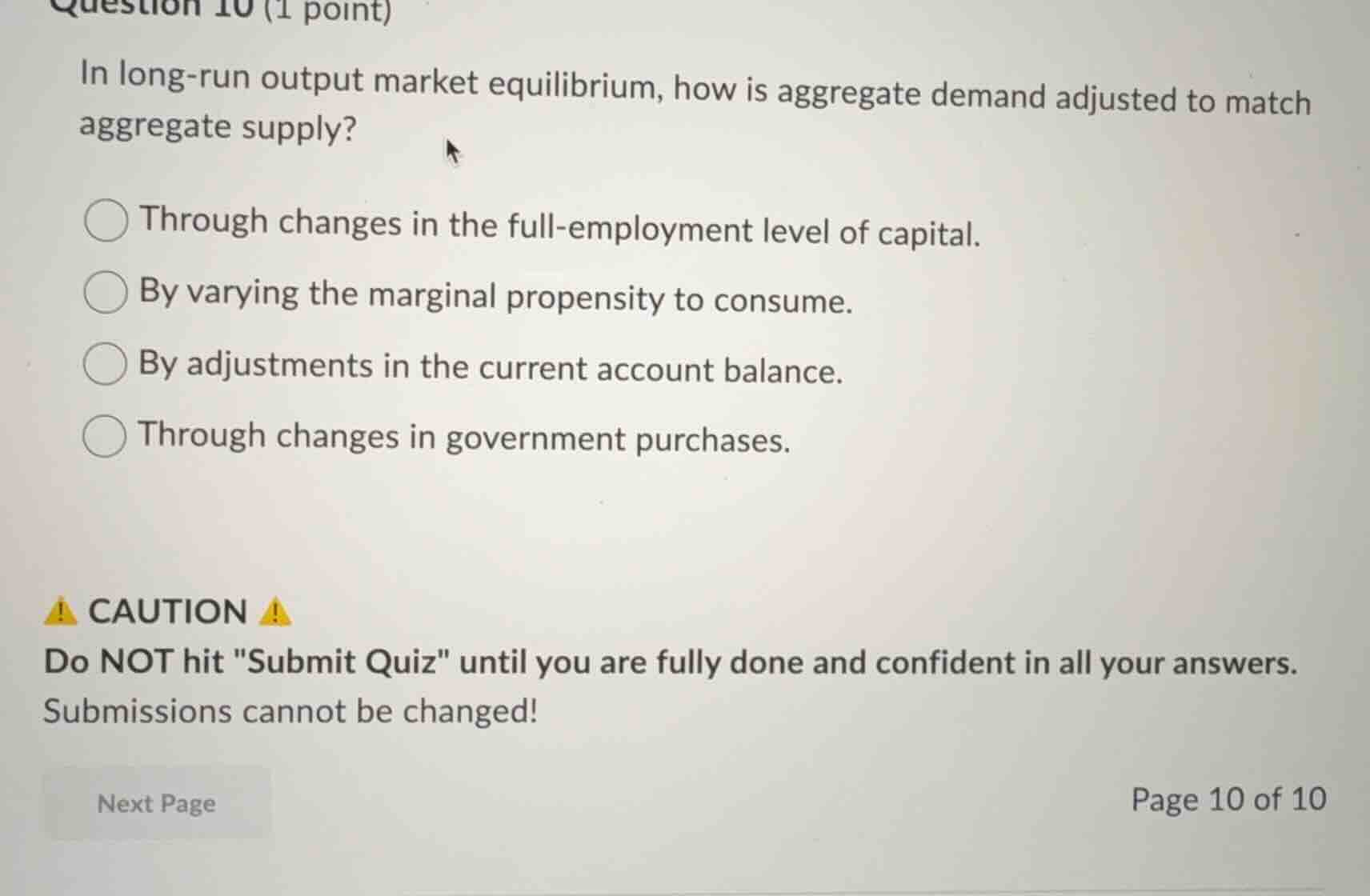
in long - run output market equilibrium, how is aggregate demand adjusted to match aggregate supply?
○ through changes in the full - employment level of capital.
○ by varying the marginal propensity to consume.
○ by adjustments in the current account balance.
○ through changes in government purchases.
⚠️ caution ⚠️
do not hit \submit quiz\ until you are fully done and confident in all your answers.
submissions cannot be changed!
next page page 10 of 10
Brief Explanations
- Analyze option 1: In long - run equilibrium, the full - employment level of capital (and labor) determines the long - run aggregate supply. Aggregate demand adjusts to match aggregate supply through changes in factors that affect the full - employment level of capital (e.g., investment in capital, technological change which can impact capital productivity).
- Analyze option 2: The marginal propensity to consume is a relatively stable parameter in the short - run and long - run related to consumption function, not a mechanism for adjusting aggregate demand to match aggregate supply in the long - run output market equilibrium.
- Analyze option 3: The current account balance is related to international trade and financial flows, not the primary mechanism for adjusting aggregate demand to match aggregate supply in the domestic long - run output market equilibrium.
- Analyze option 4: Government purchases are a component of aggregate demand, but in the long - run, the adjustment of aggregate demand to match aggregate supply (which is determined by full - employment levels of factors like capital and labor) is not primarily through changes in government purchases. Government purchases are more of a short - run fiscal policy tool.

Snap & solve any problem in the app
Get step-by-step solutions on Sovi AI
Photo-based solutions with guided steps
Explore more problems and detailed explanations
A. Through changes in the full - employment level of capital.