QUESTION IMAGE
Question
question 7 of 10
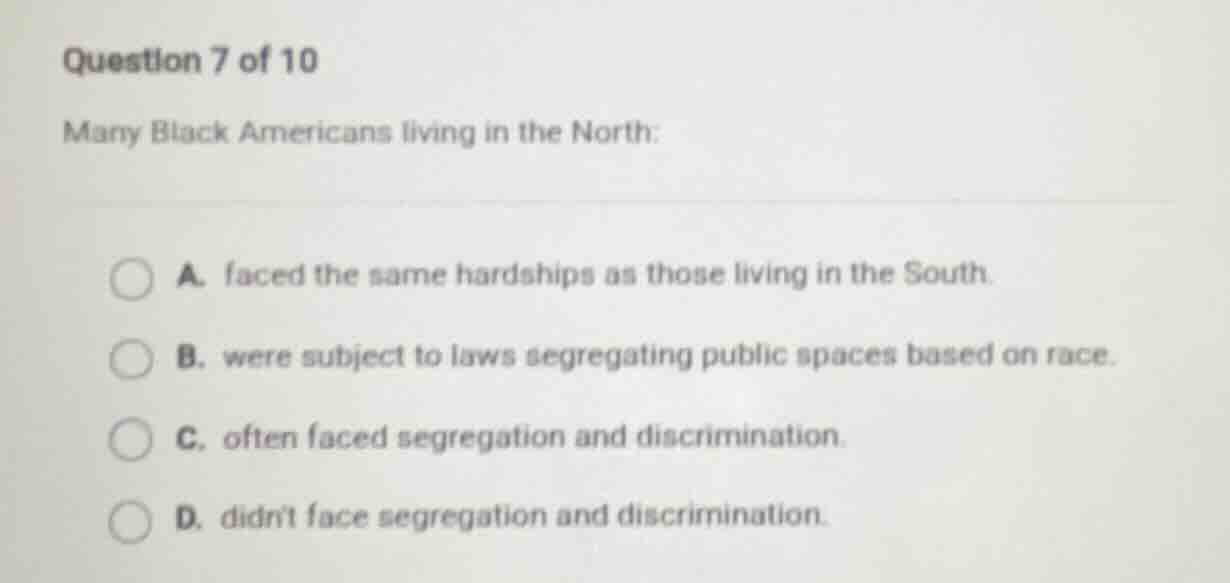
many black americans living in the north:
a. faced the same hardships as those living in the south.
b. were subject to laws segregating public spaces based on race.
c. often faced segregation and discrimination.
d. didnt face segregation and discrimination.
Analyze Northern racial dynamics
In the late 19th and 20th centuries, particularly during the Great Migration, hundreds of thousands of Black Americans moved from the rural South to Northern cities. While the North did not have the pervasive, legally mandated de jure segregation systems (like Jim Crow laws) found in the South, Black Northerners still faced widespread de facto segregation, systemic racism, and economic discrimination.
Evaluate the answer choices
- A. faced the same hardships as those living in the South. This is incorrect. While hardships in the North were severe, they were not identical to the South, which featured legally enforced Jim Crow segregation, disenfranchisement, and extreme state-sanctioned racial violence.
- B. were subject to laws segregating public spaces based on race. This is incorrect. Legally mandated segregation of public spaces (de jure segregation) was characteristic of Southern state laws, whereas Northern segregation was largely maintained through custom, redlining, and informal practices (de facto segregation).
- C. often faced segregation and discrimination. This is correct. Black Americans in the North frequently encountered Racial Segregation in housing (redlining, restrictive covenants) and discrimination in employment, education, and daily life, despite the absence of formal Jim Crow laws.
- D. didn't face segregation and discrimination. This is historically inaccurate, as racial prejudice and systemic barriers were widespread in Northern urban centers.

Snap & solve any problem in the app
Get step-by-step solutions on Sovi AI
Photo-based solutions with guided steps
Explore more problems and detailed explanations
- (A) faced the same hardships as those living in the South.
- (B) were subject to laws segregating public spaces based on race.
- (C) often faced segregation and discrimination. (Correct answer)
- (D) didn't face segregation and discrimination.