QUESTION IMAGE
Question
question 3 of 10
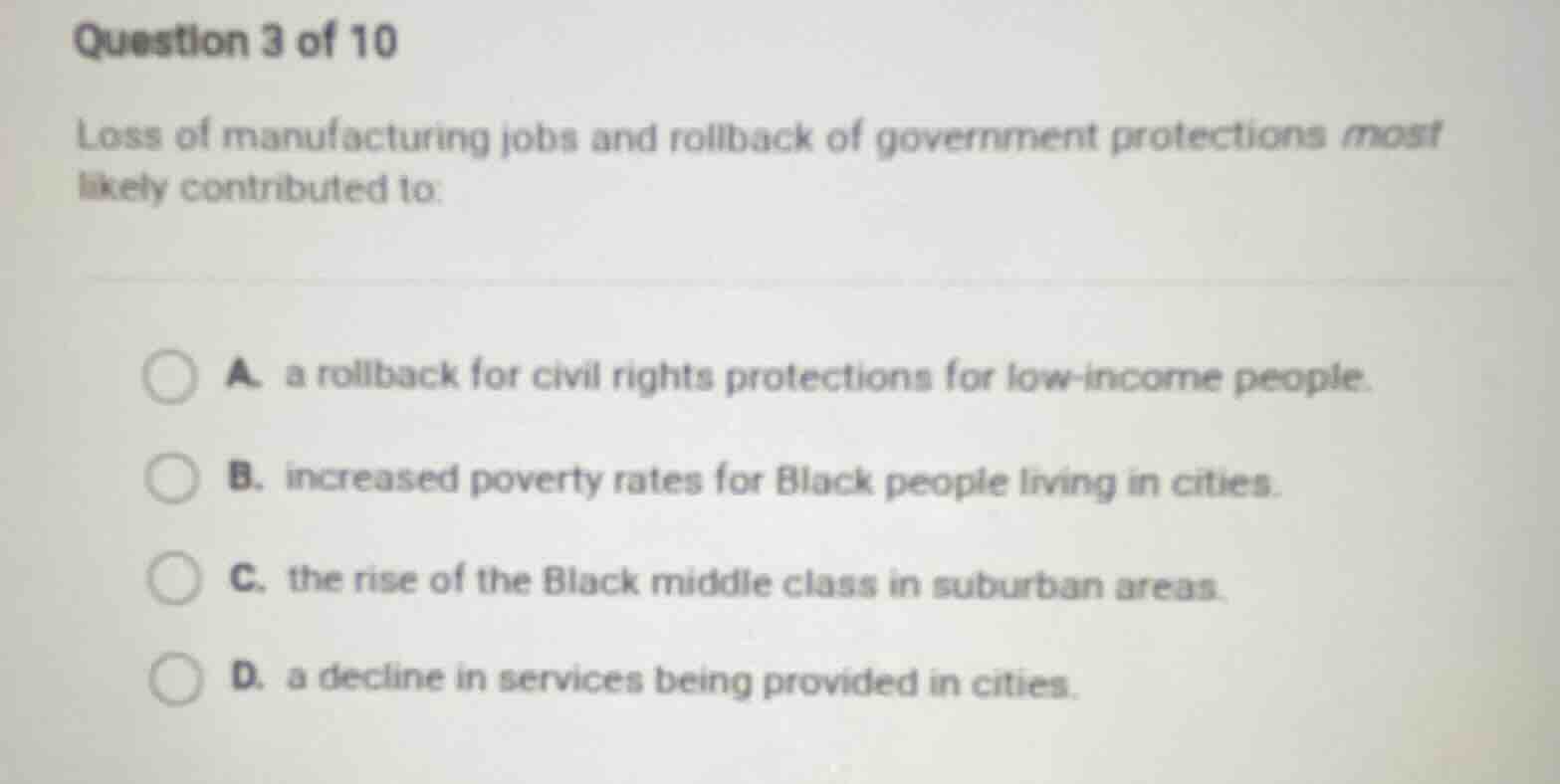
loss of manufacturing jobs and rollback of government protections most likely contributed to:
a. a rollback for civil rights protections for low-income people.
b. increased poverty rates for black people living in cities.
c. the rise of the black middle class in suburban areas.
d. a decline in services being provided in cities.
Analyze the historical context
Using the Reaganomics and Deregulation knowledge points, we examine the late 20th-century economic shifts. The decline of manufacturing (deindustrialization) and the reduction of federal social safety nets disproportionately impacted urban centers where working-class minorities were concentrated.
Evaluate the impact on urban populations
Using the Civil Rights Backlash knowledge point, we analyze how these structural economic changes affected minority communities. The loss of stable, well-paying industrial jobs in cities, combined with reduced government assistance, directly led to a sharp increase in poverty rates, particularly for Black residents living in urban areas.
Assess the multiple-choice options
- A is incorrect because the prompt focuses on economic and social welfare protections rather than a direct rollback of legal civil rights protections.
- B is correct because deindustrialization and reduced social spending directly drove up urban poverty rates for Black families.
- C is incorrect because these factors hindered, rather than helped, middle-class expansion in suburbs.
- D is incorrect because while municipal services did decline, the primary and most direct socioeconomic consequence of these combined factors was the rise in poverty.

Snap & solve any problem in the app
Get step-by-step solutions on Sovi AI
Photo-based solutions with guided steps
Explore more problems and detailed explanations
- (A) a rollback for civil rights protections for low-income people.
- (B) increased poverty rates for Black people living in cities. (Correct answer)
- (C) the rise of the Black middle class in suburban areas.
- (D) a decline in services being provided in cities.