QUESTION IMAGE
Question
question 10
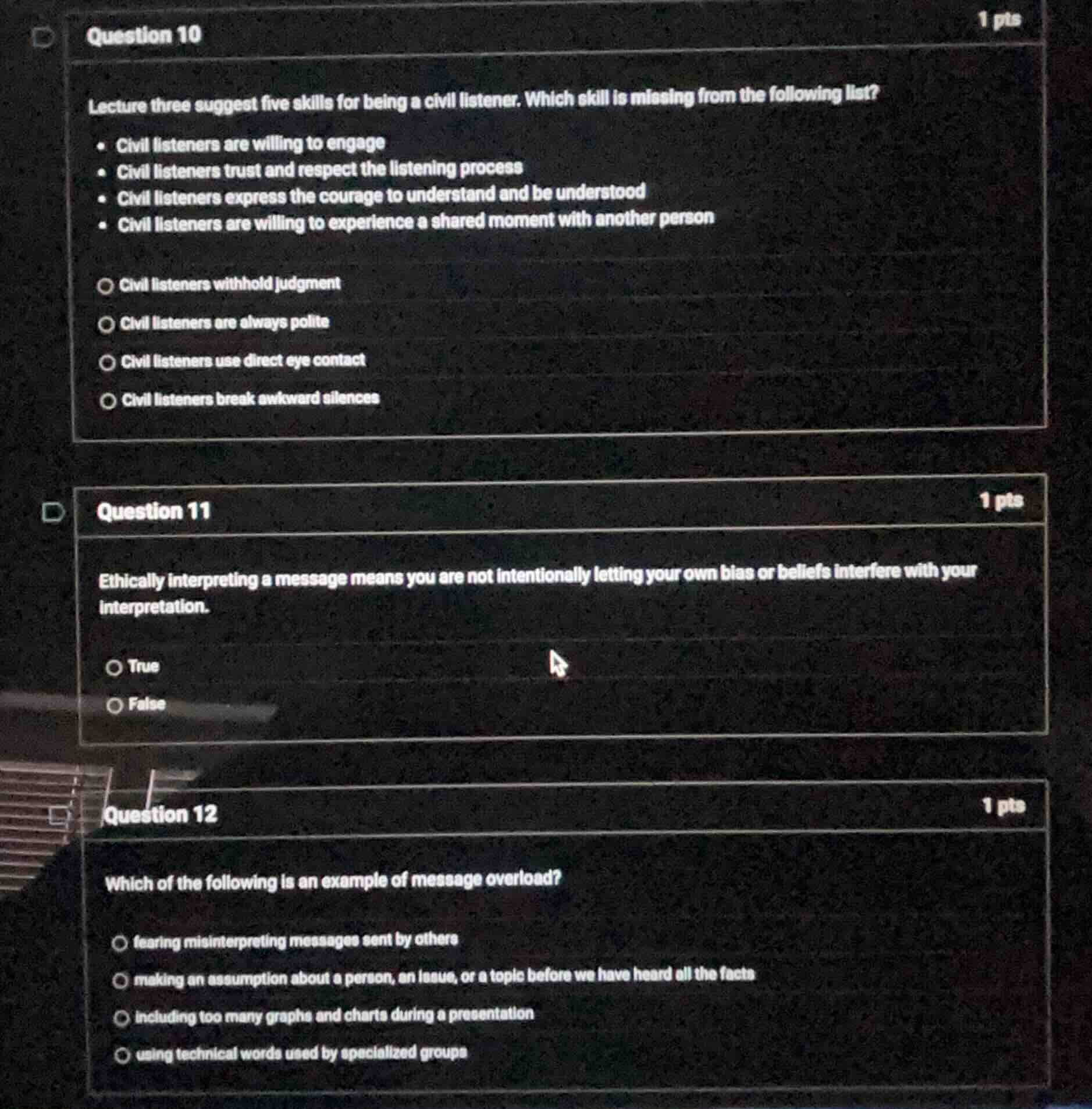
lecture three suggest five skills for being a civil listener. which skill is missing from the following list?
- civil listeners are willing to engage
- civil listeners trust and respect the listening process
- civil listeners express the courage to understand and be understood
- civil listeners are willing to experience a shared moment with another person
- civil listeners withhold judgment
- civil listeners are always polite
- civil listeners use direct eye contact
- civil listeners break awkward silences
question 11
ethically interpreting a message means you are not intentionally letting your own bias or beliefs interfere with your interpretation.
- true
- false
question 12
which of the following is an example of message overload?
- fearing misinterpreting messages sent by others
- making an assumption about a person, an issue, or a topic before we have heard all the facts
- including too many graphs and charts during a presentation
- using technical words used by specialized groups
Analyze civil listening skills
We examine the five skills required to be a civil listener based on communication studies and Civil Dialogue Format principles. The four listed skills are:
- Civil listeners are willing to engage.
- Civil listeners trust and respect the listening process.
- Civil listeners express the courage to understand and be understood.
- Civil listeners are willing to experience a shared moment with another person.
The fifth core skill that completes this framework is that civil listeners withhold judgment. This allows them to fully receive the speaker's message before evaluating it.
Evaluate ethical message interpretation
Ethical communication standards dictate that interpreting a message ethically requires the listener to strive for objectivity. This means actively preventing personal biases, prejudices, or preconceived beliefs from distorting or interfering with the intended meaning of the speaker's message. Therefore, the statement is true.
Define message overload
Message overload occurs when a person receives more information than they can process effectively. Among the choices:
- Fearing misinterpretation relates to receiver apprehension.
- Making assumptions before hearing facts is prejudgment.
- Including too many graphs and charts during a presentation floods the audience with excessive visual and textual data, which is a classic example of message overload.
- Using technical words is a semantic barrier (jargon).
Thus, the third option is the correct example.

Snap & solve any problem in the app
Get step-by-step solutions on Sovi AI
Photo-based solutions with guided steps
Explore more problems and detailed explanations
Question 10
- O Civil listeners withhold judgment (Correct answer)
- O Civil listeners are always polite
- O Civil listeners use direct eye contact
- O Civil listeners break awkward silences
Question 11
- O True (Correct answer)
- O False
Question 12
- O fearing misinterpreting messages sent by others
- O making an assumption about a person, an issue, or a topic before we have heard all the facts
- O including too many graphs and charts during a presentation (Correct answer)
- O using technical words used by specialized groups