QUESTION IMAGE
Question
question 7 of 10
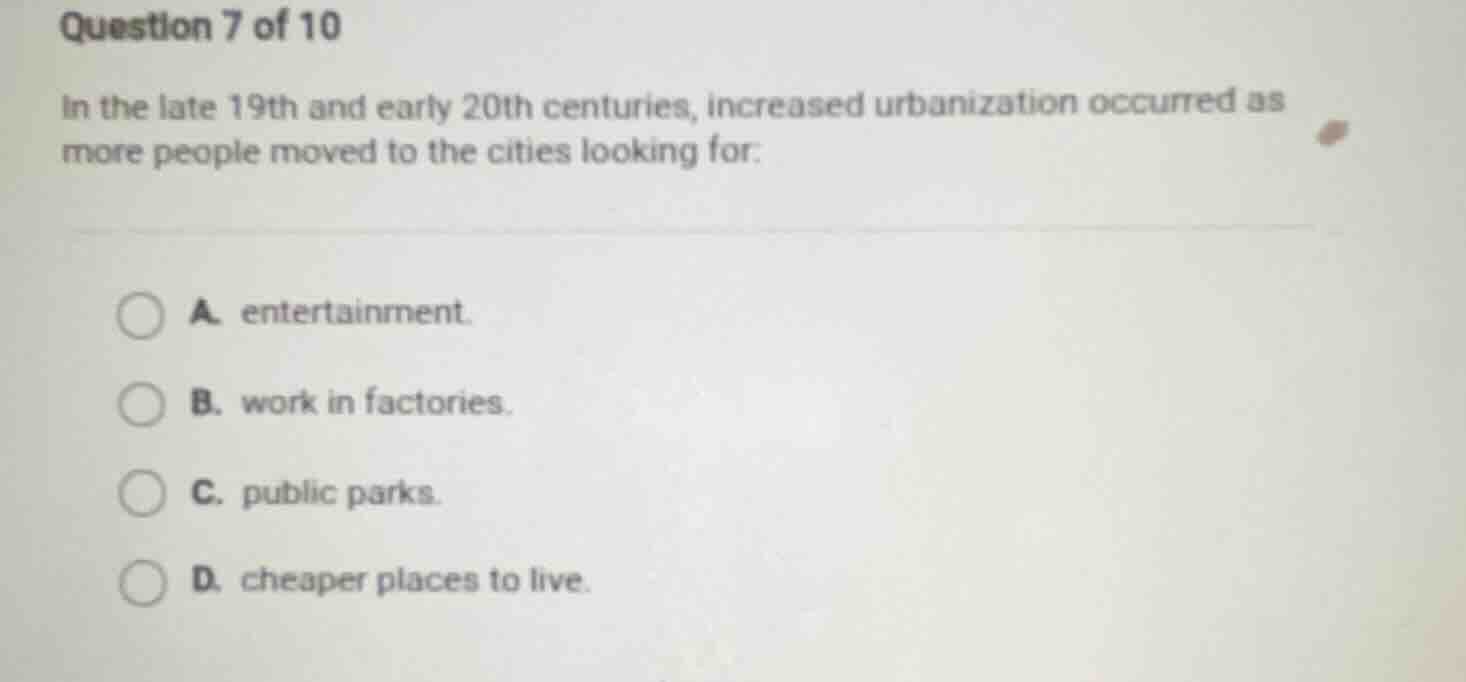
in the late 19th and early 20th centuries, increased urbanization occurred as more people moved to the cities looking for:
a. entertainment.
b. work in factories.
c. public parks.
d. cheaper places to live.
Analyze the historical context of urbanization
During the late 19th and early 20th centuries (the Gilded Age and Progressive Era), the United States experienced rapid industrialization. The expansion of industries, powered by innovations like the Bessemer process and mass production, led to a massive demand for labor in urban centers.
Evaluate the pull factors for cities
The primary pull factor drawing millions of rural Americans and foreign immigrants to cities was economic opportunity. Factories, mills, and manufacturing plants were concentrated in urban areas, offering abundant industrial jobs.
Assess the given options
- A. entertainment: While cities offered theaters and sports, this was not the primary driver of mass migration.
- B. work in factories: This directly represents the primary economic driver (industrial employment) of rapid urbanization.
- C. public parks: Parks were a secondary development (like Central Park) to improve city life, not the main reason people moved.
- D. cheaper places to live: Cities were often crowded and expensive, with high tenement rents, rather than offering cheaper living.

Snap & solve any problem in the app
Get step-by-step solutions on Sovi AI
Photo-based solutions with guided steps
Explore more problems and detailed explanations
- (A) entertainment.
- (B) work in factories. (Correct answer)
- (C) public parks.
- (D) cheaper places to live.