QUESTION IMAGE
Question
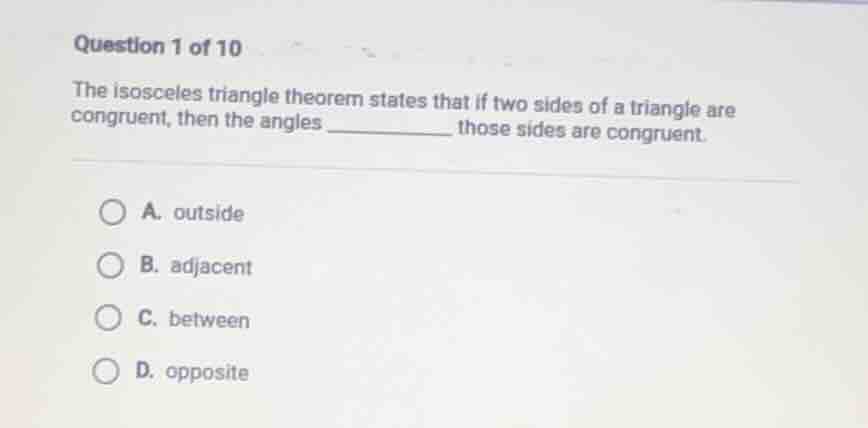
question 3 of 10 the isosceles triangle theorem states that if two sides of a triangle are congruent, then the angles ___ those sides are congruent. a. between b. opposite c. outside d. adjacent
Brief Explanations
The isosceles triangle theorem is a fundamental geometric principle. In a triangle, when two sides are congruent (equal in length), the angles opposite those sides have a specific relationship.
- Option A: "between" is incorrect. If we consider the sides, the angles between two sides would be the included angle, but this is not what the isosceles - triangle theorem refers to.
- Option B: "opposite" is correct. The isosceles triangle theorem states that if two sides of a triangle are congruent, then the angles opposite those sides are congruent. For example, in an isosceles triangle \(ABC\) with \(AB = AC\), \(\angle B=\angle C\) (where \(\angle B\) is opposite \(AC\) and \(\angle C\) is opposite \(AB\)).
- Option C: "outside" is incorrect. Angles outside the triangle (exterior angles) are related to the interior angles by the exterior - angle theorem (\(exterior\ angle=sum\ of\ two\ non - adjacent\ interior\ angles\)), but this is not relevant to the isosceles - triangle theorem.
- Option D: "adjacent" is incorrect. Adjacent angles share a common side, but the isosceles - triangle theorem is not about adjacent angles in relation to congruent sides.
Snap & solve any problem in the app
Get step-by-step solutions on Sovi AI
Photo-based solutions with guided steps
Explore more problems and detailed explanations
B. opposite