QUESTION IMAGE
Question
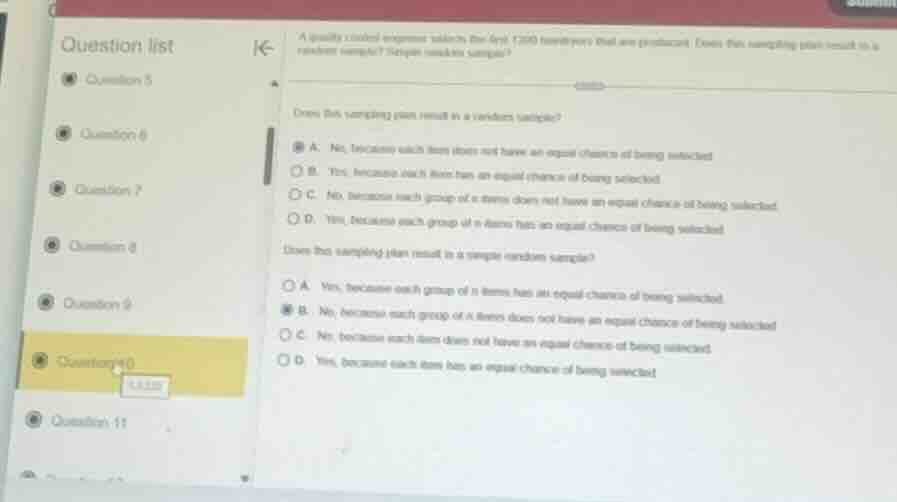
a quality control engineer selects the first 1200 hairdryers that are produced. does this sampling plan result in a random sample? simple random sample?
does this sampling plan result in a random sample?
a. no, because each item does not have an equal chance of being selected
b. yes, because each item has an equal chance of being selected
c. no, because each group of n items does not have an equal chance of being selected
d. yes, because each group of n items has an equal chance of being selected
does this sampling plan result in a simple random sample?
a. yes, because each group of n items has an equal chance of being selected
b. no, because each group of n items does not have an equal chance of being selected
c. no, because each item does not have an equal chance of being selected
d. yes, because each item has an equal chance of being selected
⚡ Using what you learned: Sampling Methods
Step 1: Analyze the Sampling Method
The quality control engineer selects the first \(1200\) hairdryers that are produced.
This is a convenience sample because the engineer is selecting items that are readily available (the very first ones off the production line) rather than using a random mechanism to select from the entire population of hairdryers.
Step 2: Determine if it is a Random Sample
A random sample requires that each individual member of the population has an equal chance of being selected.
Because only the first \(1200\) hairdryers have any chance of being selected, and any hairdryers produced after the first \(1200\) have a \(0\%\) chance of being selected, each item does not have an equal chance of being selected.
- Conclusion for Part 1: No, because each item does not have an equal chance of being selected. (Option A)
Step 3: Determine if it is a Simple Random Sample
A simple random sample (SRS) of size \(n\) requires that every possible sample of size \(n\) has an equal chance of being selected.
Since the engineer only selects the first \(1200\) hairdryers, any group of \(1200\) hairdryers that includes items produced later in the run has a \(0\%\) chance of being selected. Therefore, not all groups of size \(n\) have an equal chance of being selected.
- Conclusion for Part 2: No, because each group of \(n\) items does not have an equal chance of being selected. (Option B)

Snap & solve any problem in the app
Get step-by-step solutions on Sovi AI
Photo-based solutions with guided steps
Explore more problems and detailed explanations
- Does this sampling plan result in a random sample?
A. No, because each item does not have an equal chance of being selected.
- Does this sampling plan result in a simple random sample?
B. No, because each group of \(n\) items does not have an equal chance of being selected.