Sovi.AI - AI Math Tutor

Scan to solve math questions

QUESTION IMAGE

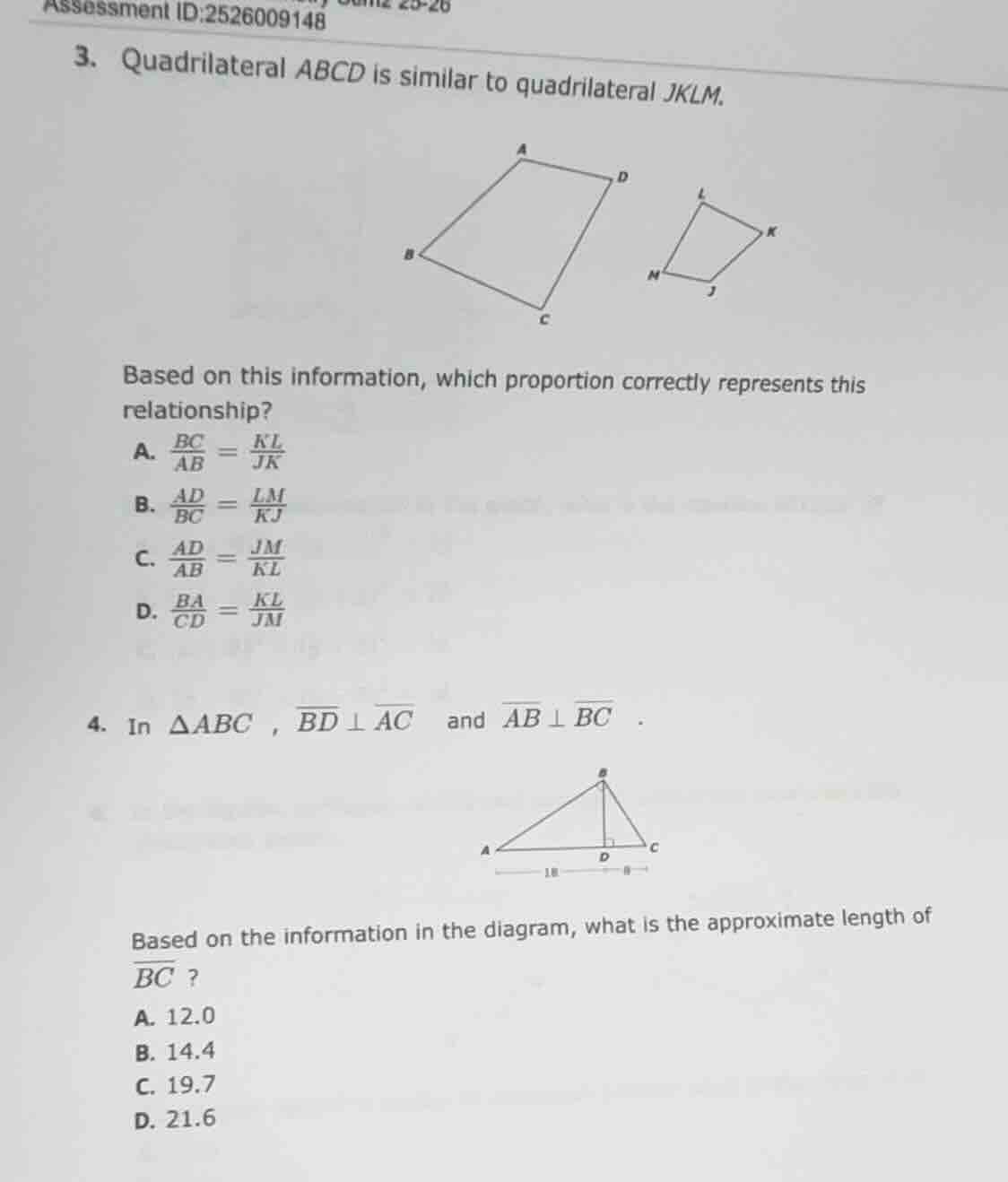
3. quadrilateral abcd is similar to quadrilateral jklm. based on this i…

Question

  1. quadrilateral abcd is similar to quadrilateral jklm.

based on this information, which proportion correctly represents this relationship?
a. \\(\frac{bc}{ab} = \frac{kl}{jk}\\)
b. \\(\frac{ad}{bc} = \frac{lm}{kj}\\)
c. \\(\frac{ad}{ab} = \frac{jm}{kl}\\)
d. \\(\frac{ba}{cd} = \frac{kl}{jm}\\)

  1. in \\(\delta abc\\), \\(\overline{bd} \perp \overline{ac}\\) and \\(\overline{ab} \perp \overline{bc}\\).

based on the information in the diagram, what is the approximate length of \\(\overline{bc}\\)?
a. 12.0
b. 14.4
c. 19.7
d. 21.6

Explanation:

Response

<pre_analysis>
{
"quality": "clear",
"question_count": 2,
"skills_matched": [
"step_cot",
"multiple_choice_formatter",
"explain_then_answer",
"tutor"
],
"needs_drawing": false,
"concepts_used": [],
"new_concepts": [
"Similar Polygons",
"Geometric Mean Theorem"
],
"current_concepts": [
"Similar Polygons",
"Geometric Mean Theorem",
"Right Triangle Similarity"
]
}
</pre_analysis>

<reasoning>

Identify corresponding sides of similar quadrilaterals

For Question 3, we are given that quadrilateral \(ABCD\) is similar to quadrilateral \(JKLM\).
The order of vertices in the similarity statement \(ABCD \sim JKLM\) defines the corresponding vertices and sides:

  • Vertex \(A\) corresponds to \(J\)
  • Vertex \(B\) corresponds to \(K\)
  • Vertex \(C\) corresponds to \(L\)
  • Vertex \(D\) corresponds to \(M\)

Therefore, the corresponding side lengths are proportional:
\[
\frac{AB}{JK} = \frac{BC}{KL} = \frac{CD}{LM} = \frac{DA}{MJ}
\]

Evaluate the given proportions for Question 3

Let's test each option:

  • Option A: \(\frac{BC}{AB} = \frac{KL}{JK}\)

Rearranging \(\frac{AB}{JK} = \frac{BC}{KL}\) gives:
\[
\frac{BC}{AB} = \frac{KL}{JK}
\]
This is a correct proportion.

  • Option B: \(\frac{AD}{BC} = \frac{LM}{KJ}\)

The corresponding side for \(AD\) is \(JM\), and for \(BC\) is \(KL\). This is incorrect.

  • Option C: \(\frac{AD}{AB} = \frac{JM}{KL}\)

The corresponding side for \(AB\) is \(JK\), not \(KL\). This is incorrect.

  • Option D: \(\frac{BA}{CD} = \frac{KL}{JM}\)

The corresponding side for \(BA\) is \(KJ\), and for \(CD\) is \(LM\). This is incorrect.

Thus, Option A is correct.

Set up similarity in the right triangle for Question 4

For Question 4, we have a right triangle \(\triangle ABC\) with \(\overline{AB} \perp \overline{BC}\), meaning \(\angle ABC = 90^\circ\).
An altitude \(\overline{BD}\) is drawn to the hypotenuse \(\overline{AC}\), so \(\overline{BD} \perp \overline{AC}\).
This splits \(\triangle ABC\) into two smaller triangles that are similar to each other and to the larger triangle:
\[
\triangle BDC \sim \triangle ABC
\]
From this similarity, we can write the ratio of corresponding sides:
\[
\frac{BC}{AC} = \frac{DC}{BC}
\]

Calculate the length of BC

Using the geometric mean relationship:
\[
BC^2 = AC \cdot DC
\]
From the diagram:

  • \(AD = 18\)
  • \(DC = 8\)
  • \(AC = AD + DC = 18 + 8 = 26\)

Substitute these values into the equation:
\[
BC^2 = 26 \cdot 8 = 208
\]
\[
BC = \sqrt{208} \approx 14.42
\]

Comparing this with the options, \(14.4\) is Option B.
</reasoning>

<answer>

Question 3

<mcq-correct>(A) \(\frac{BC}{AB} = \frac{KL}{JK}\)</mcq-correct>
<mcq-option>(B) \(\frac{AD}{BC} = \frac{LM}{KJ}\)</mcq-option>
<mcq-option>(C) \(\frac{AD}{AB} = \frac{JM}{KL}\)</mcq-option>
<mcq-option>(D) \(\frac{BA}{CD} = \frac{KL}{JM}\)</mcq-option>

Question 4

<mcq-option>(A) 12.0</mcq-option>
<mcq-correct>(B) 14.4</mcq-correct>
<mcq-option>(C) 19.7</mcq-option>
<mcq-option>(D) 21.6</mcq-option>
</answer>

<post_analysis>
{
"subject": "Mathematics",
"question_type": "Multiple Choice",
"knowledge_point": [
"Mathematics",
"Geometry",
"Similarity and Right Triangles"
]
}
</post_analysis>

Answer:

<pre_analysis>
{
"quality": "clear",
"question_count": 2,
"skills_matched": [
"step_cot",
"multiple_choice_formatter",
"explain_then_answer",
"tutor"
],
"needs_drawing": false,
"concepts_used": [],
"new_concepts": [
"Similar Polygons",
"Geometric Mean Theorem"
],
"current_concepts": [
"Similar Polygons",
"Geometric Mean Theorem",
"Right Triangle Similarity"
]
}
</pre_analysis>

<reasoning>

Identify corresponding sides of similar quadrilaterals

For Question 3, we are given that quadrilateral \(ABCD\) is similar to quadrilateral \(JKLM\).
The order of vertices in the similarity statement \(ABCD \sim JKLM\) defines the corresponding vertices and sides:

  • Vertex \(A\) corresponds to \(J\)
  • Vertex \(B\) corresponds to \(K\)
  • Vertex \(C\) corresponds to \(L\)
  • Vertex \(D\) corresponds to \(M\)

Therefore, the corresponding side lengths are proportional:
\[
\frac{AB}{JK} = \frac{BC}{KL} = \frac{CD}{LM} = \frac{DA}{MJ}
\]

Evaluate the given proportions for Question 3

Let's test each option:

  • Option A: \(\frac{BC}{AB} = \frac{KL}{JK}\)

Rearranging \(\frac{AB}{JK} = \frac{BC}{KL}\) gives:
\[
\frac{BC}{AB} = \frac{KL}{JK}
\]
This is a correct proportion.

  • Option B: \(\frac{AD}{BC} = \frac{LM}{KJ}\)

The corresponding side for \(AD\) is \(JM\), and for \(BC\) is \(KL\). This is incorrect.

  • Option C: \(\frac{AD}{AB} = \frac{JM}{KL}\)

The corresponding side for \(AB\) is \(JK\), not \(KL\). This is incorrect.

  • Option D: \(\frac{BA}{CD} = \frac{KL}{JM}\)

The corresponding side for \(BA\) is \(KJ\), and for \(CD\) is \(LM\). This is incorrect.

Thus, Option A is correct.

Set up similarity in the right triangle for Question 4

For Question 4, we have a right triangle \(\triangle ABC\) with \(\overline{AB} \perp \overline{BC}\), meaning \(\angle ABC = 90^\circ\).
An altitude \(\overline{BD}\) is drawn to the hypotenuse \(\overline{AC}\), so \(\overline{BD} \perp \overline{AC}\).
This splits \(\triangle ABC\) into two smaller triangles that are similar to each other and to the larger triangle:
\[
\triangle BDC \sim \triangle ABC
\]
From this similarity, we can write the ratio of corresponding sides:
\[
\frac{BC}{AC} = \frac{DC}{BC}
\]

Calculate the length of BC

Using the geometric mean relationship:
\[
BC^2 = AC \cdot DC
\]
From the diagram:

  • \(AD = 18\)
  • \(DC = 8\)
  • \(AC = AD + DC = 18 + 8 = 26\)

Substitute these values into the equation:
\[
BC^2 = 26 \cdot 8 = 208
\]
\[
BC = \sqrt{208} \approx 14.42
\]

Comparing this with the options, \(14.4\) is Option B.
</reasoning>

<answer>

Question 3

<mcq-correct>(A) \(\frac{BC}{AB} = \frac{KL}{JK}\)</mcq-correct>
<mcq-option>(B) \(\frac{AD}{BC} = \frac{LM}{KJ}\)</mcq-option>
<mcq-option>(C) \(\frac{AD}{AB} = \frac{JM}{KL}\)</mcq-option>
<mcq-option>(D) \(\frac{BA}{CD} = \frac{KL}{JM}\)</mcq-option>

Question 4

<mcq-option>(A) 12.0</mcq-option>
<mcq-correct>(B) 14.4</mcq-correct>
<mcq-option>(C) 19.7</mcq-option>
<mcq-option>(D) 21.6</mcq-option>
</answer>

<post_analysis>
{
"subject": "Mathematics",
"question_type": "Multiple Choice",
"knowledge_point": [
"Mathematics",
"Geometry",
"Similarity and Right Triangles"
]
}
</post_analysis>