Sovi.AI - AI Math Tutor

Scan to solve math questions

QUESTION IMAGE

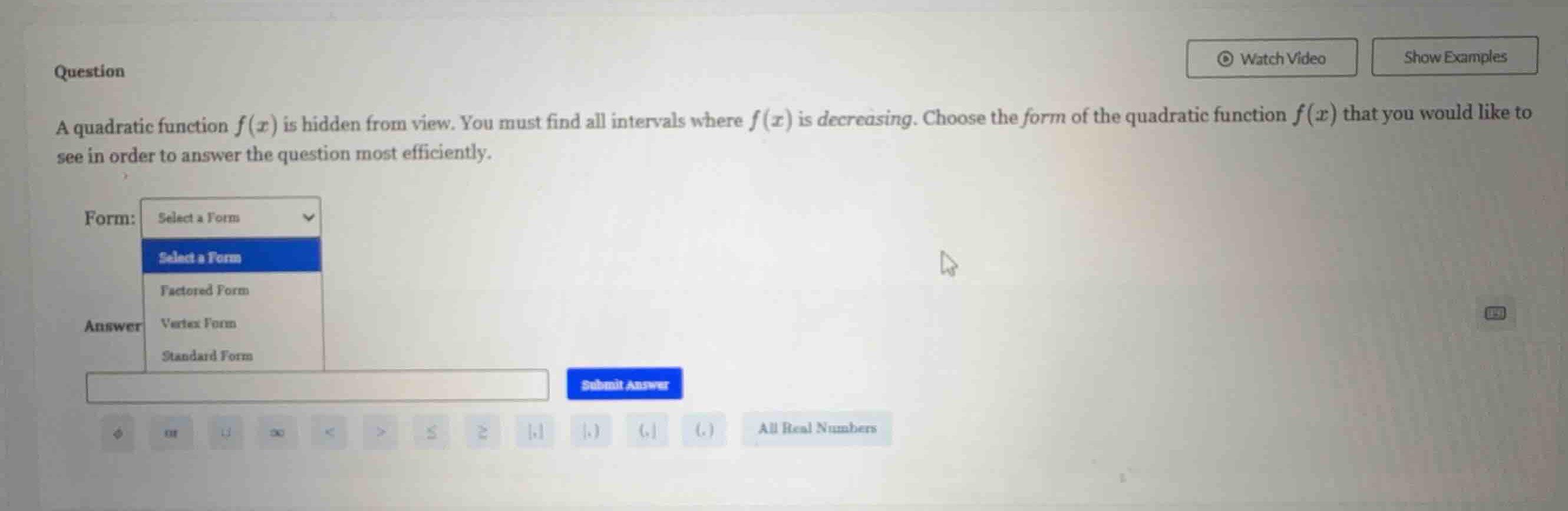
a quadratic function \\(f(x)\\) is hidden from view. you must find all …

Question

a quadratic function \\(f(x)\\) is hidden from view. you must find all intervals where \\(f(x)\\) is decreasing. choose the form of the quadratic function \\(f(x)\\) that you would like to see in order to answer the question most efficiently.

Explanation:

Response

<pre_analysis>
{
"quality": "clear",
"question_count": 1,
"skills_matched": [
"direct_cot",
"multiple_choice_formatter",
"explain_then_answer",
"tutor"
],
"needs_drawing": false,
"concepts_used": [],
"new_concepts": [
"Quadratic Forms",
"Vertex Form",
"Decreasing Intervals"
],
"current_concepts": [
"Quadratic Forms",
"Vertex Form",
"Decreasing Intervals"
]
}
</pre_analysis>

<reasoning>

Identify the goal

The goal is to find the intervals where a quadratic function \(f(x)\) is decreasing. We need to choose the most efficient form of the quadratic function to answer this.

Analyze quadratic properties

A quadratic function changes from increasing to decreasing (or vice versa) at its vertex. The x-coordinate of the vertex, \(h\), defines the boundary of these intervals.

Evaluate the forms

  • Standard Form \(f(x) = ax^2 + bx + c\) requires calculating the vertex using \(x = -\frac{b}{2a}\).
  • Factored Form \(f(x) = a(x-r_1)(x-r_2)\) requires finding the average of the roots to locate the vertex.
  • Vertex Form \(f(x) = a(x-h)^2 + k\) directly reveals the vertex \((h, k)\) and the direction of opening from the sign of \(a\).

Determine the most efficient form

Vertex Form is the most efficient because the vertex coordinate \(h\) and the leading coefficient \(a\) are immediately visible without any calculation.
</reasoning>

<answer>
<mcq-option>Factored Form</mcq-option>
<mcq-correct>Vertex Form</mcq-correct>
<mcq-option>Standard Form</mcq-option>
</answer>

<post_analysis>
{
"subject": "Mathematics",
"question_type": "Multiple Choice",
"knowledge_point": [
"Mathematics",
"Algebra",
"Vertex Form"
]
}
</post_analysis>

Answer:

<pre_analysis>
{
"quality": "clear",
"question_count": 1,
"skills_matched": [
"direct_cot",
"multiple_choice_formatter",
"explain_then_answer",
"tutor"
],
"needs_drawing": false,
"concepts_used": [],
"new_concepts": [
"Quadratic Forms",
"Vertex Form",
"Decreasing Intervals"
],
"current_concepts": [
"Quadratic Forms",
"Vertex Form",
"Decreasing Intervals"
]
}
</pre_analysis>

<reasoning>

Identify the goal

The goal is to find the intervals where a quadratic function \(f(x)\) is decreasing. We need to choose the most efficient form of the quadratic function to answer this.

Analyze quadratic properties

A quadratic function changes from increasing to decreasing (or vice versa) at its vertex. The x-coordinate of the vertex, \(h\), defines the boundary of these intervals.

Evaluate the forms

  • Standard Form \(f(x) = ax^2 + bx + c\) requires calculating the vertex using \(x = -\frac{b}{2a}\).
  • Factored Form \(f(x) = a(x-r_1)(x-r_2)\) requires finding the average of the roots to locate the vertex.
  • Vertex Form \(f(x) = a(x-h)^2 + k\) directly reveals the vertex \((h, k)\) and the direction of opening from the sign of \(a\).

Determine the most efficient form

Vertex Form is the most efficient because the vertex coordinate \(h\) and the leading coefficient \(a\) are immediately visible without any calculation.
</reasoning>

<answer>
<mcq-option>Factored Form</mcq-option>
<mcq-correct>Vertex Form</mcq-correct>
<mcq-option>Standard Form</mcq-option>
</answer>

<post_analysis>
{
"subject": "Mathematics",
"question_type": "Multiple Choice",
"knowledge_point": [
"Mathematics",
"Algebra",
"Vertex Form"
]
}
</post_analysis>