Sovi.AI - AI Math Tutor

Scan to solve math questions

QUESTION IMAGE

providing a child with a sticker each time he picks up his toys is an e…

Question

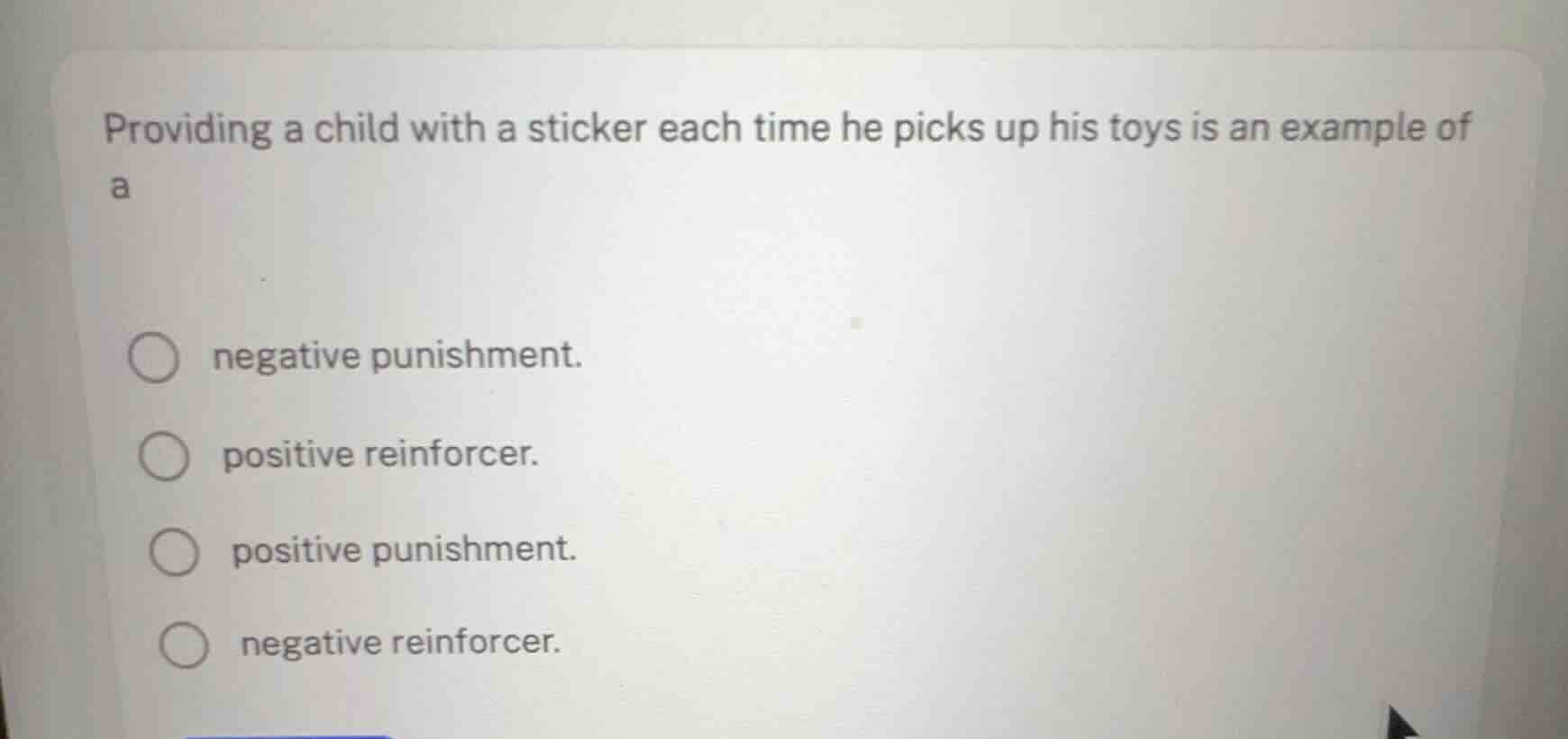
providing a child with a sticker each time he picks up his toys is an example of a

negative punishment.
positive reinforcer.
positive punishment.
negative reinforcer.

Explanation:

Response

<pre_analysis>
{
"quality": "clear",
"question_count": 1,
"skills_matched": [
"direct_cot",
"multiple_choice_formatter",
"explain_then_answer",
"tutor",
"mastery_adaptive_brevity"
],
"needs_drawing": false,
"concepts_used": [
"Operant Conditioning",
"Primary Reinforcers",
"Secondary Reinforcers"
],
"new_concepts": [],
"current_concepts": [
"Operant Conditioning",
"Primary Reinforcers",
"Secondary Reinforcers",
"Positive Reinforcement"
]
}
</pre_analysis>

<reasoning>

Analyze the behavior and consequence

Using the Operant Conditioning knowledge point, we identify the target behavior and the consequence:

  • Behavior: The child picks up his toys.
  • Consequence: The child is given a sticker.

Determine the operant conditioning mechanism

Using the Operant Conditioning knowledge point, we classify the consequence:

  • Positive vs. Negative: A stimulus (sticker) is added or presented following the behavior, which makes it "positive."
  • Reinforcement vs. Punishment: The sticker is intended to increase the likelihood that the child will pick up his toys in the future, which makes it "reinforcement."
  • Therefore, the sticker acts as a positive reinforcer.

Classify the type of reinforcer

Using the Primary Reinforcers and Secondary Reinforcers knowledge points:

  • A sticker is not an innate, biological need (like food or water), so it is not a primary reinforcer.
  • Instead, it is a conditioned or secondary reinforcer that has acquired value through association and social learning.
  • Thus, providing the sticker is an example of using a positive reinforcer.

</reasoning>

<answer>
<mcq-option>negative punishment.</mcq-option>
<mcq-correct>positive reinforcer.</mcq-correct>
<mcq-option>positive punishment.</mcq-option>
<mcq-option>negative reinforcer.</mcq-option>
</answer>

<post_analysis>
{
"subject": "Social Science",
"question_type": "Multiple Choice",
"knowledge_point": [
"Social Science",
"Psychology",
"Operant Conditioning"
]
}
</post_analysis>

Answer:

<pre_analysis>
{
"quality": "clear",
"question_count": 1,
"skills_matched": [
"direct_cot",
"multiple_choice_formatter",
"explain_then_answer",
"tutor",
"mastery_adaptive_brevity"
],
"needs_drawing": false,
"concepts_used": [
"Operant Conditioning",
"Primary Reinforcers",
"Secondary Reinforcers"
],
"new_concepts": [],
"current_concepts": [
"Operant Conditioning",
"Primary Reinforcers",
"Secondary Reinforcers",
"Positive Reinforcement"
]
}
</pre_analysis>

<reasoning>

Analyze the behavior and consequence

Using the Operant Conditioning knowledge point, we identify the target behavior and the consequence:

  • Behavior: The child picks up his toys.
  • Consequence: The child is given a sticker.

Determine the operant conditioning mechanism

Using the Operant Conditioning knowledge point, we classify the consequence:

  • Positive vs. Negative: A stimulus (sticker) is added or presented following the behavior, which makes it "positive."
  • Reinforcement vs. Punishment: The sticker is intended to increase the likelihood that the child will pick up his toys in the future, which makes it "reinforcement."
  • Therefore, the sticker acts as a positive reinforcer.

Classify the type of reinforcer

Using the Primary Reinforcers and Secondary Reinforcers knowledge points:

  • A sticker is not an innate, biological need (like food or water), so it is not a primary reinforcer.
  • Instead, it is a conditioned or secondary reinforcer that has acquired value through association and social learning.
  • Thus, providing the sticker is an example of using a positive reinforcer.

</reasoning>

<answer>
<mcq-option>negative punishment.</mcq-option>
<mcq-correct>positive reinforcer.</mcq-correct>
<mcq-option>positive punishment.</mcq-option>
<mcq-option>negative reinforcer.</mcq-option>
</answer>

<post_analysis>
{
"subject": "Social Science",
"question_type": "Multiple Choice",
"knowledge_point": [
"Social Science",
"Psychology",
"Operant Conditioning"
]
}
</post_analysis>