QUESTION IMAGE
Question
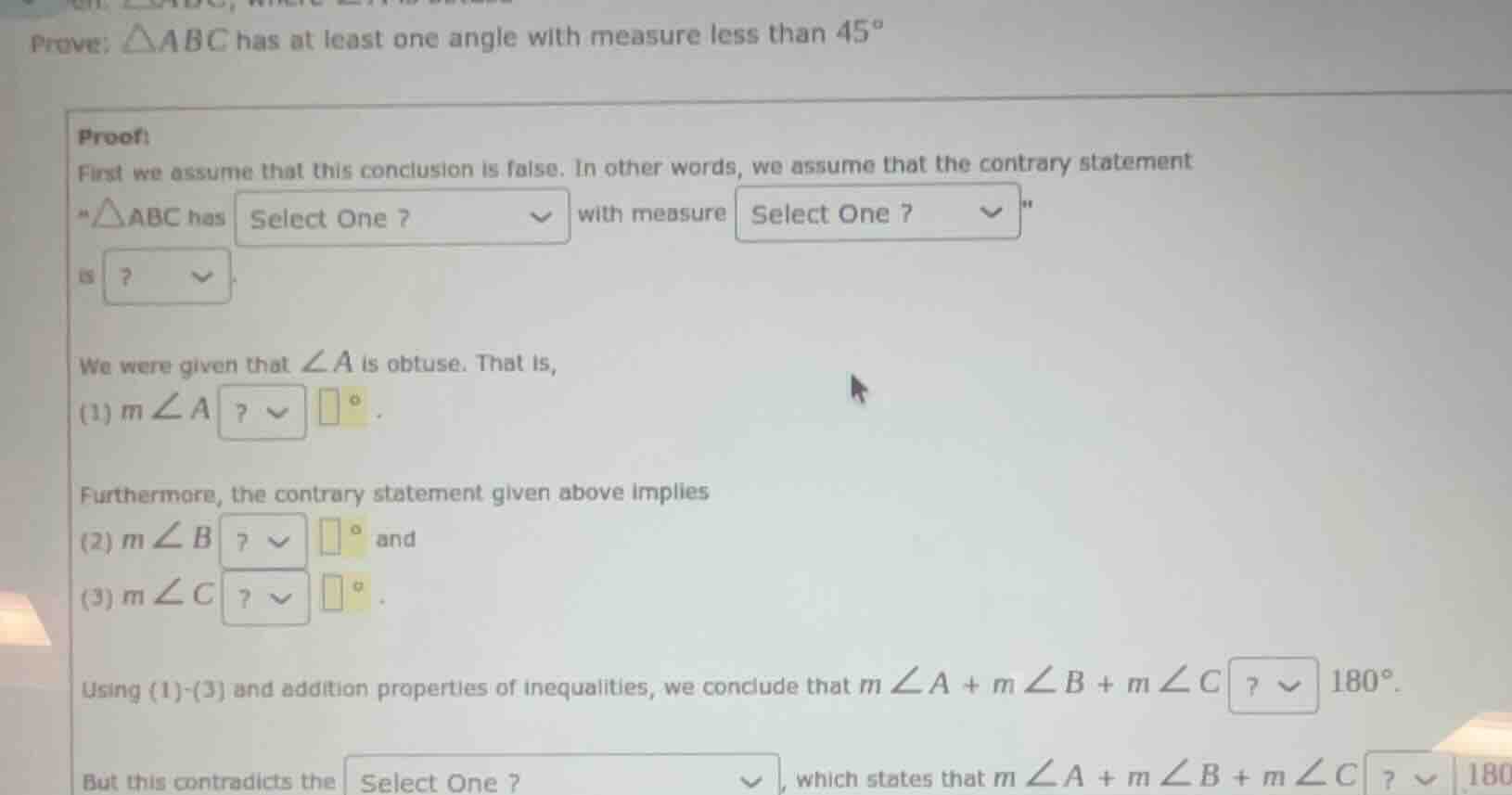
prove: \\(\triangle abc\\) has at least one angle with measure less than \\(45^\circ\\)
proof:
first we assume that this conclusion is false. in other words, we assume that the contrary statement
\\\(\triangle abc\\) has select one with measure select one is select one\.
we were given that \\(\angle a\\) is obtuse. that is,
(1) \\(m\angle a\\) ? \\( ^\circ\\).
furthermore, the contrary statement given above implies
(2) \\(m\angle b\\) ? \\( ^\circ\\) and
(3) \\(m\angle c\\) ? \\( ^\circ\\).
using (1)-(3) and addition properties of inequalities, we conclude that \\(m\angle a + m\angle b + m\angle c\\) ? \\(180^\circ\\).
but this contradicts the select one, which states that \\(m\angle a + m\angle b + m\angle c\\) ? \\(180^\circ\\).
Formulate the negation of the conclusion
Define inequalities from given conditions and negation
Sum the inequalities and identify contradiction

Snap & solve any problem in the app
Get step-by-step solutions on Sovi AI
Photo-based solutions with guided steps
Explore more problems and detailed explanations
Proof:
First we assume that this conclusion is false. In other words, we assume that the contrary statement "\(\triangle ABC\) has <blank>no angle</blank> with measure <blank>less than \(45^\circ\)</blank> is <blank>true</blank>."
We were given that \(\angle A\) is obtuse. That is,
(1) \(m\angle A\) <blank>\(>\)</blank> <blank>\(90\)</blank>\(^\circ\).
Furthermore, the contrary statement given above implies
(2) \(m\angle B\) <blank>\(\ge\)</blank> <blank>\(45\)</blank>\(^\circ\) and
(3) \(m\angle C\) <blank>\(\ge\)</blank> <blank>\(45\)</blank>\(^\circ\).
Using (1)-(3) and addition properties of inequalities, we conclude that \(m\angle A + m\angle B + m\angle C\) <blank>\(>\)</blank> \(180^\circ\).
But this contradicts the <blank>Triangle Angle Sum Theorem</blank>, which states that \(m\angle A + m\angle B + m\angle C\) <blank>\(=\)</blank> \(180^\circ\).