QUESTION IMAGE
Question
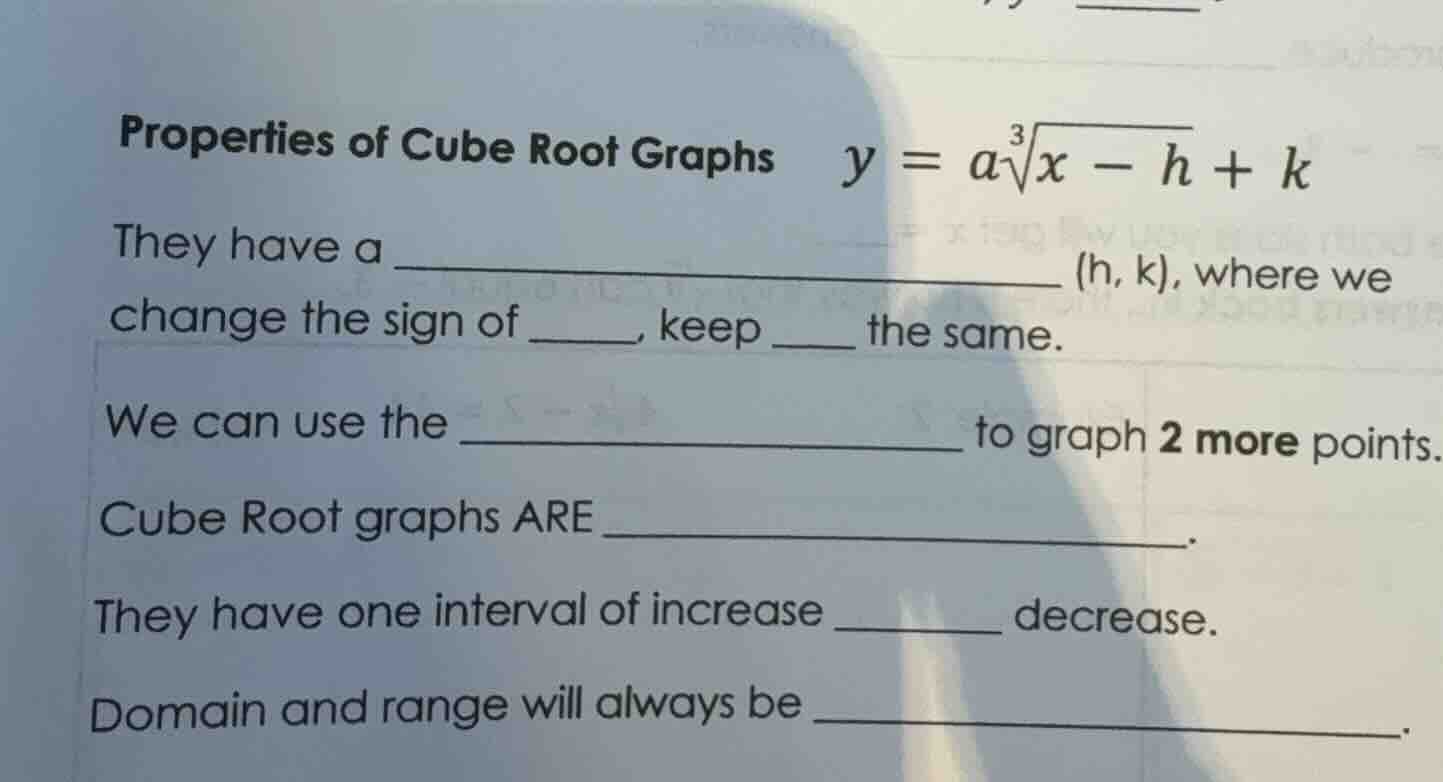
properties of cube root graphs \\(y = a\sqrt3{x - h} + k\\)
they have a \\(\underline{\quad\quad\quad\quad\quad\quad\quad\quad\quad\quad\quad\quad\quad\quad}\\) \\((h, k)\\), where we change the sign of \\(\underline{\quad\quad}\\), keep \\(\underline{\quad\quad}\\) the same.
we can use the \\(\underline{\quad\quad\quad\quad\quad\quad\quad\quad\quad\quad\quad\quad\quad\quad}\\) to graph 2 more points.
cube root graphs are \\(\underline{\quad\quad\quad\quad\quad\quad\quad\quad\quad\quad\quad\quad\quad\quad}\\).
they have one interval of increase \\(\underline{\quad\quad\quad\quad}\\) decrease.
domain and range will always be \\(\underline{\quad\quad\quad\quad\quad\quad\quad\quad\quad\quad\quad\quad\quad\quad}\\).
🆕 New Concept Discovered: Cube Root Functions
Analyzing key features, transformations, and symmetry of cube root graphs.
Step 1: Identify the key point \((h, k)\)
For a cube root function in the form \(y = a\sqrt[3]{x - h} + k\), the central point where the graph changes curvature is called the inflection point (or point of inflection).
To find this point from the equation:
- We look at the value inside the radical, \(x - h\). We change the sign of the number next to \(x\) to get \(h\).
- We look at the constant outside the radical, \(k\). We keep the sign of \(k\) the same.
Therefore:
- First blank: inflection point (or point of inflection)
- Second blank: \(h\)
- Third blank: \(k\)
Step 2: Determine how to find additional points
To graph more points easily from the inflection point \((h, k)\), we use the value of \(a\) (the vertical stretch/compression factor). Since \(\sqrt[3]{1} = 1\) and \(\sqrt[3]{-1} = -1\), moving \(1\) unit to the right of \(h\) changes the \(y\)-value by \(+a\), and moving \(1\) unit to the left changes the \(y\)-value by \(-a\). This pattern is often referred to as the slope (or "slope" \(a\)) or a table of values. In standard algebra curriculum, this is referred to as using the "slope" or parameter \(a\) to find the next points \((h+1, k+a)\) and \((h-1, k-a)\).
- Fourth blank: "slope" \(a\) (or parameter \(a\))
Step 3: Identify the symmetry of the graph
A cube root graph is symmetric about its inflection point. Rotating the graph \(180^\circ\) around \((h, k)\) lands it back onto itself. This means cube root graphs are symmetric (specifically, they have point symmetry or are odd functions when centered at the origin).
- Fifth blank: symmetric about the inflection point (or functions with point symmetry)
Step 4: Determine intervals of increase or decrease
A cube root function \(y = a\sqrt[3]{x - h} + k\) is strictly monotonic.
- If \(a > 0\), the graph increases across its entire domain (it has one interval of increase and no interval of decrease).
- If \(a < 0\), the graph decreases across its entire domain (it has no interval of increase and one interval of decrease).
Thus, it has one interval of increase or decrease (never both).
- Sixth blank: or
Step 5: Determine domain and range
Unlike square root functions, you can take the cube root of any real number (positive, negative, or zero). Therefore, there are no restrictions on the input \(x\) or the output \(y\). Both the domain and range are always all real numbers.
- Seventh blank: all real numbers (or \((-\infty, \infty)\))

Snap & solve any problem in the app
Get step-by-step solutions on Sovi AI
Photo-based solutions with guided steps
Explore more problems and detailed explanations
Here are the completed sentences for the properties of cube root graphs:
- They have an inflection point \((h, k)\), where we change the sign of \(h\), keep \(k\) the same.
- We can use the "slope" \(a\) to graph 2 more points.
- Cube Root graphs ARE symmetric about the inflection point.
- They have one interval of increase or decrease.
- Domain and range will always be all real numbers (or \((-\infty, \infty)\)).