QUESTION IMAGE
Question
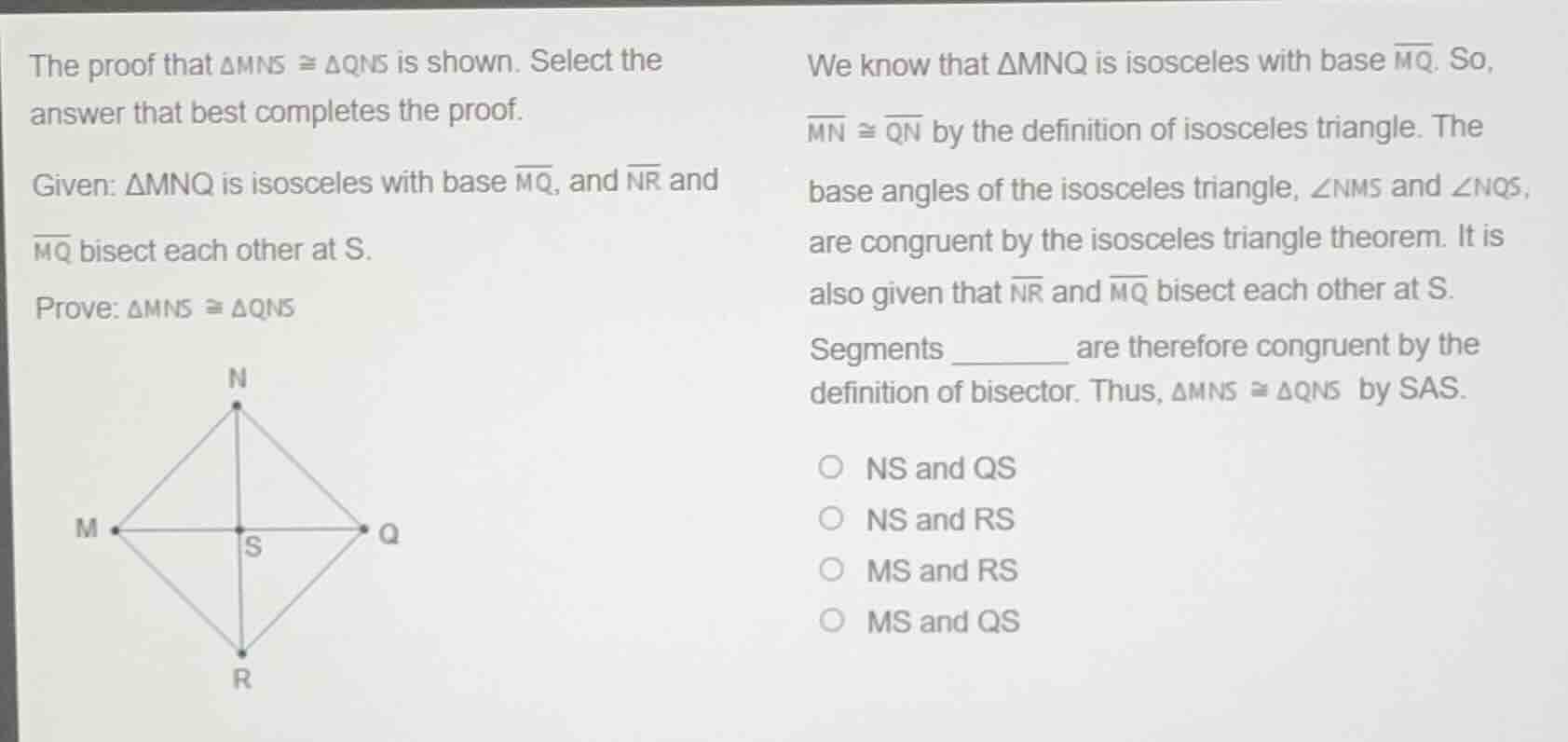
the proof that \\(\delta mns \cong \delta qns\\) is shown. select the answer that best completes the proof.
given: \\(\delta mnq\\) is isosceles with base \\(\overline{mq}\\), and \\(\overline{nr}\\) and \\(\overline{mq}\\) bisect each other at \\(s\\).
prove: \\(\delta mns \cong \delta qns\\)
we know that \\(\delta mnq\\) is isosceles with base \\(\overline{mq}\\). so, \\(\overline{mn} \cong \overline{qn}\\) by the definition of isosceles triangle. the base angles of the isosceles triangle, \\(\angle nms\\) and \\(\angle nqs\\), are congruent by the isosceles triangle theorem. it is also given that \\(\overline{nr}\\) and \\(\overline{mq}\\) bisect each other at \\(s\\). segments ______ are therefore congruent by the definition of bisector. thus, \\(\delta mns \cong \delta qns\\) by sas.
ns and qs
ns and rs
ms and rs
ms and qs
Identify the target triangles and given components
We want to prove \(\Delta MNS \cong \Delta QNS\) using the SAS (Side-Angle-Side) Congruence Postulate.
From the proof text, we already have:
- Side: \(\overline{MN} \cong \overline{QN}\) (using Isosceles Triangle Definition).
- Angle: \(\angle NMS \cong \angle NQS\) (by the Isosceles Triangle Theorem).
Determine the required side for SAS
To use SAS Congruence Postulate for \(\Delta MNS\) and \(\Delta QNS\):
- The congruent angles are \(\angle NMS\) and \(\angle NQS\).
- The sides forming these angles are:
- For \(\angle NMS\): sides \(\overline{MN}\) and \(\overline{MS}\).
- For \(\angle NQS\): sides \(\overline{QN}\) and \(\overline{QS}\).
- Since we already have \(\overline{MN} \cong \overline{QN}\), we need the other pair of sides forming the angles to be congruent: \(\overline{MS} \cong \overline{QS}\).
Apply the definition of bisector
It is given that \(\overline{NR}\) and \(\overline{MQ}\) bisect each other at \(S\).
By the definition of a segment bisector, the bisector divides a segment into two congruent segments.
Since \(\overline{NR}\) bisects \(\overline{MQ}\) at \(S\), point \(S\) is the midpoint of \(\overline{MQ}\).
Therefore, segments \(MS\) and \(QS\) are congruent.

Snap & solve any problem in the app
Get step-by-step solutions on Sovi AI
Photo-based solutions with guided steps
Explore more problems and detailed explanations
- NS and QS
- NS and RS
- MS and RS
- MS and QS (Correct answer)