QUESTION IMAGE
Question
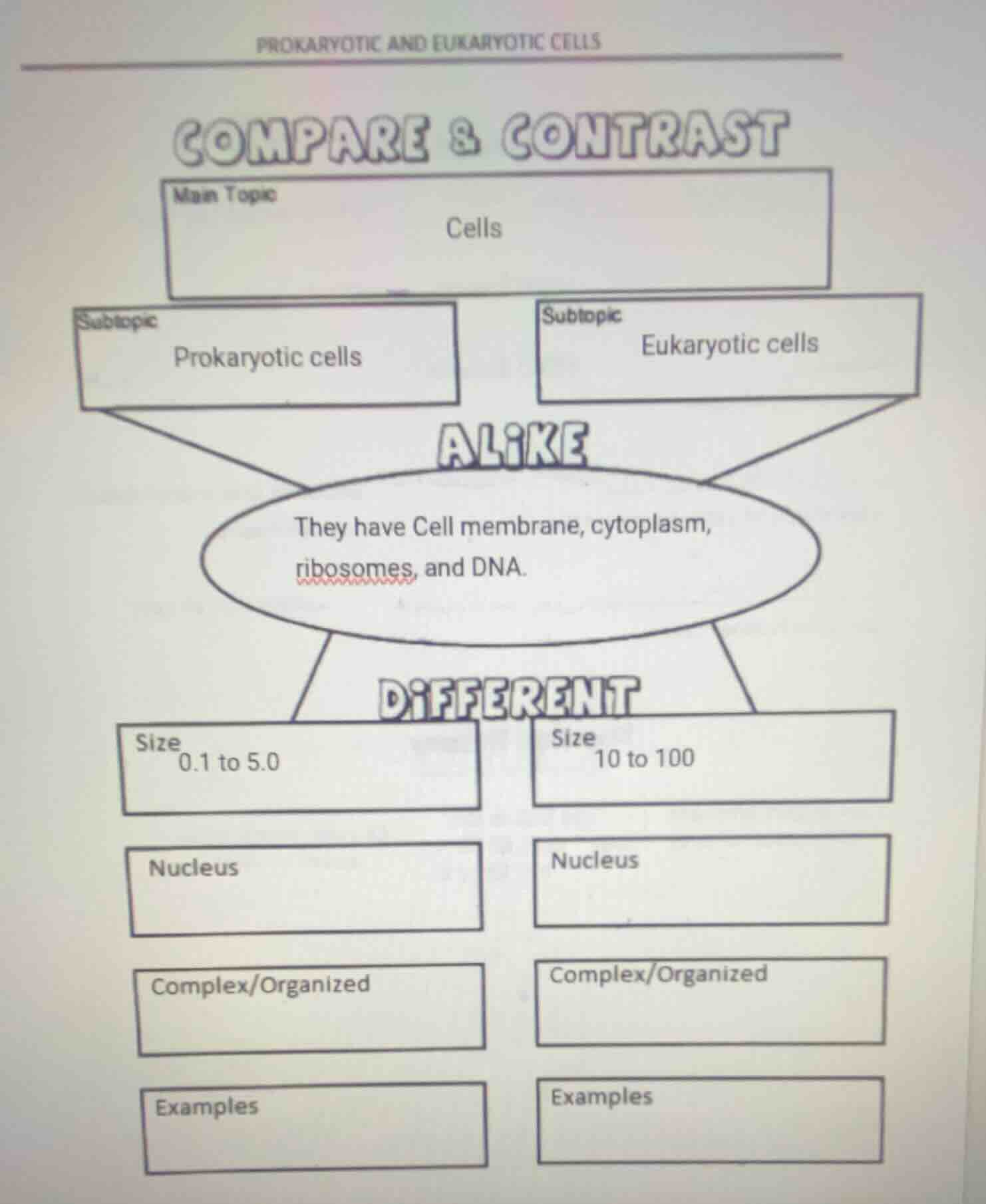
prokaryotic and eukaryotic cells
compare & contrast
main topic: cells
subtopic: prokaryotic cells
subtopic: eukaryotic cells
alike
they have cell membrane, cytoplasm, ribosomes, and dna.
different
prokaryotic cells:
size: 0.1 to 5.0
nucleus:
complex/organized:
examples:
eukaryotic cells:
size: 10 to 100
nucleus:
complex/organized:
examples:
Identify the comparison categories
We compare prokaryotic and eukaryotic cells.
The categories are nucleus, complexity, and examples.
Analyze prokaryotic cell characteristics
Prokaryotes lack a membrane-bound nucleus.
They are simple, unicellular, and unorganized.
Examples include bacteria and archaea.
Analyze eukaryotic cell characteristics
Eukaryotes possess a membrane-bound nucleus.
They are highly complex and organized.
Examples include plants, animals, and fungi.
Formulate the final table entries
We fill each corresponding blank box.
The answers are structured by category.

Snap & solve any problem in the app
Get step-by-step solutions on Sovi AI
Photo-based solutions with guided steps
Explore more problems and detailed explanations
| Category | Prokaryotic cells | Eukaryotic cells |
|---|---|---|
| Complex/Organized | Simple, single-celled, lacks membrane-bound organelles | Complex, organized, contains membrane-bound organelles |
| Examples | Bacteria, Archaea | Plants, Animals, Fungi, Protists |