QUESTION IMAGE
Question
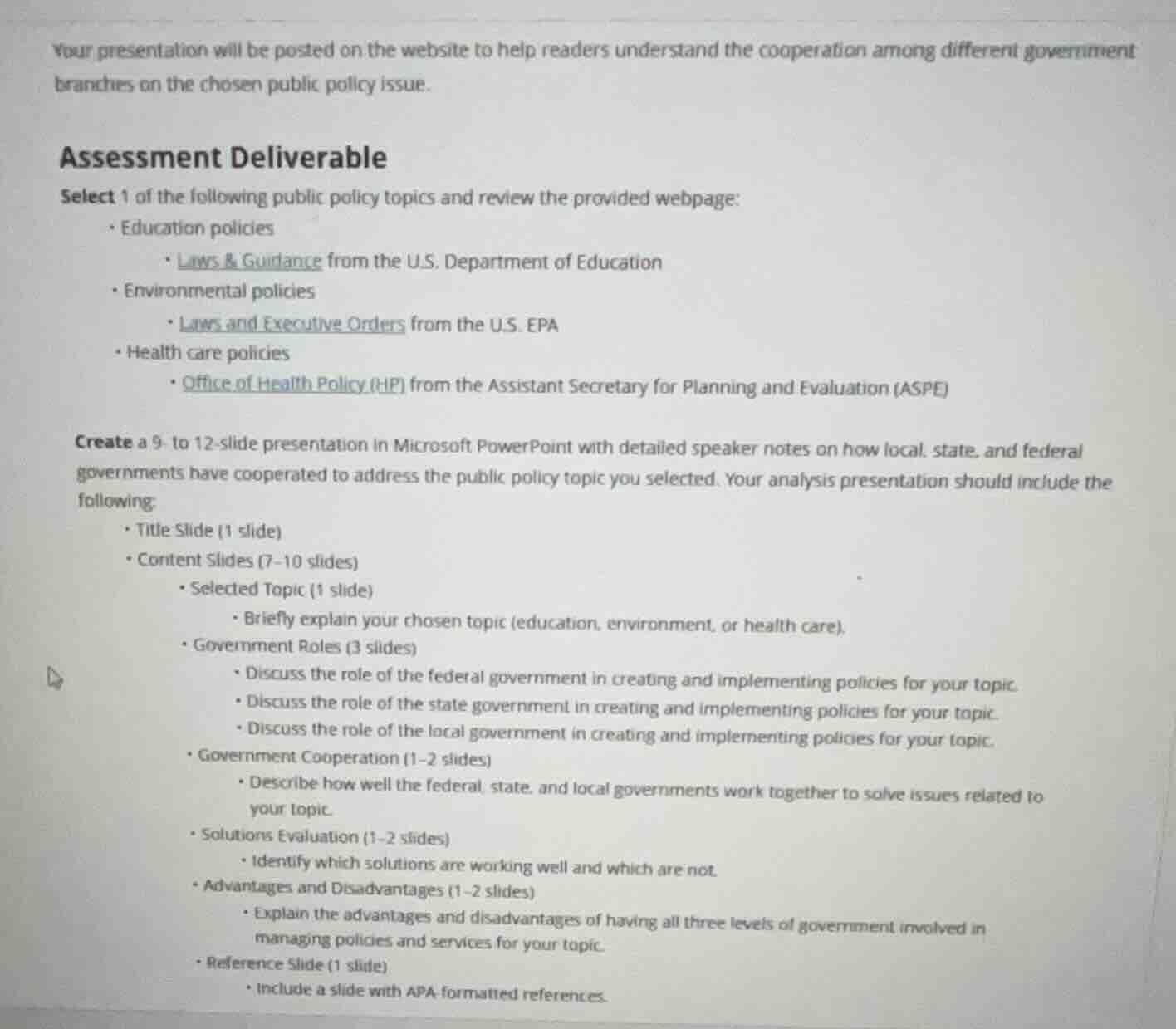
your presentation will be posted on the website to help readers understand the cooperation among different government branches on the chosen public policy issue.
assessment deliverable
select 1 of the following public policy topics and review the provided webpage:
- education policies
- laws & guidance from the u.s. department of education
- environmental policies
- laws and executive orders from the u.s. epa
- health care policies
- office of health policy (hp) from the assistant secretary for planning and evaluation (aspe)
create a 9- to 12-slide presentation in microsoft powerpoint with detailed speaker notes on how local, state, and federal governments have cooperated to address the public policy topic you selected. your analysis presentation should include the following:
- title slide (1 slide)
- content slides (7-10 slides)
- selected topic (1 slide)
- briefly explain your chosen topic (education, environment, or health care).
- government roles (3 slides)
- discuss the role of the federal government in creating and implementing policies for your topic.
- discuss the role of the state government in creating and implementing policies for your topic.
- discuss the role of the local government in creating and implementing policies for your topic.
- government cooperation (1-2 slides)
- describe how well the federal, state, and local governments work together to solve issues related to your topic.
- solutions evaluation (1-2 slides)
- identify which solutions are working well and which are not.
- advantages and disadvantages (1-2 slides)
- explain the advantages and disadvantages of having all three levels of government involved in managing policies and services for your topic.
- reference slide (1 slide)
- include a slide with apa-formatted references.
Select policy topic
Select one public policy area to analyze. Environmental policy is chosen here.
Outline government roles
Analyze federal, state, and local roles in environmental policy.
- Federal: Sets national standards (e.g., Clean Air Act) via the EPA.
- State: Enforces federal standards and manages state-specific resources.
- Local: Implements municipal waste, zoning, and local water safety.
This demonstrates Federalism in action.
Evaluate cooperation
Assess how these levels interact.
- Cooperation: Shared funding and joint enforcement.
- Conflict: Unfunded mandates and regulatory overlap.
This highlights Intergovernmental Relations.
Propose solutions
Evaluate policy solutions.
- Working well: Collaborative watershed management.
- Needs improvement: Standardizing chemical runoff limits.
Assess advantages
Analyze multi-level governance.
- Advantages: Tailored local solutions with strong federal backing.
- Disadvantages: Bureaucratic delays and coordination friction.

Snap & solve any problem in the app
Get step-by-step solutions on Sovi AI
Photo-based solutions with guided steps
Explore more problems and detailed explanations
To successfully complete your presentation on intergovernmental cooperation, here is a structured outline and guide based on the Environmental Policies topic:
Slide 1: Title Slide
- Title: Intergovernmental Cooperation in U.S. Environmental Policy
- Subtitle: How Federal, State, and Local Governments Collaborate on Clean Water and Air
- Speaker Notes: Introduce the purpose of the presentation, which is to analyze how different levels of government coordinate to manage environmental protection.
Slide 2: Selected Topic (Environmental Policies)
- Content: Overview of Environmental Policy in the U.S.
- Key Points: Focus on the Clean Water Act and Clean Air Act as primary frameworks.
- Speaker Notes: Explain that environmental issues do not respect political boundaries, making cooperation across levels of government essential.
Slide 3: Federal Government Role
- Content: The Role of the U.S. Environmental Protection Agency (EPA)
- Key Points: Sets national baseline standards, conducts research, and provides major funding grants.
- Speaker Notes: Discuss how the federal government uses its authority to establish uniform national standards so states do not compete by lowering environmental protections.
Slide 4: State Government Role
- Content: State Environmental Agencies (e.g., State DEQs)
- Key Points: Implement and enforce federal standards, issue permits, and monitor compliance.
- Speaker Notes: Explain that states have the flexibility to set stricter standards than the federal baseline to address unique regional ecological needs.
Slide 5: Local Government Role
- Content: Municipal and County Action
- Key Points: Manage local waste, water treatment facilities, zoning laws, and local parks.
- Speaker Notes: Highlight that local governments are on the front lines of daily environmental management, directly interacting with citizens and local businesses.
Slide 6: Government Cooperation
- Content: Collaborative Environmental Management
- Key Points: Joint funding programs, shared data networks, and coordinated disaster responses.
- Speaker Notes: Describe how the three levels work together, such as federal grants funding state-administered water infrastructure projects implemented by local utility departments.
Slide 7: Solutions Evaluation
- Content: What is Working and What is Not
- Working Well: Coordinated watershed management across state lines.
- Needs Improvement: Addressing non-point source pollution (like agricultural runoff) due to regulatory gaps between federal guidelines and local zoning.
- Speaker Notes: Evaluate the effectiveness of current cooperative frameworks, noting where communication or funding gaps exist.
Slide 8: Advantages and Disadvantages
- Advantages: Local customization of rules, shared financial burdens, and national consistency.
- Disadvantages: Bureaucratic delays, unfunded federal mandates, and political friction between state and federal administrations.
- Speaker Notes: Weigh the benefits of decentralized implementation against the coordination challenges inherent in a federal system.
Slide 9: Reference Slide
- Content: APA-Formatted References
- Sources:
- U.S. Environmental Protection Agency. (n.d.). Laws and Executive Orders. https://www.epa.gov/laws-regulations
- Selected academic or government sources on federalism and environmental policy.