QUESTION IMAGE
Question
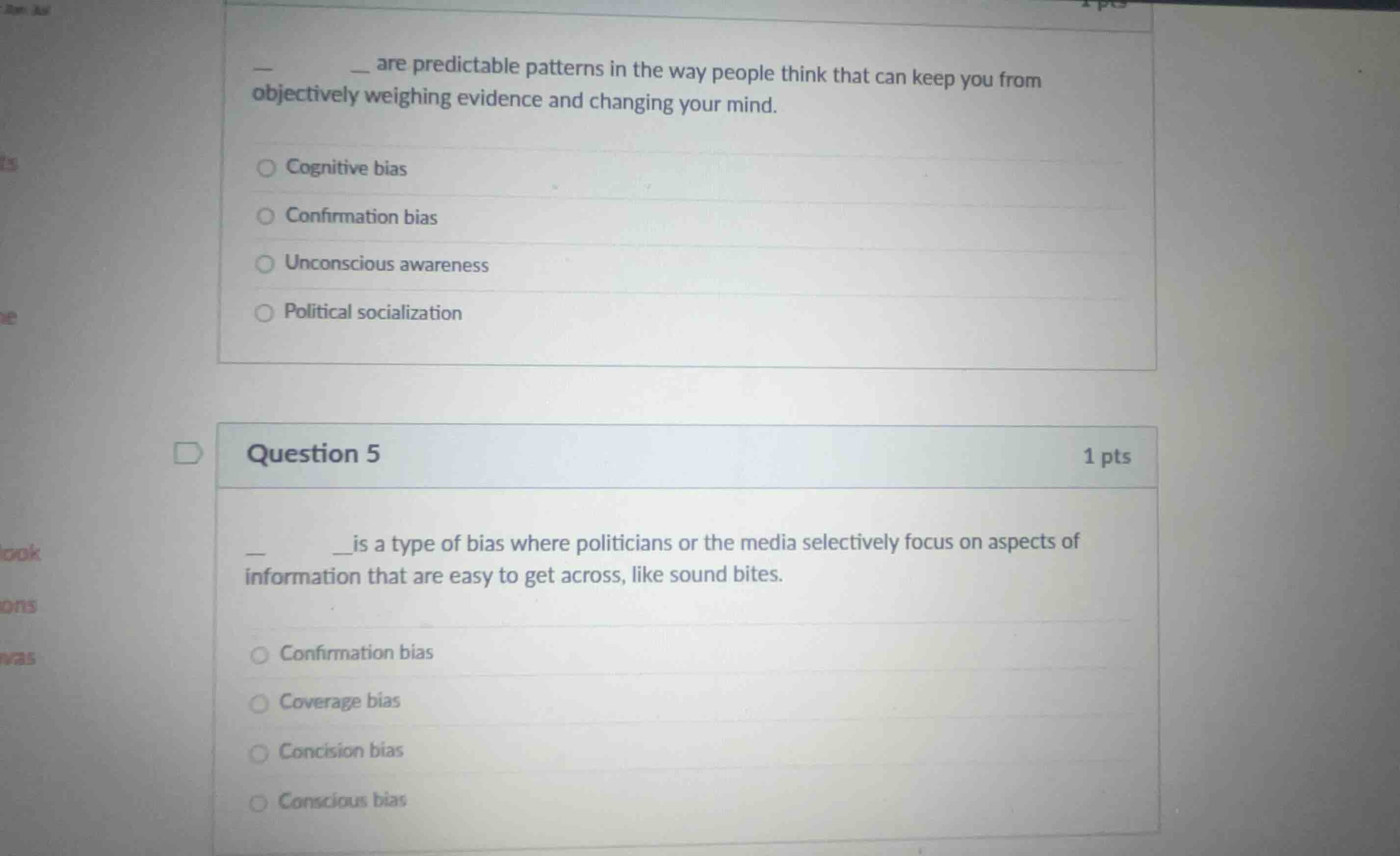
— — are predictable patterns in the way people think that can keep you from objectively weighing evidence and changing your mind.
cognitive bias
confirmation bias
unconscious awareness
political socialization
question 5
— — is a type of bias where politicians or the media selectively focus on aspects of information that are easy to get across, like sound bites.
confirmation bias
coverage bias
concision bias
conscious bias
Analyze the first question
The first question asks for a term defined as "predictable patterns in the way people think that can keep you from objectively weighing evidence and changing your mind."
Applying the concept of Cognitive Bias, we know that systematic, predictable deviations from rational judgment are classified broadly as cognitive biases. This matches the definition perfectly.
Analyze the second question
The second question asks for "a type of bias where politicians or the media selectively focus on aspects of information that are easy to get across, like sound bites."
This refers to a specific form of media bias. When information is selected or simplified because it is brief, simple, and easy to fit into short segments (like sound bites), it is known as concision bias. This prevents in-depth discussion of complex issues.
Evaluate the options for Question 1
- Cognitive bias: Correct. It is the umbrella term for these predictable mental patterns.
- Confirmation bias: Incorrect. This is a specific type of cognitive bias, not the general definition.
- Unconscious awareness: Incorrect. This is a contradictory psychological term.
- Political socialization: Incorrect. This is the process by which people form their political ideas.
Evaluate the options for Question 2
- Confirmation bias: Incorrect. This is seeking information that confirms existing beliefs.
- Coverage bias: Incorrect. This refers to giving unequal amounts of coverage to different sides.
- Concision bias: Correct. This is the bias toward brief, easily summarized information and sound bites.
- Conscious bias: Incorrect. This refers to explicit, intentional prejudice.

Snap & solve any problem in the app
Get step-by-step solutions on Sovi AI
Photo-based solutions with guided steps
Explore more problems and detailed explanations
Question 1
- (A) Cognitive bias (Correct answer)
- (B) Confirmation bias
- (C) Unconscious awareness
- (D) Political socialization
Question 2
- (A) Confirmation bias
- (B) Coverage bias
- (C) Concision bias (Correct answer)
- (D) Conscious bias