QUESTION IMAGE
Question
practice with parallel and perpendicular lines.
use the diagram to complete the statements.
segment ad must be congruent to segment v
segment bc must be congruent to segment v
Identify the geometric properties in the diagram
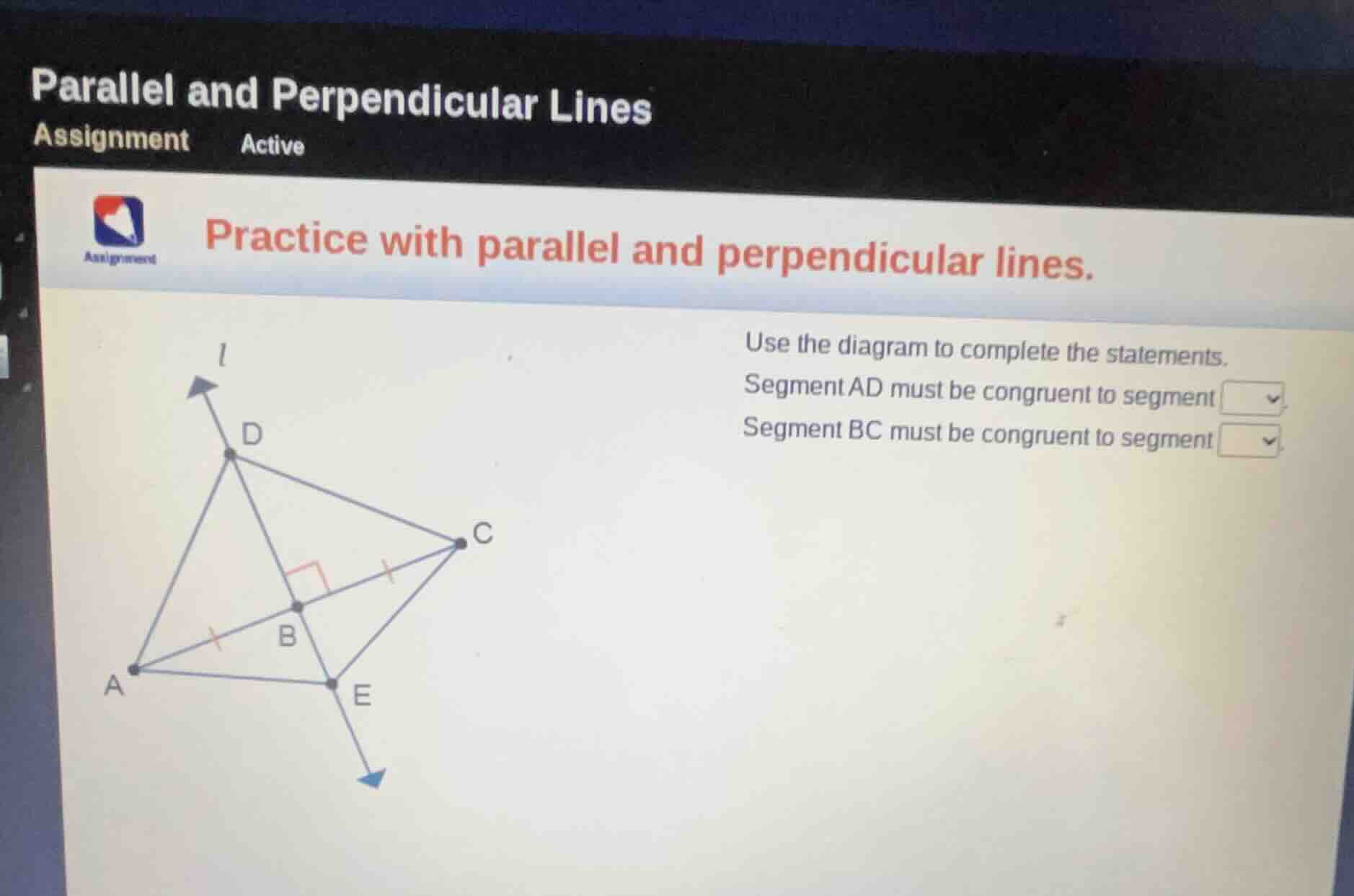
The diagram shows line \(l\) passing through points \(D\), \(B\), and \(E\).
Segment \(AC\) intersects line \(l\) at point \(B\).
The red square at the intersection indicates that line \(l\) is perpendicular to segment \(AC\), so \(l \perp AC\).
The tick marks on segments \(AB\) and \(BC\) indicate that \(AB = BC\), meaning \(B\) is the midpoint of segment \(AC\).
Therefore, line \(l\) is the perpendicular bisector of segment \(AC\).
Apply the Perpendicular Bisector Theorem
The Perpendicular Bisector Theorem states that any point on the perpendicular bisector of a segment is equidistant from the endpoints of that segment.
Since line \(l\) is the perpendicular bisector of segment \(AC\):
- Point \(D\) lies on line \(l\), so it is equidistant from \(A\) and \(C\). Thus, \(AD = CD\), meaning segment \(AD\) is congruent to segment \(CD\).
- Point \(E\) lies on line \(l\), so it is equidistant from \(A\) and \(C\). Thus, \(AE = CE\), meaning segment \(AE\) is congruent to segment \(CE\).
Determine the congruent segments for the statements
- For the first statement: "Segment \(AD\) must be congruent to segment [ ]".
Since \(D\) lies on the perpendicular bisector of \(AC\), segment \(AD\) is congruent to segment \(CD\).
- For the second statement: "Segment \(BC\) must be congruent to segment [ ]".
Since \(B\) is the midpoint of segment \(AC\), segment \(BC\) is congruent to segment \(AB\).

Snap & solve any problem in the app
Get step-by-step solutions on Sovi AI
Photo-based solutions with guided steps
Explore more problems and detailed explanations
Use the diagram to complete the statements.
Segment AD must be congruent to segment <blank>CD</blank>
Segment BC must be congruent to segment <blank>AB</blank>