QUESTION IMAGE
Question
¡practica! nivel i - b
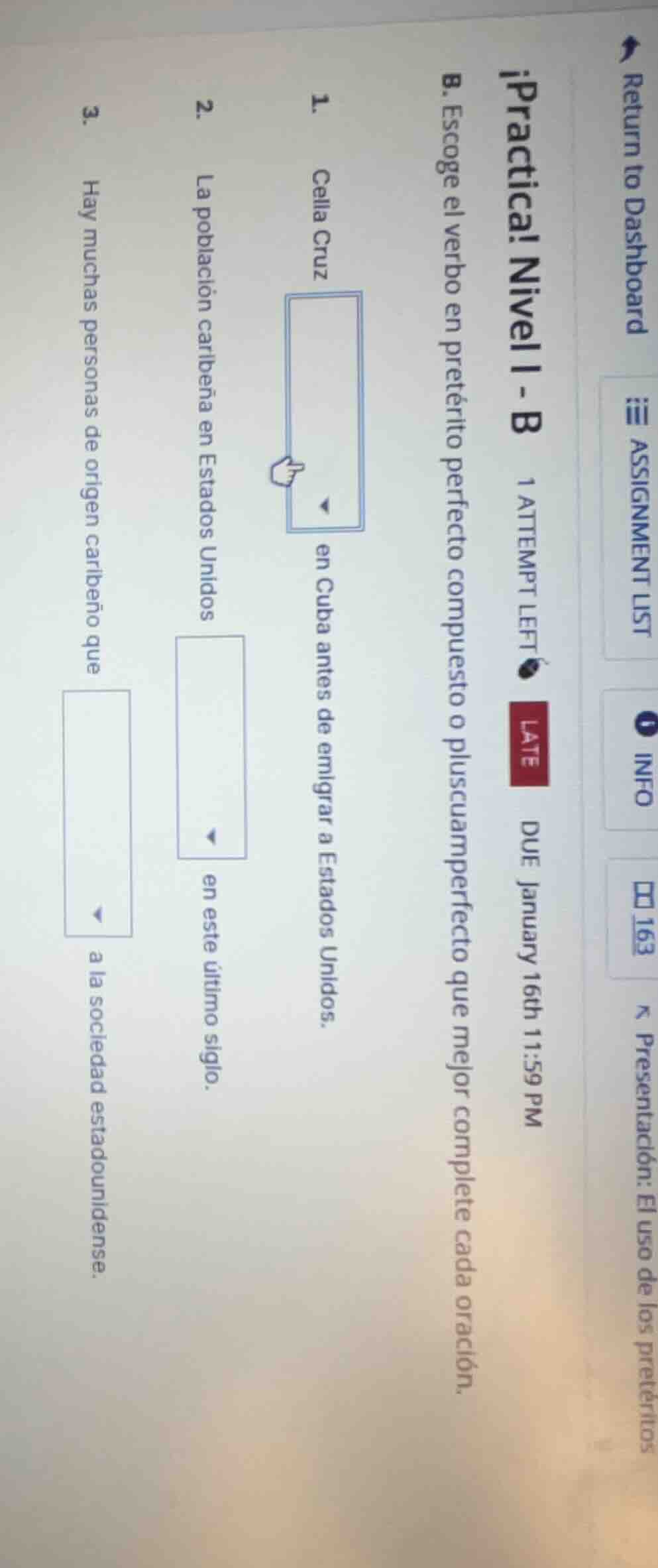
b. escoge el verbo en pretérito perfecto compuesto o pluscuamperfecto que mejor complete cada oración.
- celia cruz
- la población caribeña en estados unidos
- hay muchas personas de origen caribeño que
return to dashboard
assignment list
info
163
presentación: el uso de los pretéritos
To solve these Spanish verb - tense (pretérito perfecto compuesto or pluscuamperfecto) problems, we analyze each sentence:
Sentence 1: "Celia Cruz ____ en Cuba antes de emigrar a Estados Unidos."
The action of being in Cuba happened before the action of emigrating (which is also a past action). The pluscuamperfecto is used to describe an action that was completed before another past action. The verb "ser" (to be) in the pluscuamperfecto for "Celia Cruz" (third - person singular, feminine) is "había sido". But if we consider the context of "vivir" (to live), the pluscuamperfecto of "vivir" for third - person singular is "había vivido". However, a more common and context - appropriate verb here could be "había vivido" or "había sido" (depending on the intended meaning). But if we assume the verb is "vivir", the correct form for the pluscuamperfecto (action before emigrating, which is past) is "había vivido".
Sentence 2: "La población caribeña en Estados Unidos ____ en este último siglo."
The pretérito perfecto compuesto is used to describe an action that started in the past and has a connection to the present or an action that was completed in the past within a time period that includes the present. "Haber + past participle" is the structure. The verb "aumentar" (to increase) in the pretérito perfecto compuesto for "la población" (third - person singular) is "ha aumentado".
Sentence 3: "Hay muchas personas de origen caribeño que ____ a la sociedad estadounidense."
The pretérito perfecto compuesto is used here to describe an action (integrating into American society) that has been completed and has a connection to the present (there are many such people now). The verb "integrarse" (to integrate oneself) in the pretérito perfecto compuesto for "personas" (third - person plural) is "han integrado" (if we use "integrar" in the active voice, or "han sido integradas" in the passive voice. A more common verb here could be "han adaptado" or "han integrado" depending on the context. If we take "adaptarse" (to adapt oneself), the pretérito perfecto compuesto for third - person plural is "han adaptado".
Final Answers (assuming common verb choices):
- había vivido
- ha aumentado
- han integrado
(Note: The answers may vary slightly depending on the exact verbs and context intended in the exercise. If the verbs in the dropdowns are different, the answers would be adjusted accordingly. For example, if the first dropdown has verbs like "vivir", "ser", "estar", the most appropriate for the context of living in Cuba before emigrating is "había vivido" (pluscuamperfecto of "vivir").)

Snap & solve any problem in the app
Get step-by-step solutions on Sovi AI
Photo-based solutions with guided steps
Explore more problems and detailed explanations
To solve these Spanish verb - tense (pretérito perfecto compuesto or pluscuamperfecto) problems, we analyze each sentence:
Sentence 1: "Celia Cruz ____ en Cuba antes de emigrar a Estados Unidos."
The action of being in Cuba happened before the action of emigrating (which is also a past action). The pluscuamperfecto is used to describe an action that was completed before another past action. The verb "ser" (to be) in the pluscuamperfecto for "Celia Cruz" (third - person singular, feminine) is "había sido". But if we consider the context of "vivir" (to live), the pluscuamperfecto of "vivir" for third - person singular is "había vivido". However, a more common and context - appropriate verb here could be "había vivido" or "había sido" (depending on the intended meaning). But if we assume the verb is "vivir", the correct form for the pluscuamperfecto (action before emigrating, which is past) is "había vivido".
Sentence 2: "La población caribeña en Estados Unidos ____ en este último siglo."
The pretérito perfecto compuesto is used to describe an action that started in the past and has a connection to the present or an action that was completed in the past within a time period that includes the present. "Haber + past participle" is the structure. The verb "aumentar" (to increase) in the pretérito perfecto compuesto for "la población" (third - person singular) is "ha aumentado".
Sentence 3: "Hay muchas personas de origen caribeño que ____ a la sociedad estadounidense."
The pretérito perfecto compuesto is used here to describe an action (integrating into American society) that has been completed and has a connection to the present (there are many such people now). The verb "integrarse" (to integrate oneself) in the pretérito perfecto compuesto for "personas" (third - person plural) is "han integrado" (if we use "integrar" in the active voice, or "han sido integradas" in the passive voice. A more common verb here could be "han adaptado" or "han integrado" depending on the context. If we take "adaptarse" (to adapt oneself), the pretérito perfecto compuesto for third - person plural is "han adaptado".
Final Answers (assuming common verb choices):
- había vivido
- ha aumentado
- han integrado
(Note: The answers may vary slightly depending on the exact verbs and context intended in the exercise. If the verbs in the dropdowns are different, the answers would be adjusted accordingly. For example, if the first dropdown has verbs like "vivir", "ser", "estar", the most appropriate for the context of living in Cuba before emigrating is "había vivido" (pluscuamperfecto of "vivir").)