QUESTION IMAGE
Question
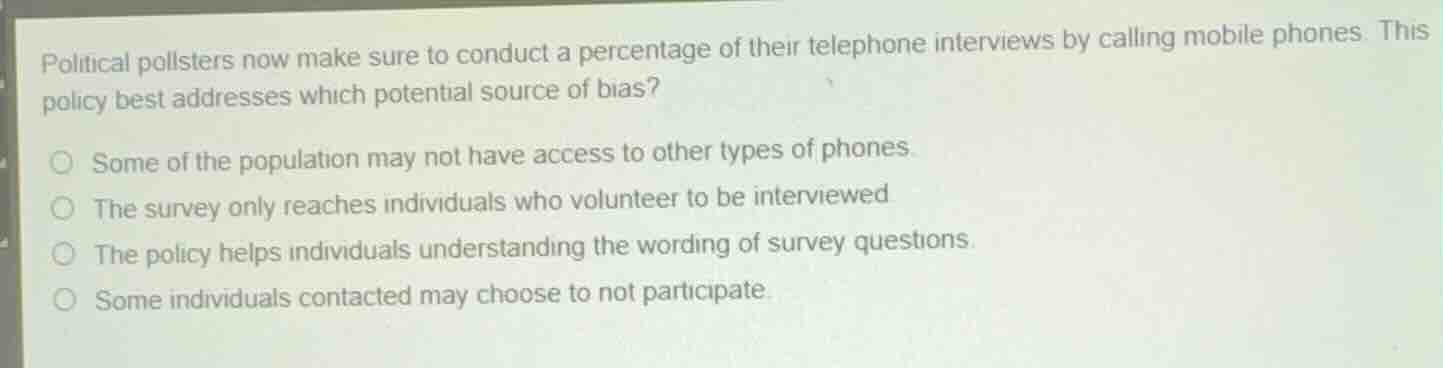
political pollsters now make sure to conduct a percentage of their telephone interviews by calling mobile phones. this policy best addresses which potential source of bias?
some of the population may not have access to other types of phones.
the survey only reaches individuals who volunteer to be interviewed.
the policy helps individuals understanding the wording of survey questions.
some individuals contacted may choose to not participate.
Analyze the polling scenario
Using the Sampling Bias Sources knowledge point
The scenario describes political pollsters conducting a percentage of their telephone interviews by calling mobile phones. Historically, telephone surveys relied heavily or exclusively on landline telephone numbers.
Evaluate the options against sampling bias
Using the Sampling Bias Sources knowledge point
- Option 1 ("Some of the population may not have access to other types of phones"): Many people, especially younger demographics, only own mobile phones and do not have landlines. Excluding mobile phones creates undercoverage bias because a segment of the population cannot be reached. Calling mobile phones directly addresses this coverage gap.
- Option 2 ("The survey only reaches individuals who volunteer to be interviewed"): This describes voluntary response bias, which is not resolved simply by changing the type of phone line called.
- Option 3 ("The policy helps individuals understanding the wording of survey questions"): This relates to response bias or question wording, which is unaffected by the technology used to place the call.
- Option 4 ("Some individuals contacted may choose to not participate"): This describes nonresponse bias, which remains an issue regardless of whether a landline or mobile phone is dialed.

Snap & solve any problem in the app
Get step-by-step solutions on Sovi AI
Photo-based solutions with guided steps
Explore more problems and detailed explanations
- (A) Some of the population may not have access to other types of phones. (Correct answer)
- (B) The survey only reaches individuals who volunteer to be interviewed.
- (C) The policy helps individuals understanding the wording of survey questions.
- (D) Some individuals contacted may choose to not participate.