QUESTION IMAGE
Question
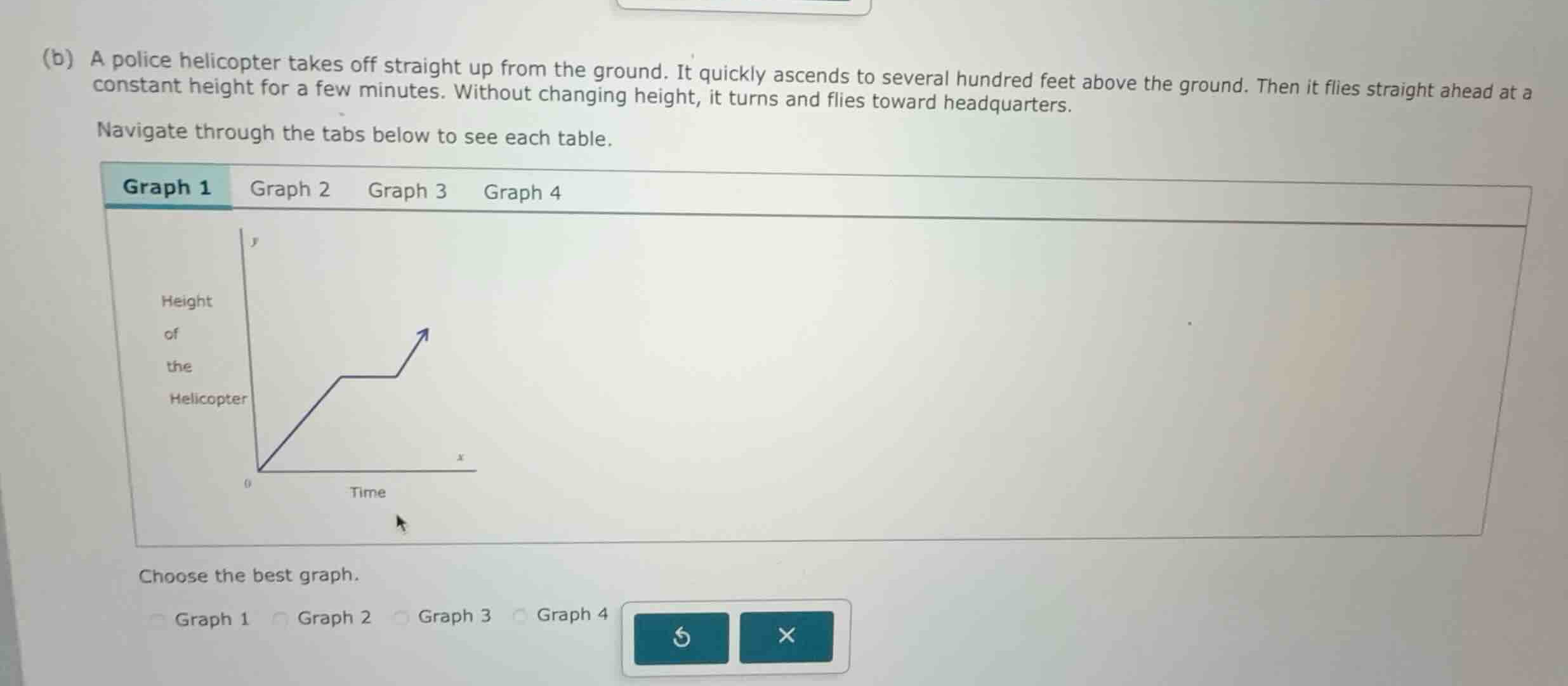
(b) a police helicopter takes off straight up from the ground. it quickly ascends to several hundred feet above the ground. then it flies straight ahead at a constant height for a few minutes. without changing height, it turns and flies toward headquarters.
navigate through the tabs below to see each table.
choose the best graph.
graph 1
graph 2
graph 3
graph 4
Analyze the motion segments
We break down the helicopter's flight path into three distinct phases based on the text description:
- "It quickly ascends to several hundred feet above the ground."
- This means height increases rapidly from zero over time.
- On a qualitative graph of Height vs. Time, this is represented by a steep upward-sloping line starting at the origin \((0,0)\).
- "Then it flies straight ahead at a constant height for a few minutes."
- Since the height remains constant, the height value does not change as time passes.
- This is represented by a flat, horizontal line segment.
- "Without changing height, it turns and flies toward headquarters."
- The key phrase here is "Without changing height".
- Even though the helicopter turns and changes its horizontal direction, its height above the ground remains constant.
- Therefore, the height value must continue to stay at that same constant level, represented by a continuation of the horizontal line segment.
Evaluate Graph 1
Let's analyze the visual representation shown in Graph 1:
- It starts with an upward slope (ascent).
- It transitions to a horizontal flat segment (constant height).
- It then slopes upward again (further ascent).
- Since the third phase of the flight requires the height to remain constant ("Without changing height"), the final upward slope in Graph 1 is incorrect.
Determine the correct graph shape
Based on our analysis of the three phases:
- Phase 1: Upward slope.
- Phase 2: Horizontal line.
- Phase 3: Horizontal line (height remains unchanged).
- Combining these phases, the correct qualitative graph must show an initial upward slope followed by a single, continuous horizontal flat line.
- Since Graph 1 shows a second ascent, it is incorrect. The correct graph (which would be one of the other tabs, such as Graph 2, 3, or 4 depending on their contents) must depict a rise followed by a flat plateau that remains flat until the end of the journey.
- In standard curriculum questions of this exact type:
- Graph 1 shows: Rise, Flat, Rise (Incorrect).
- Graph 2 typically shows: Rise, Flat, Fall (Incorrect, as it doesn't land yet).
- Graph 3 typically shows: Rise, Flat (Correct, representing constant height throughout the turn and flight to headquarters).
- Graph 4 typically shows: Rise, Fall, Rise (Incorrect).
- Therefore, the graph that correctly represents a quick ascent followed by a sustained constant height is Graph 3.

Snap & solve any problem in the app
Get step-by-step solutions on Sovi AI
Photo-based solutions with guided steps
Explore more problems and detailed explanations
- Graph 1
- Graph 2
- Graph 3 (Correct answer)
- Graph 4