QUESTION IMAGE
Question
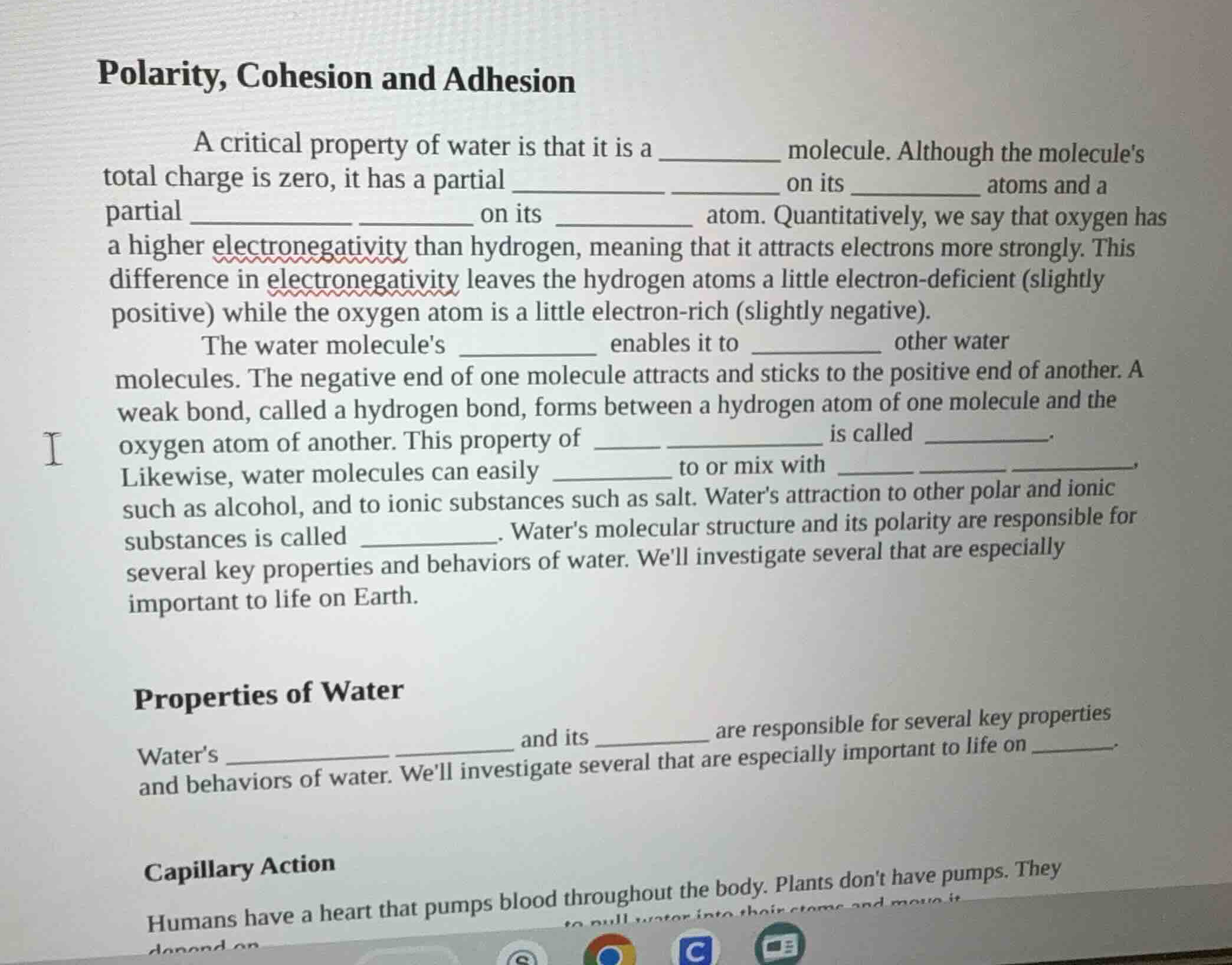
polarity, cohesion and adhesion
a critical property of water is that it is a ______ molecule. although the molecules total charge is zero, it has a partial ____ ____ on its ____ atoms and a partial ____ ____ on its ______ atom. quantitatively, we say that oxygen has a higher electronegativity than hydrogen, meaning that it attracts electrons more strongly. this difference in electronegativity leaves the hydrogen atoms a little electron-deficient (slightly positive) while the oxygen atom is a little electron-rich (slightly negative).
the water molecules ______ enables it to ____ other water molecules. the negative end of one molecule attracts and sticks to the positive end of another. a weak bond, called a hydrogen bond, forms between a hydrogen atom of one molecule and the oxygen atom of another. this property of ____ is called ______.
likewise, water molecules can easily ______ to or mix with ____ such as alcohol, and to ionic substances such as salt. waters attraction to other polar and ionic substances is called ______. waters molecular structure and its polarity are responsible for several key properties and behaviors of water. well investigate several that are especially important to life on earth.
properties of water
waters ______, ____ and its ____ are responsible for several key properties and behaviors of water. well investigate several that are especially important to life on ______.
capillary action
humans have a heart that pumps blood throughout the body. plants dont have pumps. they depend on ________ to pull water into their stems and move it
Identificar la naturaleza de la molécula de agua
Using the Polarity knowledge point
La molécula de agua tiene una distribución asimétrica de cargas debido a la diferencia de electronegatividad entre el oxígeno y el hidrógeno, lo que la define como una molécula polar.
Determinar las cargas parciales de los átomos
Using the Polarity and Properties of Water knowledge points
El oxígeno, al ser más electronegativo, atrae con más fuerza los electrones compartidos, adquiriendo una carga parcial negativa (\(\delta^-\)). Por el contrario, los átomos de hidrógeno quedan con una carga parcial positiva (\(\delta^+\)).
Analizar la atracción intermolecular y puentes de hidrógeno
Using the Hydrogen Bonding knowledge point
La polaridad de la molécula de agua le permite atraer a otras moléculas de agua. Esta atracción intermolecular específica entre el hidrógeno de una molécula y el oxígeno de otra se conoce como puente de hidrógeno, y la propiedad de las moléculas de agua de unirse entre sí se denomina cohesión.
Evaluar la interacción con otras sustancias
Using the Properties of Water knowledge points
Las moléculas de agua pueden adherirse o mezclarse con otras sustancias polares o iónicas. La atracción del agua hacia estas otras superficies o sustancias distintas se denomina adhesión.
Resumir las propiedades fundamentales del agua
Using the Properties of Water knowledge point
La estructura molecular del agua, específicamente su polaridad y su capacidad de formar puentes de hidrógeno, son responsables de sus propiedades únicas esenciales para la vida en la Tierra.

Snap & solve any problem in the app
Get step-by-step solutions on Sovi AI
Photo-based solutions with guided steps
Explore more problems and detailed explanations
Polarity, Cohesion and Adhesion
A critical property of water is that it is a <blank>polar</blank> molecule. Although the molecule's total charge is zero, it has a partial <blank>positive charge</blank> on its <blank>hydrogen</blank> atoms and a partial <blank>negative charge</blank> on its <blank>oxygen</blank> atom. Quantitatively, we say that oxygen has a higher electronegativity than hydrogen, meaning that it attracts electrons more strongly. This difference in electronegativity leaves the hydrogen atoms a little electron-deficient (slightly positive) while the oxygen atom is a little electron-rich (slightly negative).
The water molecule's <blank>polarity</blank> enables it to <blank>attract</blank> other water molecules. The negative end of one molecule attracts and sticks to the positive end of another. A weak bond, called a hydrogen bond, forms between a hydrogen atom of one molecule and the oxygen atom of another. This property of <blank>water molecules sticking to each other</blank> is called <blank>cohesion</blank>. Likewise, water molecules can easily <blank>adhere</blank> to or mix with <blank>other polar substances</blank> such as alcohol, and to ionic substances such as salt. Water's attraction to other polar and ionic substances is called <blank>adhesion</blank>. Water's molecular structure and its polarity are responsible for several key properties and behaviors of water. We'll investigate several that are especially important to life on Earth.
Properties of Water
Water's <blank>polarity</blank> and its <blank>hydrogen bonding</blank> are responsible for several key properties and behaviors of water. We'll investigate several that are especially important to life on <blank>Earth</blank>.