QUESTION IMAGE
Question
physique terminale c et d
d) exprimer la distance kk en fonction de (m), (q), (b) et (v_k).
- dès que la particule sort du champ magnétique, la d.d.p. devient négative.
a) quelle est alors la nature du mouvement de la particule en allant de (p_2) à (p_1) ?
b) donner lénergie cinétique de la particule en l en fonction de (m), (q), (v_k) et (u).
c) quel est lintérêt du passage de la particule dans le champ électrique ?
- a partir de l la particule décrit la trajectoire ((c_2)) et sort du champ magnétique par l.
a) exprimer ll en fonction de (m), (q), (b), (u) et (v_k). comparer ll et kk.
b) calculer les temps (t_1) et (t_2) mis pour parcourir respectivement ((c_1)) et ((c_2)).
exercice 14 : bac 2007
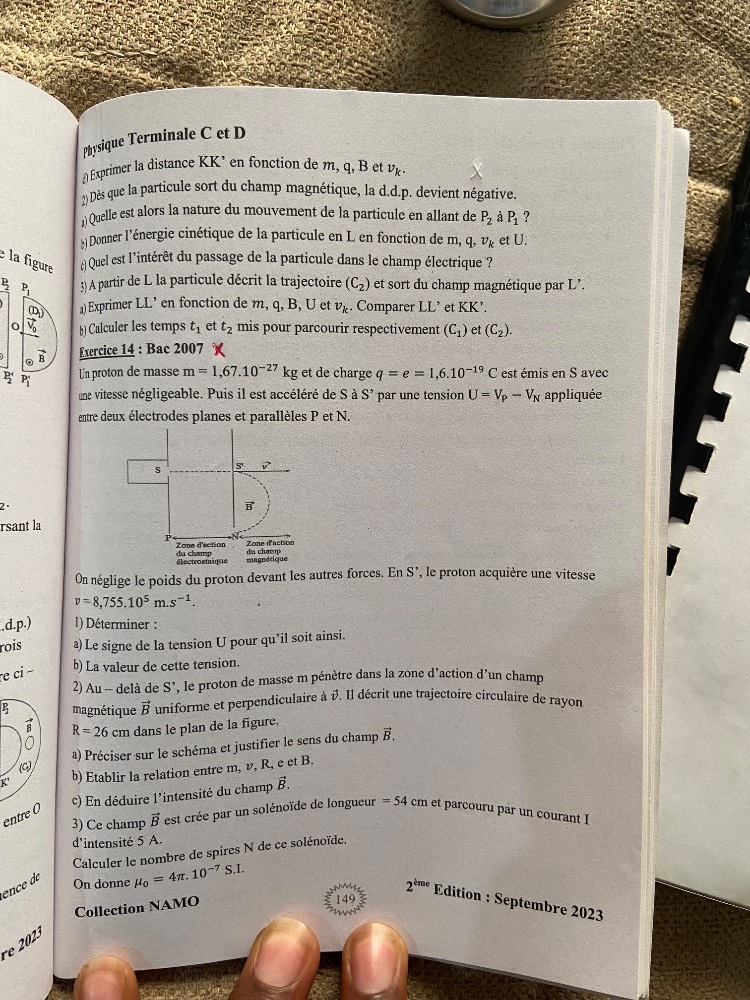
un proton de masse (m = 1,67.10^{-27}\text{ kg}) et de charge (q = e = 1,6.10^{-19}\text{ c}) est émis en s avec une vitesse négligeable. puis il est accéléré de s à s par une tension (u = v_p - v_n) appliquée entre deux électrodes planes et parallèles p et n.
on néglige le poids du proton devant les autres forces. en s, le proton acquière une vitesse (v = 8,755.10^5\text{ m.s}^{-1}).
- déterminer :
a) le signe de la tension u pour quil soit ainsi.
b) la valeur de cette tension.
- au-delà de s, le proton de masse m pénètre dans la zone daction dun champ magnétique (\vec{b}) uniforme et perpendiculaire à (\vec{v}). il décrit une trajectoire circulaire de rayon (r = 26\text{ cm}) dans le plan de la figure.
a) préciser sur le schéma et justifier le sens du champ (\vec{b}).
b) etablir la relation entre (m), (v), (r), (e) et (b).
c) en déduire lintensité du champ (\vec{b}).
- ce champ (\vec{b}) est créé par un solénoïde de longueur (= 54\text{ cm}) et parcouru par un courant i dintensité (5\text{ a}).
calculer le nombre de spires n de ce solénoïde.
on donne (\mu_0 = 4\pi . 10^{-7}\text{ s.i.})
🆕 New Concept Discovered: Charged Particles in Electric and Magnetic Fields
Charged particles accelerate in electric fields and curve in magnetic fields.
Step 1: Sign of the voltage \(U\)
For a positively charged proton (\(q = e > 0\)) to be accelerated from plate \(P\) (at potential \(V_P\)) to plate \(N\) (at potential \(V_N\)), the electric force must point in the direction of motion (from \(P\) to \(N\)).
The electric field \(\vec{E}\) points from high potential to low potential. Since \(q > 0\), the force \(\vec{F}_e = q\vec{E}\) is in the same direction as \(\vec{E}\). Therefore, the potential at \(P\) must be higher than at \(N\):
Thus, the voltage \(U = V_P - V_N\) must be positive:
Step 2: Value of the voltage \(U\)
Applying the work-energy theorem between \(S\) (where \(v_S \approx 0\)) and \(S'\) (where \(v = 8.755 \cdot 10^5\text{ m}\cdot\text{s}^{-1}\)):
Solving for \(U\):
Substitute the given values:
- \(m = 1.67 \cdot 10^{-27}\text{ kg}\)
- \(q = 1.6 \cdot 10^{-19}\text{ C}\)
- \(v = 8.755 \cdot 10^5\text{ m}\cdot\text{s}^{-1}\)
Step 3: Direction of the magnetic field \(\vec{B}\)
The magnetic force acting on the moving proton is given by the Lorentz force:
- The proton is positively charged (\(q > 0\)), so \(\vec{F}_m\) has the same direction as \(\vec{v} \times \vec{B}\).
- At point \(S'\), the velocity \(\vec{v}\) is directed horizontally to the right.
- The trajectory curves downwards, meaning the magnetic force \(\vec{F}_m\) is directed downwards.
- Using the right-hand rule (fingers along \(\vec{v}\), curl towards \(\vec{B}\), thumb points in the direction of \(\vec{F}_m\)), the magnetic field \(\vec{B}\) must be directed out of the page (represented by \(\odot\)).
Step 4: Relation between \(m\), \(v\), \(R\), \(e\), and \(B\)
The magnetic force acts as the centripetal force keeping the proton in its circular path:
Simplifying by dividing both sides by \(v\):
Step 5: Intensity of the magnetic field \(B\)
Isolating \(B\) from the previous relation:
Substitute the given values:
- \(R = 26\text{ cm} = 0.26\text{ m}\)
Step 6: Number of turns \(N\) of the solenoid
The magnetic field inside a long solenoid is given by:
Solving for \(N\):
Substitute the given values:
- \(L = 54\text{ cm} = 0.54\text{ m}\)
- \(I = 5\text{ A}\)
- \(\mu_0 = 4\pi \cdot 10^{-7}\text{ S.I.}\)

Snap & solve any problem in the app
Get step-by-step solutions on Sovi AI
Photo-based solutions with guided steps
Explore more problems and detailed explanations
1)
a) Sign of \(U\): \(U > 0\) (positive)
b) Value of \(U\): \(U \approx 4000\text{ V}\) (or \(4\text{ kV}\))
2)
a) Direction of \(\vec{B}\): Out of the page (\(\odot\)) because the magnetic force \(\vec{F}_m\) is directed downwards to curve the trajectory of the positive charge \(q > 0\) moving to the right.
b) Relation: \(e \cdot B = \frac{m v}{R}\)
c) Intensity of \(B\): \(B \approx 0.035\text{ T}\)
- Number of turns \(N\): \(N \approx 3016\text{ turns}\)