QUESTION IMAGE
Question
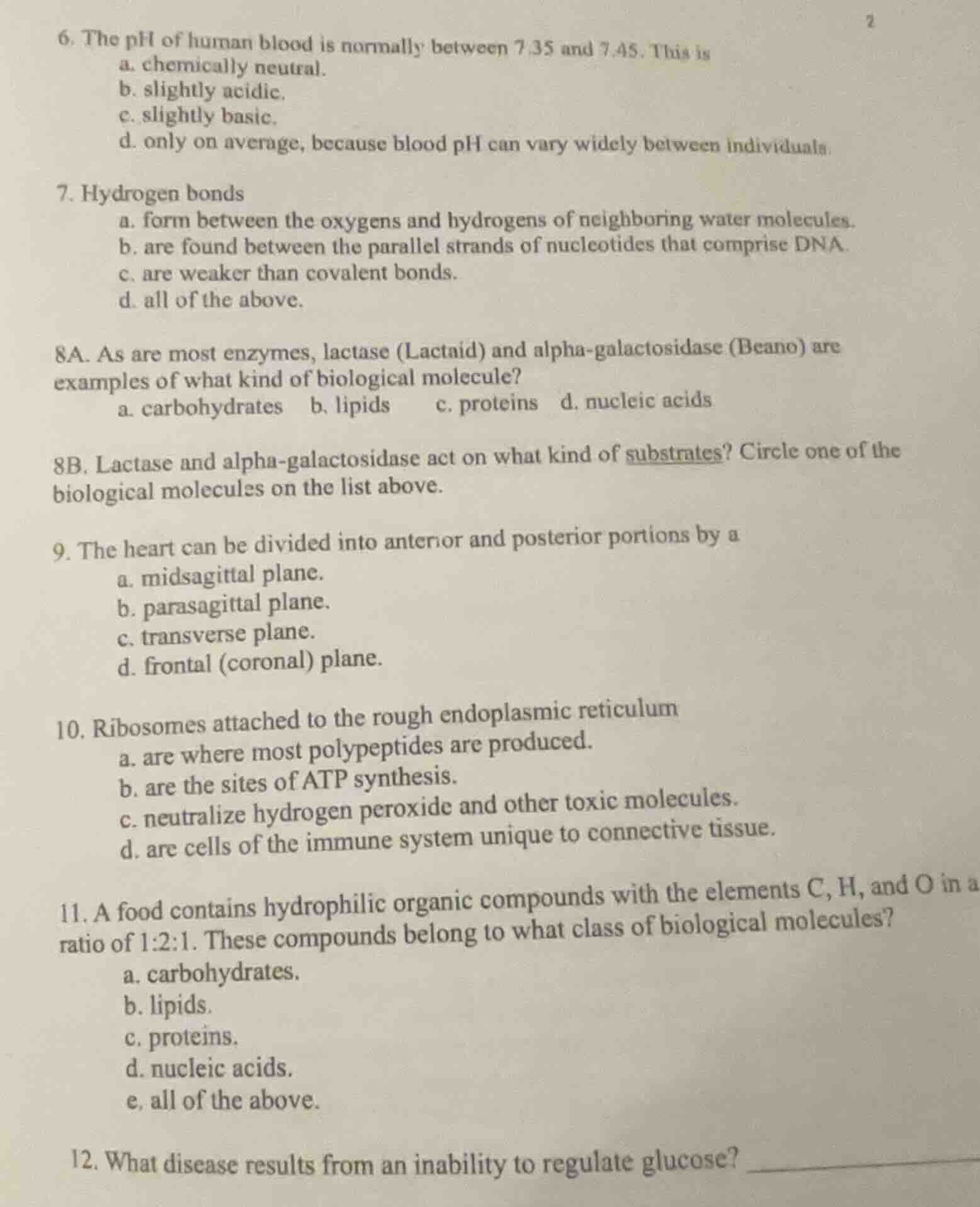
- the ph of human blood is normally between 7.35 and 7.45. this is
a. chemically neutral.
b. slightly acidic.
c. slightly basic.
d. only on average, because blood ph can vary widely between individuals.
- hydrogen bonds
a. form between the oxygens and hydrogens of neighboring water molecules.
b. are found between the parallel strands of nucleotides that comprise dna.
c. are weaker than covalent bonds.
d. all of the above.
8a. as are most enzymes, lactase (lactaid) and alpha-galactosidase (beano) are examples of what kind of biological molecule?
a. carbohydrates b. lipids c. proteins d. nucleic acids
8b. lactase and alpha-galactosidase act on what kind of substrates? circle one of the biological molecules on the list above.
- the heart can be divided into anterior and posterior portions by a
a. midsagittal plane.
b. parasagittal plane.
c. transverse plane.
d. frontal (coronal) plane.
- ribosomes attached to the rough endoplasmic reticulum
a. are where most polypeptides are produced.
b. are the sites of atp synthesis.
c. neutralize hydrogen peroxide and other toxic molecules.
d. are cells of the immune system unique to connective tissue.
- a food contains hydrophilic organic compounds with the elements c, h, and o in a ratio of 1:2:1. these compounds belong to what class of biological molecules?
a. carbohydrates.
b. lipids.
c. proteins.
d. nucleic acids.
e. all of the above.
- what disease results from an inability to regulate glucose? _________
Analyze pH of human blood (Question 6)
A pH of 7.0 is neutral. Values below 7.0 are acidic, and values above 7.0 are basic (alkaline). Since human blood pH is normally between 7.35 and 7.45, it is slightly above 7.0, making it slightly basic.
Analyze hydrogen bonds (Question 7)
Hydrogen bonds form between the partially negative oxygen of one water molecule and the partially positive hydrogen of an adjacent water molecule. They also form between complementary nitrogenous bases (nucleotide strands) in DNA. Furthermore, hydrogen bonds are intermolecular forces that are significantly weaker than covalent bonds. Therefore, all statements are correct.
Analyze enzymes and substrates (Questions 8A & 8B)
Enzymes, including lactase and alpha-galactosidase, are proteins. Lactase breaks down lactose, and alpha-galactosidase breaks down complex sugars (like melibiose, raffinose, and stachyose). Both lactose and these complex sugars are carbohydrates.
Analyze anatomical planes (Question 9)
The frontal (or coronal) plane divides the body or an organ vertically into anterior (front) and posterior (back) portions.
Analyze ribosomes on rough ER (Question 10)
Ribosomes attached to the rough endoplasmic reticulum are primarily responsible for synthesizing proteins (polypeptides) that are destined for membranes, lysosomal organelles, or export from the cell.
Analyze organic compound ratio (Question 11)
Organic compounds containing carbon, hydrogen, and oxygen in a 1:2:1 ratio (\(\text{CH}_2\text{O}\)) are carbohydrates (monosaccharides).
Identify glucose regulation disease (Question 12)
An inability to regulate blood glucose levels properly results in the metabolic disease known as diabetes (specifically diabetes mellitus).

Snap & solve any problem in the app
Get step-by-step solutions on Sovi AI
Photo-based solutions with guided steps
Explore more problems and detailed explanations
Question 6
- a. chemically neutral.
- b. slightly acidic.</mcq-correct>
- c. slightly basic. (Correct answer)
<mcq-option>d. only on average, because blood pH can vary widely between individuals.
Question 7
- a. form between the oxygens and hydrogens of neighboring water molecules.
- b. are found between the parallel strands of nucleotides that comprise DNA.
- c. are weaker than covalent bonds.
- d. all of the above. (Correct answer)
Question 8A
- a. carbohydrates
- b. lipids
- c. proteins (Correct answer)
- d. nucleic acids
Question 8B
The substrate class is <blank>carbohydrates</blank>.
Question 9
- a. midsagittal plane.
- b. parasagittal plane.
- c. transverse plane.
- d. frontal (coronal) plane. (Correct answer)
Question 10
- a. are where most polypeptides are produced. (Correct answer)
- b. are the sites of ATP synthesis.
- c. neutralize hydrogen peroxide and other toxic molecules.
- d. are cells of the immune system unique to connective tissue.
Question 11
- a. carbohydrates. (Correct answer)
- b. lipids.
- c. proteins.
- d. nucleic acids.
- e. all of the above.
Question 12
What disease results from an inability to regulate glucose? <blank>Diabetes (Diabetes mellitus)</blank>