QUESTION IMAGE
Question
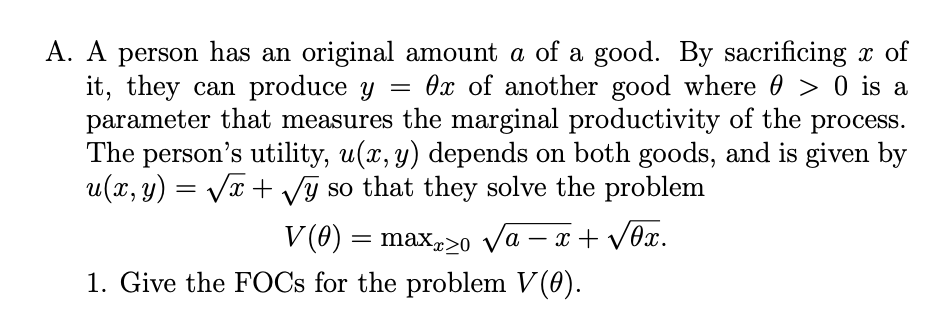
a. a person has an original amount (a) of a good. by sacrificing (x) of it, they can produce (y = \theta x) of another good where (\theta > 0) is a parameter that measures the marginal productivity of the process. the persons utility, (u(x,y)) depends on both goods, and is given by (u(x,y) = \sqrt{x} + \sqrt{y}) so that they solve the problem
\\v(\theta) = \max_{x \ge 0} \sqrt{a - x} + \sqrt{\theta x}.\\
- give the focs for the problem (v(\theta)).
🆕 New Concept Discovered: First-Order Conditions (FOC)
Finding optimal choices by setting derivatives to zero.
Step 1: Identify the objective function
The optimization problem is to maximize the utility function with respect to the decision variable \( x \):
Here, \( x \) represents the amount of the original good sacrificed, which must satisfy the constraints \( 0 \leq x \leq a \).
Step 2: Differentiate with respect to \( x \)
To find the First-Order Condition (FOC), we take the first derivative of the objective function with respect to \( x \) and set it equal to zero.
Using the chain rule:
- The derivative of \(\sqrt{a - x}\) with respect to \( x \) is:
- The derivative of \(\sqrt{\theta x}\) with respect to \( x \) is:
Step 3: Set the derivative to zero
Setting the sum of these derivatives to zero gives the first-order condition for an interior optimum:
This can be simplified by multiplying the entire equation by 2:

Snap & solve any problem in the app
Get step-by-step solutions on Sovi AI
Photo-based solutions with guided steps
Explore more problems and detailed explanations
The First-Order Condition (FOC) for an interior solution is:
which simplifies to: