QUESTION IMAGE
Question
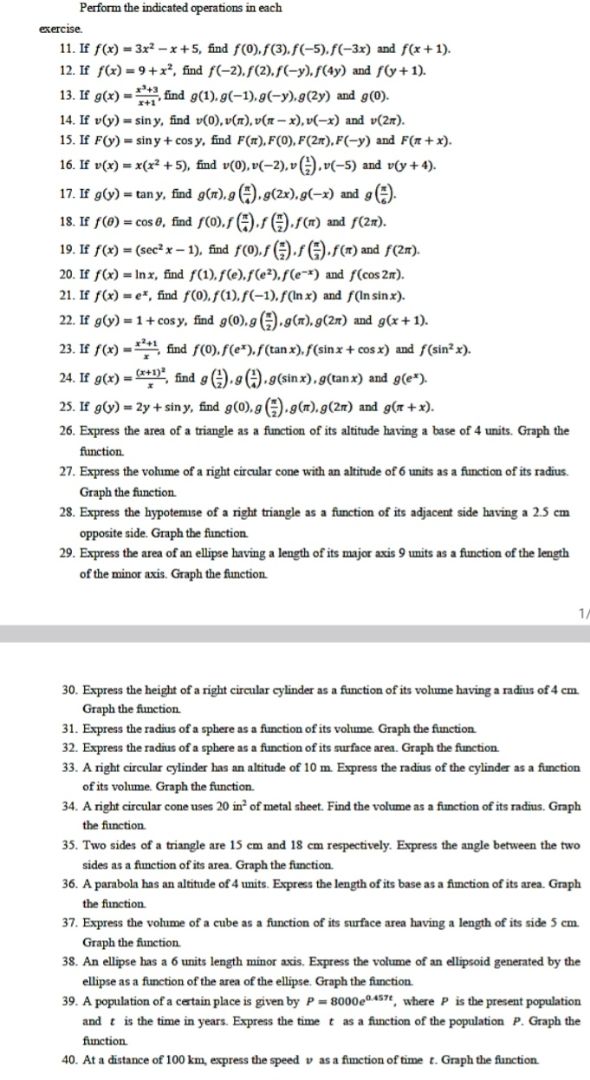
perform the indicated operations in each exercise.
- if (f(x) = 3x^2 - x + 5), find (f(0), f(3), f(-5), f(-3x)) and (f(x+1)).
- if (f(x) = 9 + x^2), find (f(-2), f(2), f(-y), f(4y)) and (f(y+1)).
- if (g(x) = \frac{x^3+3}{x+1}), find (g(1), g(-1), g(-y), g(2y)) and (g(0)).
- if (v(y) = sin y), find (v(0), v(pi), v(pi-x), v(-x)) and (v(2pi)).
- if (f(y) = sin y + cos y), find (f(pi), f(0), f(2pi), f(-y)) and (f(pi+x)).
- if (v(x) = x(x^2+5)), find (v(0), v(-2), vleft(\frac{1}{2}
ight), v(-5)) and (v(y+4)).
- if (g(y) = \tan y), find (g(pi), gleft(\frac{pi}{3}
ight), g(2x), g(-x)) and (gleft(\frac{pi}{6}
ight)).
- if (f(\theta) = cos\theta), find (f(0), fleft(\frac{pi}{4}
ight), fleft(\frac{pi}{2}
ight), f(pi)) and (f(2pi)).
- if (f(x) = (sec^2 x - 1)), find (f(0), fleft(\frac{pi}{4}
ight), fleft(\frac{pi}{3}
ight), f(pi)) and (f(2pi)).
- if (f(x) = ln x), find (f(1), f(e), f(e^2), f(e^{-x})) and (f(cos 2pi)).
- if (f(x) = e^x), find (f(0), f(1), f(-1), f(ln x)) and (f(lnsin x)).
- if (g(y) = 1 + cos y), find (g(0), gleft(\frac{pi}{2}
ight), g(pi), g(2pi)) and (g(x+1)).
- if (f(x) = \frac{x^2+1}{x}), find (f(0), f(e^x), f(\tan x), f(sin x + cos x)) and (f(sin^2 x)).
- if (g(x) = \frac{(x+1)^2}{x}), find (gleft(\frac{1}{2}
ight), gleft(\frac{a}{b}
ight), g(sin x), g(\tan x)) and (g(e^x)).
- if (g(y) = 2y + sin y), find (g(0), gleft(\frac{pi}{2}
ight), g(pi), g(2pi)) and (g(pi+x)).
- express the area of a triangle as a function of its altitude having a base of 4 units. graph the function.
- express the volume of a right circular cone with an altitude of 6 units as a function of its radius. graph the function.
- express the hypotenuse of a right triangle as a function of its adjacent side having a 2.5 cm opposite side. graph the function.
- express the area of an ellipse having a length of its major axis 9 units as a function of the length of the minor axis. graph the function.
- express the height of a right circular cylinder as a function of its volume having a radius of 4 cm. graph the function.
- express the radius of a sphere as a function of its volume. graph the function.
- express the radius of a sphere as a function of its surface area. graph the function.
- a right circular cylinder has an altitude of 10 m. express the radius of the cylinder as a function of its volume. graph the function.
- a right circular cone uses 20 in(^2) of metal sheet. find the volume as a function of its radius. graph the function.
- two sides of a triangle are 15 cm and 18 cm respectively. express the angle between the two sides as a function of its area. graph the function.
- a parabola has an altitude of 4 units. express the length of its base as a function of its area. graph the function.
- express the volume of a cube as a function of its surface area having a length of its side 5 cm. graph the function.
- an ellipse has a 6 units length minor axis. express the volume of an ellipsoid generated by the ellipse as a function of the area of the ellipse. graph the function.
- a population of a certain place is given by (p = 8000e^{0.457t}), where (p) is the present population and (t) is the time in years. express the time (t) as a function of the population (p). graph the function.
- at a distance of 100 km, express the speed (v) as a function of time (t). graph the function.
⚡ Using what you learned: representing functions (tables, graphs, equations, mappings)
Step 1: Evaluate \( f(0) \)
Substitute \( x = 0 \) into the function \( f(x) = 3x^2 - x + 5 \):
Step 2: Evaluate \( f(3) \)
Substitute \( x = 3 \) into the function:
Step 3: Evaluate \( f(-5) \)
Substitute \( x = -5 \) into the function:
Step 4: Evaluate \( f(-3x) \)
Substitute the expression \( -3x \) in place of every \( x \) in the function:
Step 5: Evaluate \( f(x + 1) \)
Substitute the expression \( x + 1 \) in place of every \( x \) in the function:
Expand the squared term and simplify:

Snap & solve any problem in the app
Get step-by-step solutions on Sovi AI
Photo-based solutions with guided steps
Explore more problems and detailed explanations
For Exercise 11, where \( f(x) = 3x^2 - x + 5 \):
- \( f(0) = 5 \)
- \( f(3) = 29 \)
- \( f(-5) = 85 \)
- \( f(-3x) = 27x^2 + 3x + 5 \)
- \( f(x + 1) = 3x^2 + 5x + 7 \)