QUESTION IMAGE
Question
past exam questions:
projectile motion (2006;3)
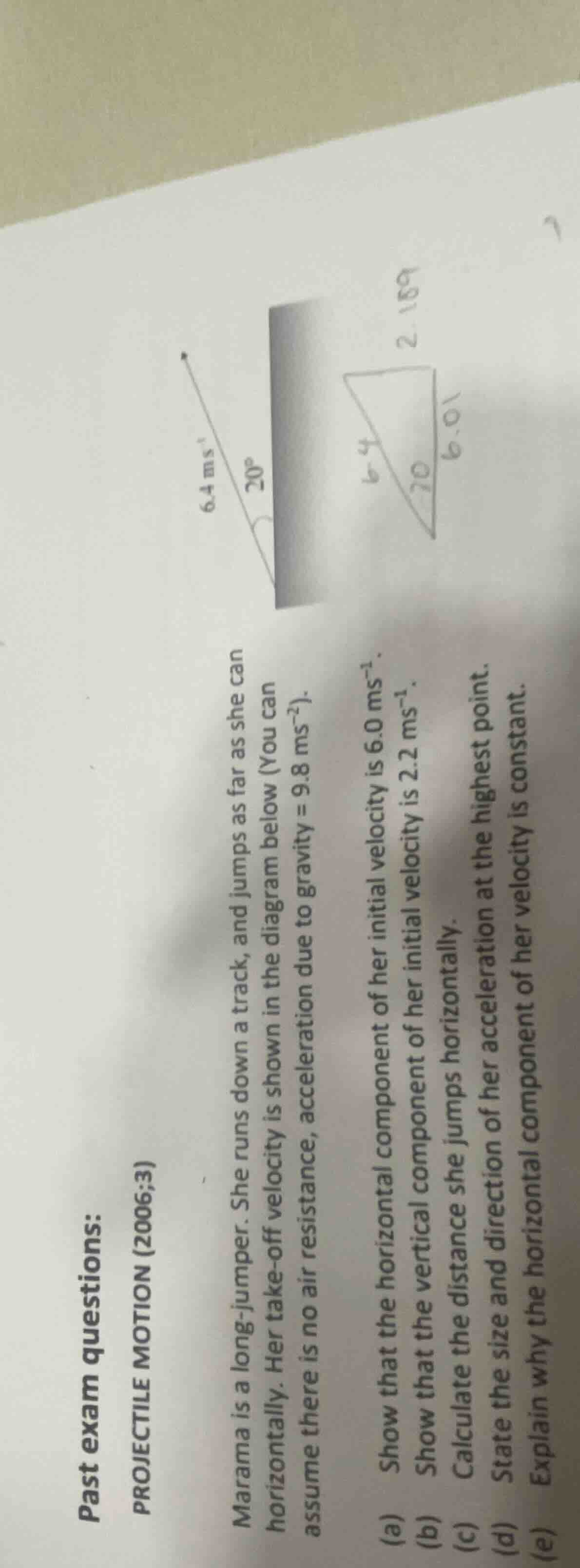
marama is a long-jumper. she runs down a track, and jumps as far as she can horizontally. her take-off velocity is shown in the diagram below (you can assume there is no air resistance, acceleration due to gravity = \\(9.8\text{ ms}^{-2}\\)).
(a) show that the horizontal component of her initial velocity is \\(6.0\text{ ms}^{-1}\\).
(b) show that the vertical component of her initial velocity is \\(2.2\text{ ms}^{-1}\\).
(c) calculate the distance she jumps horizontally.
(d) state the size and direction of her acceleration at the highest point.
(e) explain why the horizontal component of her velocity is constant.
Resolve initial velocity components
Using the Vector Components knowledge point, we calculate the horizontal and vertical components of the initial velocity \(v = 6.4\text{ ms}^{-1}\) at an angle of \(\theta = 20^\circ\):
- Horizontal component:
- Vertical component:
Calculate flight time and range
Using the Projectile Motion knowledge point, we find the total time of flight \(t\) and horizontal distance \(d\):
- The time to reach maximum height is:
- Total flight time for a symmetric trajectory:
- Horizontal distance:
Determine acceleration at highest point
Using the Projectile Motion knowledge point, gravity is the only force acting on the projectile:
- The acceleration is constant throughout the flight.
- At the highest point, the acceleration is \(9.8\text{ ms}^{-2}\) directed vertically downwards.
Explain constant horizontal velocity
Using the Projectile Motion knowledge point, we analyze the forces acting horizontally:
- There is no air resistance, so no horizontal force acts on Marama.
- According to Newton's first law, the horizontal velocity component remains constant.

Snap & solve any problem in the app
Get step-by-step solutions on Sovi AI
Photo-based solutions with guided steps
Explore more problems and detailed explanations
Question (a)
Question (b)
Question (c)
Question (d)
Size: \(9.8\text{ ms}^{-2}\)
Direction: Vertically downwards
Question (e)
Since there is no air resistance, there are no horizontal forces acting on her, meaning her horizontal acceleration is zero and her horizontal velocity remains constant.