QUESTION IMAGE
Question
d. parts of an electrochemical cell
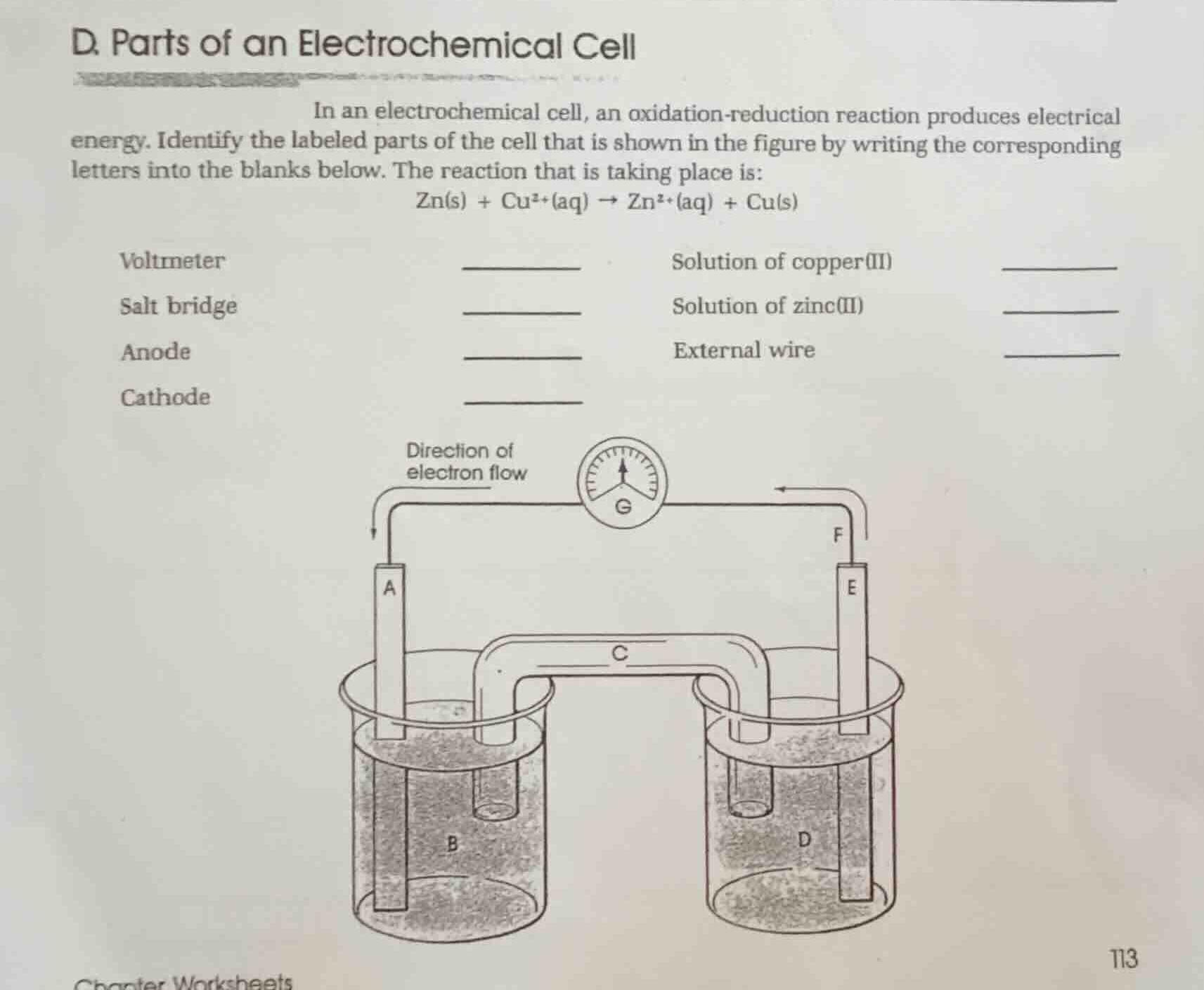
in an electrochemical cell, an oxidation-reduction reaction produces electrical energy. identify the labeled parts of the cell that is shown in the figure by writing the corresponding letters into the blanks below. the reaction that is taking place is:
\\ \text{zn(s)} + \text{cu}^{2+}\text{(aq)} \
ightarrow \text{zn}^{2+}\text{(aq)} + \text{cu(s)} \\
voltmeter _______
salt bridge _______
anode _______
cathode _______
solution of copper(ii) _______
solution of zinc(ii) _______
external wire _______
<pre_analysis>
{
"quality": "clear",
"question_count": 1,
"skills_matched": [
"step_cot",
"blank_filling_formatter",
"explain_then_answer",
"tutor",
"mastery_adaptive_brevity"
],
"needs_drawing": false,
"concepts_used": [
"Voltaic Cell Design",
"Electrode Signs"
],
"new_concepts": [
"Galvanic Cell Anatomy"
],
"current_concepts": [
"Voltaic Cell Design",
"Electrode Signs",
"Galvanic Cell Anatomy"
]
}
</pre_analysis>
<reasoning>
Identify the electron flow and electrodes
Using the Voltaic Cell Design and Electrode Signs knowledge points
The reaction is:
\[ \text{Zn(s)} + \text{Cu}^{2+}\text{(aq)}
ightarrow \text{Zn}^{2+}\text{(aq)} + \text{Cu(s)} \]
- Zinc is oxidized: \(\text{Zn(s)}
ightarrow \text{Zn}^{2+}\text{(aq)} + 2\text{e}^-\) (Anode, electrode A).
- Copper is reduced: \(\text{Cu}^{2+}\text{(aq)} + 2\text{e}^-
ightarrow \text{Cu(s)}\) (Cathode, electrode E).
- Electrons flow from anode (A) to cathode (E).
Identify the solutions and salt bridge
Using the Voltaic Cell Design knowledge point
- Solution B contains zinc ions: \(\text{Zn(II)}\) solution.
- Solution D contains copper ions: \(\text{Cu(II)}\) solution.
- Tube C connects the two half-cells: Salt bridge.
Identify the external circuit components
Using the Voltaic Cell Design knowledge point
- Component G measures voltage: Voltmeter.
- Component F is the wire connecting the electrodes: External wire.
</reasoning>
<answer>
In an electrochemical cell, an oxidation-reduction reaction produces electrical energy. Identify the labeled parts of the cell that is shown in the figure by writing the corresponding letters into the blanks below. The reaction that is taking place is:
\[ \text{Zn(s)} + \text{Cu}^{2+}\text{(aq)}
ightarrow \text{Zn}^{2+}\text{(aq)} + \text{Cu(s)} \]
Voltmeter: <blank>G</blank>
Salt bridge: <blank>C</blank>
Anode: <blank>A</blank>
Cathode: <blank>E</blank>
Solution of copper(II): <blank>D</blank>
Solution of zinc(II): <blank>B</blank>
External wire: <blank>F</blank>
</answer>
<post_analysis>
{
"subject": "Natural Science",
"question_type": "Fill-in-the-blank",
"knowledge_point": [
"Natural Science",
"Chemistry",
"Voltaic Cell Design"
]
}
</post_analysis>
Snap & solve any problem in the app
Get step-by-step solutions on Sovi AI
Photo-based solutions with guided steps
Explore more problems and detailed explanations
<pre_analysis>
{
"quality": "clear",
"question_count": 1,
"skills_matched": [
"step_cot",
"blank_filling_formatter",
"explain_then_answer",
"tutor",
"mastery_adaptive_brevity"
],
"needs_drawing": false,
"concepts_used": [
"Voltaic Cell Design",
"Electrode Signs"
],
"new_concepts": [
"Galvanic Cell Anatomy"
],
"current_concepts": [
"Voltaic Cell Design",
"Electrode Signs",
"Galvanic Cell Anatomy"
]
}
</pre_analysis>
<reasoning>
Identify the electron flow and electrodes
Using the Voltaic Cell Design and Electrode Signs knowledge points
The reaction is:
\[ \text{Zn(s)} + \text{Cu}^{2+}\text{(aq)}
ightarrow \text{Zn}^{2+}\text{(aq)} + \text{Cu(s)} \]
- Zinc is oxidized: \(\text{Zn(s)}
ightarrow \text{Zn}^{2+}\text{(aq)} + 2\text{e}^-\) (Anode, electrode A).
- Copper is reduced: \(\text{Cu}^{2+}\text{(aq)} + 2\text{e}^-
ightarrow \text{Cu(s)}\) (Cathode, electrode E).
- Electrons flow from anode (A) to cathode (E).
Identify the solutions and salt bridge
Using the Voltaic Cell Design knowledge point
- Solution B contains zinc ions: \(\text{Zn(II)}\) solution.
- Solution D contains copper ions: \(\text{Cu(II)}\) solution.
- Tube C connects the two half-cells: Salt bridge.
Identify the external circuit components
Using the Voltaic Cell Design knowledge point
- Component G measures voltage: Voltmeter.
- Component F is the wire connecting the electrodes: External wire.
</reasoning>
<answer>
In an electrochemical cell, an oxidation-reduction reaction produces electrical energy. Identify the labeled parts of the cell that is shown in the figure by writing the corresponding letters into the blanks below. The reaction that is taking place is:
\[ \text{Zn(s)} + \text{Cu}^{2+}\text{(aq)}
ightarrow \text{Zn}^{2+}\text{(aq)} + \text{Cu(s)} \]
Voltmeter: <blank>G</blank>
Salt bridge: <blank>C</blank>
Anode: <blank>A</blank>
Cathode: <blank>E</blank>
Solution of copper(II): <blank>D</blank>
Solution of zinc(II): <blank>B</blank>
External wire: <blank>F</blank>
</answer>
<post_analysis>
{
"subject": "Natural Science",
"question_type": "Fill-in-the-blank",
"knowledge_point": [
"Natural Science",
"Chemistry",
"Voltaic Cell Design"
]
}
</post_analysis>