QUESTION IMAGE
Question
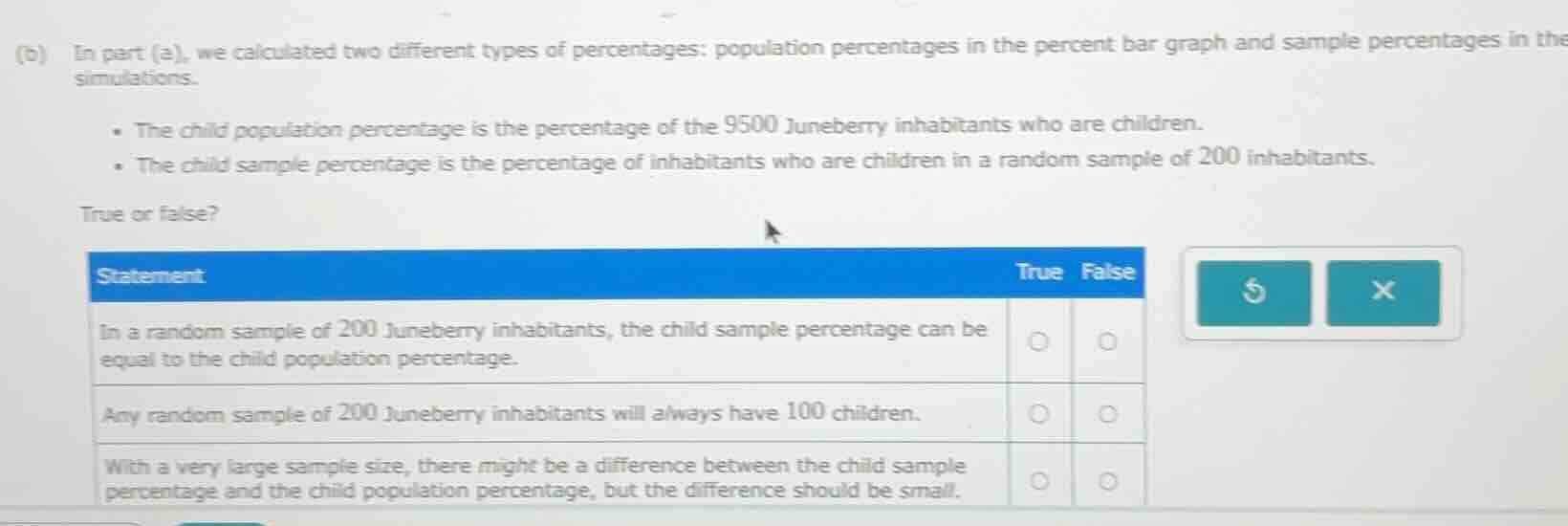
(b) in part (a), we calculated two different types of percentages: population percentages in the percent bar graph and sample percentages in the simulations.
- the child population percentage is the percentage of the 9500 juneberry inhabitants who are children.
- the child sample percentage is the percentage of inhabitants who are children in a random sample of 200 inhabitants.
true or false?
| statement | true | false |
|---|---|---|
| any random sample of 200 juneberry inhabitants will always have 100 children. | ○ | ○ |
| with a very large sample size, there might be a difference between the child sample percentage and the child population percentage, but the difference should be small. | ○ | ○ |
First Statement: "In a random sample of 200 Juneberry inhabitants, the child sample percentage can be equal to the child population percentage."
A sample is a subset of the population. By chance, a random sample can have a percentage (proportion) of a group (children here) that matches the population's percentage. For example, if the population has 20% children, a random sample could also have 20% children due to random selection aligning with the population's characteristics. So this statement is true.
Second Statement: "Any random sample of 200 Juneberry inhabitants will always have 100 children."
Random samples vary. The number of children in a sample depends on the population's child percentage and randomness. If the population's child percentage isn't 50% (since 100 out of 200 is 50%), the sample won't have 100 children. Even if it were 50%, randomness means samples can deviate (e.g., 98, 102 children). So "always" having 100 is false.
Third Statement: "With a very large sample size, there might be a difference between the child sample percentage and the child population percentage, but the difference should be small."
The Law of Large Numbers says larger samples tend to approximate the population. While the sample percentage might not equal the population percentage (due to randomness), the difference (sampling error) becomes small with large samples. So the statement (acknowledging a possible small difference) is true.

Snap & solve any problem in the app
Get step-by-step solutions on Sovi AI
Photo-based solutions with guided steps
Explore more problems and detailed explanations
- In a random sample of 200 Juneberry inhabitants, the child sample percentage can be equal to the child population percentage. - True
- Any random sample of 200 Juneberry inhabitants will always have 100 children. - False
- With a very large sample size, there might be a difference between the child sample percentage and the child population percentage, but the difference should be small. - True