QUESTION IMAGE
Question
part a
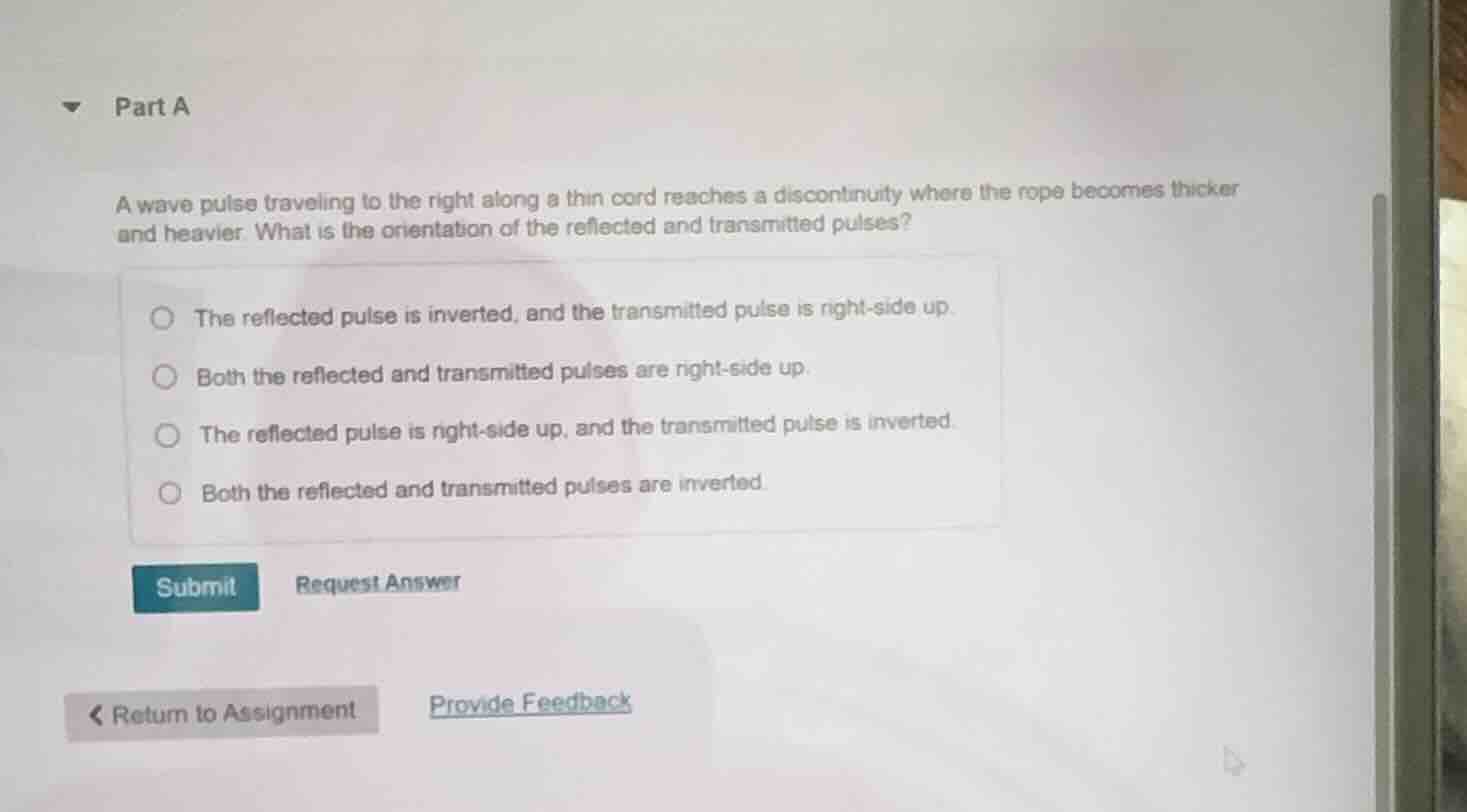
a wave pulse traveling to the right along a thin cord reaches a discontinuity where the rope becomes thicker and heavier. what is the orientation of the reflected and transmitted pulses?
- the reflected pulse is inverted, and the transmitted pulse is right-side up.
- both the reflected and transmitted pulses are right-side up.
- the reflected pulse is right-side up, and the transmitted pulse is inverted.
- both the reflected and transmitted pulses are inverted.
Analyze boundary conditions at a light-to-heavy interface
When a wave pulse travels from a lighter medium (thin cord) to a heavier medium (thicker, heavier rope), the boundary acts like a fixed end because the heavier medium has greater inertia and resists displacement.
Determine the orientation of the reflected pulse
For a wave reflecting off a boundary with a denser/heavier medium (fixed-end reflection), the reflected pulse undergoes a \(180^\circ\) phase shift, meaning it is inverted.
Determine the orientation of the transmitted pulse
A transmitted wave pulse never undergoes a phase change at a boundary, regardless of whether the transition is to a lighter or heavier medium. Therefore, the transmitted pulse remains right-side up.

Snap & solve any problem in the app
Get step-by-step solutions on Sovi AI
Photo-based solutions with guided steps
Explore more problems and detailed explanations
- The reflected pulse is inverted, and the transmitted pulse is right-side up. (Correct answer)
- Both the reflected and transmitted pulses are right-side up.
- The reflected pulse is right-side up, and the transmitted pulse is inverted.
- Both the reflected and transmitted pulses are inverted.