QUESTION IMAGE
Question
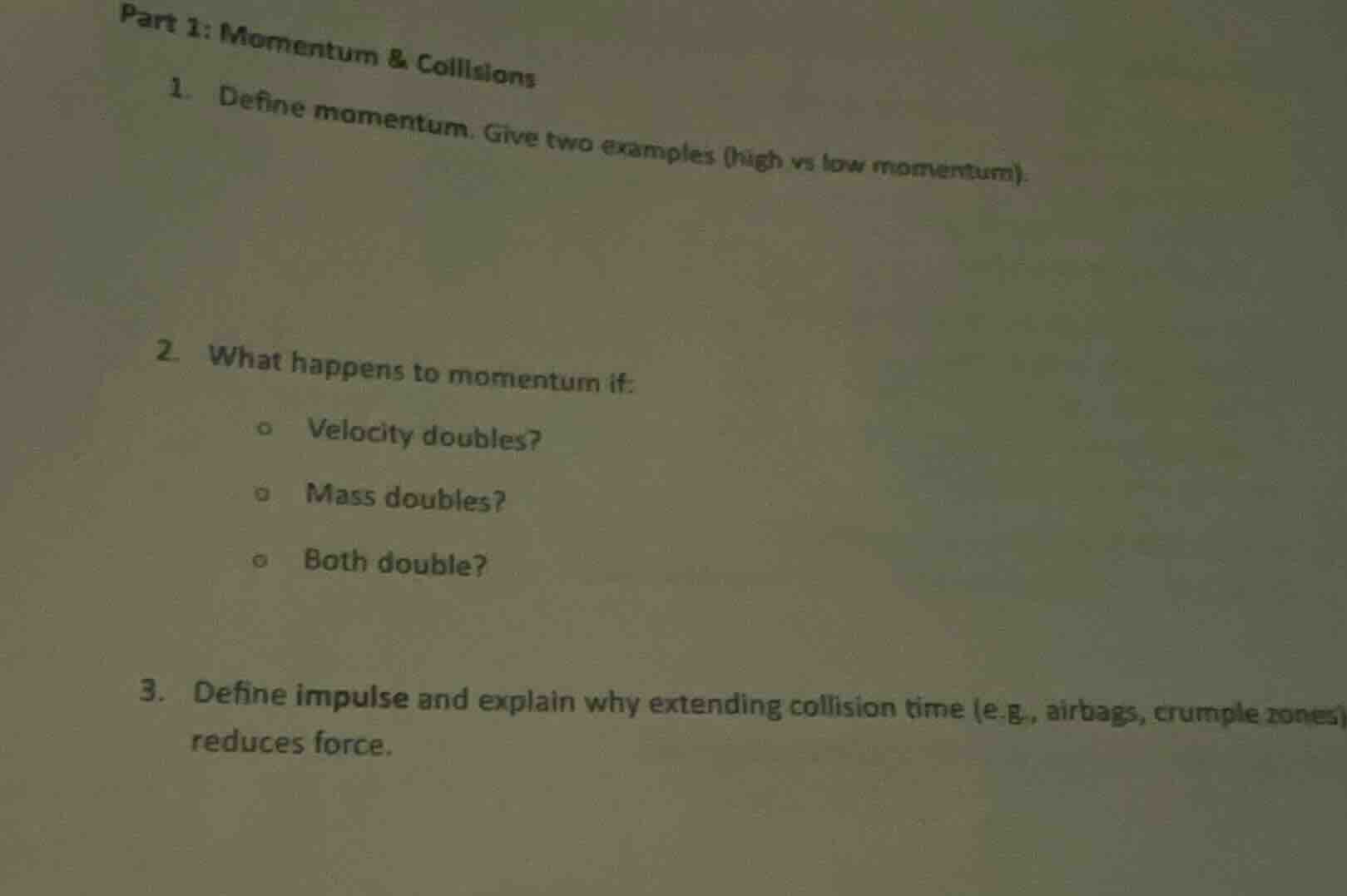
part 1: momentum & collisions
- define momentum. give two examples (high vs low momentum).
- what happens to momentum if:
- velocity doubles?
- mass doubles?
- both double?
- define impulse and explain why extending collision time (e.g., airbags, crumple zones) reduces force.
<pre_analysis>
{
"quality": "clear",
"question_count": 3,
"skills_matched": [
"step_cot",
"explain_then_answer",
"quick"
],
"needs_drawing": false,
"concepts_used": [
"Newtonian Mechanics",
"Impulse-Momentum Theorem",
"Collision Safety"
],
"new_concepts": [
"Momentum Definition",
"Impulse Definition"
],
"current_concepts": [
"Newtonian Mechanics",
"Impulse-Momentum Theorem",
"Collision Safety",
"Momentum Definition",
"Impulse Definition"
]
}
</pre_analysis>
<reasoning>
Define momentum and provide examples
\[
\]
Analyze proportional changes in momentum
\[
\]
Define impulse and analyze impact force reduction
\[
\]
</reasoning>
<answer>
Question 1
Momentum is the product of an object's mass and its velocity, represented by the formula \(p = mv\).
- High momentum example: A heavy freight train moving at high speed.
- Low momentum example: A slow-rolling tennis ball.
Question 2
- Velocity doubles: Momentum doubles (\(2p\)).
- Mass doubles: Momentum doubles (\(2p\)).
- Both double: Momentum quadruples (\(4p\)).
Question 3
Impulse is the product of the average force applied to an object and the time interval over which it acts, equal to the change in momentum (\(J = F\Delta t = \Delta p\)). Extending the collision time (\(\Delta t\)) reduces the impact force (\(F\)) because the required change in momentum (\(\Delta p\)) is spread over a longer duration, as shown by \(F = \frac{\Delta p}{\Delta t}\).
</answer>
<post_analysis>
{
"subject": "Natural Science",
"question_type": "Multi-part",
"knowledge_point": [
"Natural Science",
"Physics",
"Momentum and Impulse"
]
}
</post_analysis>
Snap & solve any problem in the app
Get step-by-step solutions on Sovi AI
Photo-based solutions with guided steps
Explore more problems and detailed explanations
<pre_analysis>
{
"quality": "clear",
"question_count": 3,
"skills_matched": [
"step_cot",
"explain_then_answer",
"quick"
],
"needs_drawing": false,
"concepts_used": [
"Newtonian Mechanics",
"Impulse-Momentum Theorem",
"Collision Safety"
],
"new_concepts": [
"Momentum Definition",
"Impulse Definition"
],
"current_concepts": [
"Newtonian Mechanics",
"Impulse-Momentum Theorem",
"Collision Safety",
"Momentum Definition",
"Impulse Definition"
]
}
</pre_analysis>
<reasoning>
Define momentum and provide examples
\[
\]
Analyze proportional changes in momentum
\[
\]
Define impulse and analyze impact force reduction
\[
\]
</reasoning>
<answer>
Question 1
Momentum is the product of an object's mass and its velocity, represented by the formula \(p = mv\).
- High momentum example: A heavy freight train moving at high speed.
- Low momentum example: A slow-rolling tennis ball.
Question 2
- Velocity doubles: Momentum doubles (\(2p\)).
- Mass doubles: Momentum doubles (\(2p\)).
- Both double: Momentum quadruples (\(4p\)).
Question 3
Impulse is the product of the average force applied to an object and the time interval over which it acts, equal to the change in momentum (\(J = F\Delta t = \Delta p\)). Extending the collision time (\(\Delta t\)) reduces the impact force (\(F\)) because the required change in momentum (\(\Delta p\)) is spread over a longer duration, as shown by \(F = \frac{\Delta p}{\Delta t}\).
</answer>
<post_analysis>
{
"subject": "Natural Science",
"question_type": "Multi-part",
"knowledge_point": [
"Natural Science",
"Physics",
"Momentum and Impulse"
]
}
</post_analysis>