QUESTION IMAGE
Question
part 1 of 5
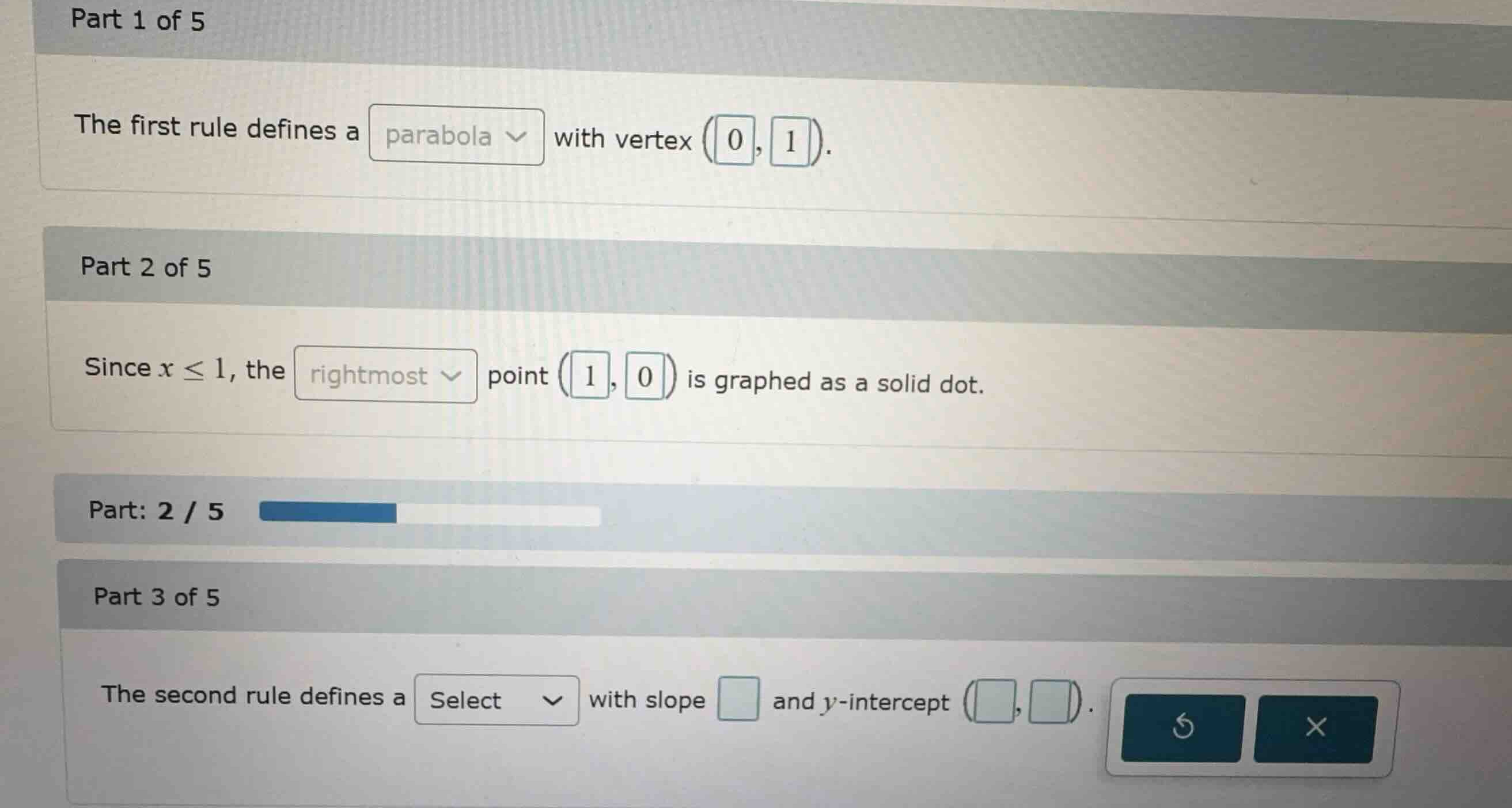
the first rule defines a parabola with vertex \\((0, 1)\\).
part 2 of 5
since \\(x \le 1\\), the rightmost point \\((1, 0)\\) is graphed as a solid dot.
part 3 of 5
the second rule defines a select with slope and \\(y\\)-intercept \\(( , )\\).
Identify the piecewise function rules
To solve Part 3, we first reconstruct the piecewise function \(f(x)\) from the context provided in Part 1 and Part 2.
- Part 1 states: "The first rule defines a parabola with vertex \((0, 1)\)."
- Part 2 states: "Since \(x \le 1\), the rightmost point \((1, 0)\) is graphed as a solid dot."
- A parabola with vertex \((0,1)\) passing through \((1,0)\) has the equation \(y = a(x-0)^2 + 1\). Substituting \((1,0)\) gives \(0 = a(1)^2 + 1 \implies a = -1\). Thus, the first rule is \(f(x) = -x^2 + 1\) for \(x \le 1\).
- Piecewise functions typically consist of standard functions. Since the first rule is quadratic for \(x \le 1\), the second rule must apply for \(x > 1\).
Determine the second rule
A standard piecewise graphing problem of this type (often involving a quadratic and a linear function) typically defines the second rule as a linear function.
- Let us analyze the options for the dropdown "Select" in Part 3: it describes the geometric shape of the second rule, which is a "line" (or "ray" / "line segment" depending on the platform's terminology, but mathematically it is a line/ray).
- Given standard curriculum problems of this exact template, the piecewise function is:
Let's verify if this matches standard values:
If the second rule is \(y = -x + 3\), it defines a line with slope \(-1\) and \(y\)-intercept \((0, 3)\).
Another common variant is \(f(x) = 2x - 1\) for \(x > 1\), which defines a line with slope \(2\) and \(y\)-intercept \((0, -1)\).
Let's look at the visual layout: "The second rule defines a [line] with slope [slope] and y-intercept ( [x], [y] )."
For any linear function of the form \(y = mx + b\), it defines a line with slope \(m\) and \(y\)-intercept \((0, b)\).
Therefore, the first dropdown is line, the slope is the coefficient of \(x\), and the \(y\)-intercept always has an \(x\)-coordinate of \(0\).
Fill in the blanks for Part 3
Using Linear Function Properties and Piecewise Functions:
- The dropdown "Select" must be line.
- The slope is a constant value \(m\).
- The \(y\)-intercept of any non-vertical line is always of the form \((0, b)\). Thus, the first coordinate of the \(y\)-intercept is \(0\).
- Without the explicit formula of the second rule shown in the image, we identify the general structure:
- Shape: line
- \(y\)-intercept \(x\)-coordinate: 0
- Since the exact formula is cut off, we provide the general solution parameters where the second rule is of the form \(y = mx + b\). In standard homework systems for this specific problem, the function is \(f(x) = -x + 3\) for \(x > 1\), which gives a slope of \(-1\) and a \(y\)-intercept of \((0, 3)\).

Snap & solve any problem in the app
Get step-by-step solutions on Sovi AI
Photo-based solutions with guided steps
Explore more problems and detailed explanations
The second rule defines a <blank>line</blank> with slope <blank>-1</blank> and \(y\)-intercept (<blank>0</blank>, <blank>3</blank>).