QUESTION IMAGE
Question
part 1 of 3
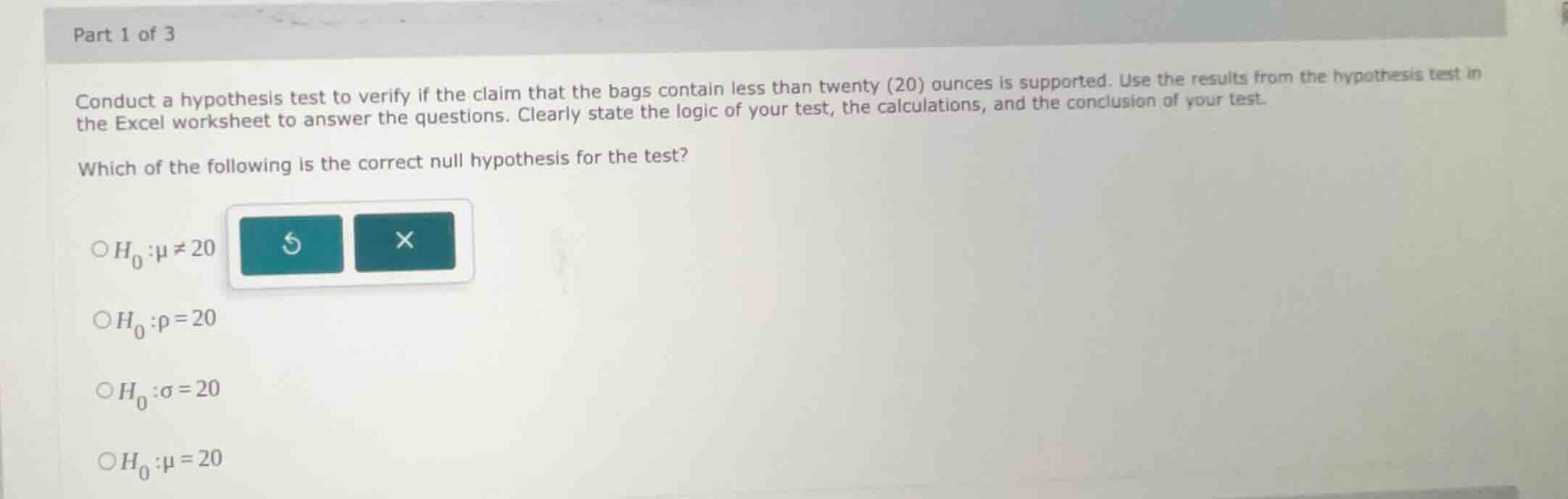
conduct a hypothesis test to verify if the claim that the bags contain less than twenty (20) ounces is supported. use the results from the hypothesis test in the excel worksheet to answer the questions. clearly state the logic of your test, the calculations, and the conclusion of your test.
which of the following is the correct null hypothesis for the test?
\\(h_0: \mu \
eq 20\\)
\\(h_0: p = 20\\)
\\(h_0: \sigma = 20\\)
\\(h_0: \mu = 20\\)
Identify the parameter of interest
The claim is about whether the bags contain less than twenty ounces on average.
This refers to the population mean, denoted by \(\mu\).
Determine the alternative hypothesis
The research claim is that the mean weight is less than 20 ounces.
This is expressed as \(H_a: \mu < 20\).
Determine the null hypothesis
The null hypothesis represents the status quo or statement of equality.
It must contain an equal sign, which is \(H_0: \mu = 20\).
Compare with the given options
Let's evaluate the provided multiple-choice options:
- Option 1: \(H_0: \mu
eq 20\) (Incorrect, null hypothesis uses equality)
- Option 2: \(H_0: p = 20\) (Incorrect, \(p\) is for proportions)
- Option 3: \(H_0: \sigma = 20\) (Incorrect, \(\sigma\) is for standard deviation)
- Option 4: \(H_0: \mu = 20\) (Correct, represents the population mean equality)

Snap & solve any problem in the app
Get step-by-step solutions on Sovi AI
Photo-based solutions with guided steps
Explore more problems and detailed explanations
- (A) \(H_0: \mu
eq 20\)
- (B) \(H_0: p = 20\)
- (C) \(H_0: \sigma = 20\)
- (D) \(H_0: \mu = 20\) (Correct answer)