QUESTION IMAGE
Question
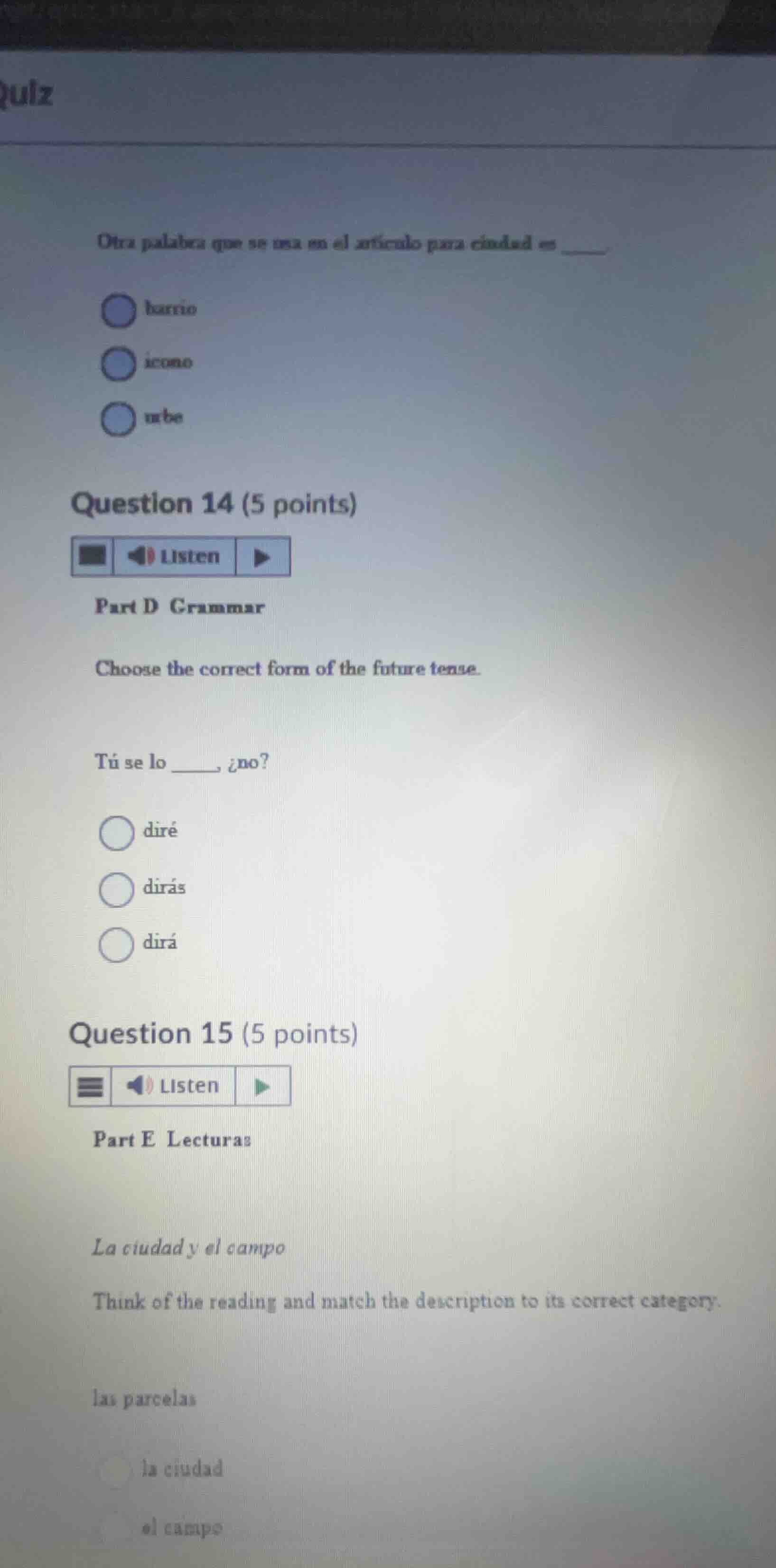
otra palabra que se usa en el artículo para ciudad es ___
- barrio
- icono
- urbe
question 14 (5 points)
part d grammar
choose the correct form of the future tense.
tú se lo ___ ¿no?
- diré
- dirás
- dirá
question 15 (5 points)
part e lecturas
la ciudad y el campo
think of the reading and match the description to its correct category.
las parcelas
- la ciudad
- el campo
<pre_analysis>
{
"quality": "clear",
"question_count": 3,
"skills_matched": [
"direct_cot",
"multiple_choice_formatter",
"explain_then_answer",
"quick"
],
"needs_drawing": false,
"concepts_used": [
"Spanish Synonyms",
"Spanish Future Tense"
],
"new_concepts": [
"Spanish Vocabulary Categorization"
],
"current_concepts": [
"Spanish Synonyms",
"Spanish Future Tense",
"Spanish Vocabulary Categorization"
]
}
</pre_analysis>
<reasoning>
Identify the synonym for "ciudad"
The first question asks for another word used in the article for "ciudad" (city).
- "barrio" means neighborhood.
- "icono" means icon.
- "urbe" means large city or metropolis.
Therefore, "urbe" is the correct synonym.
Conjugate the verb in the future tense
The second question (Question 14) asks for the correct future tense form of "decir" for the subject pronoun "Tú".
- "Tú" requires the future tense ending "-ás".
- The irregular future stem for "decir" is "dir-".
- Combining them gives "dirás".
Categorize the vocabulary term
The third question (Question 15) asks to match "las parcelas" (plots of land / parcels) to either "la ciudad" (the city) or "el campo" (the countryside).
- "las parcelas" refers to agricultural plots of land, which belong to "el campo".
</reasoning>
<answer>
Question 1
<mcq-option>(A) barrio</mcq-option>
<mcq-option>(B) icono</mcq-option>
<mcq-correct>(C) urbe</mcq-correct>
Question 14
<mcq-option>(A) diré</mcq-option>
<mcq-correct>(B) dirás</mcq-correct>
<mcq-option>(C) dirá</mcq-option>
Question 15
<mcq-option>(A) la ciudad</mcq-option>
<mcq-correct>(B) el campo</mcq-correct>
</answer>
<post_analysis>
{
"subject": "Others",
"question_type": "Multi-part",
"knowledge_point": [
"Others",
"Spanish",
"Spanish Grammar and Vocabulary"
]
}
</post_analysis>
Snap & solve any problem in the app
Get step-by-step solutions on Sovi AI
Photo-based solutions with guided steps
Explore more problems and detailed explanations
<pre_analysis>
{
"quality": "clear",
"question_count": 3,
"skills_matched": [
"direct_cot",
"multiple_choice_formatter",
"explain_then_answer",
"quick"
],
"needs_drawing": false,
"concepts_used": [
"Spanish Synonyms",
"Spanish Future Tense"
],
"new_concepts": [
"Spanish Vocabulary Categorization"
],
"current_concepts": [
"Spanish Synonyms",
"Spanish Future Tense",
"Spanish Vocabulary Categorization"
]
}
</pre_analysis>
<reasoning>
Identify the synonym for "ciudad"
The first question asks for another word used in the article for "ciudad" (city).
- "barrio" means neighborhood.
- "icono" means icon.
- "urbe" means large city or metropolis.
Therefore, "urbe" is the correct synonym.
Conjugate the verb in the future tense
The second question (Question 14) asks for the correct future tense form of "decir" for the subject pronoun "Tú".
- "Tú" requires the future tense ending "-ás".
- The irregular future stem for "decir" is "dir-".
- Combining them gives "dirás".
Categorize the vocabulary term
The third question (Question 15) asks to match "las parcelas" (plots of land / parcels) to either "la ciudad" (the city) or "el campo" (the countryside).
- "las parcelas" refers to agricultural plots of land, which belong to "el campo".
</reasoning>
<answer>
Question 1
<mcq-option>(A) barrio</mcq-option>
<mcq-option>(B) icono</mcq-option>
<mcq-correct>(C) urbe</mcq-correct>
Question 14
<mcq-option>(A) diré</mcq-option>
<mcq-correct>(B) dirás</mcq-correct>
<mcq-option>(C) dirá</mcq-option>
Question 15
<mcq-option>(A) la ciudad</mcq-option>
<mcq-correct>(B) el campo</mcq-correct>
</answer>
<post_analysis>
{
"subject": "Others",
"question_type": "Multi-part",
"knowledge_point": [
"Others",
"Spanish",
"Spanish Grammar and Vocabulary"
]
}
</post_analysis>