QUESTION IMAGE
Question
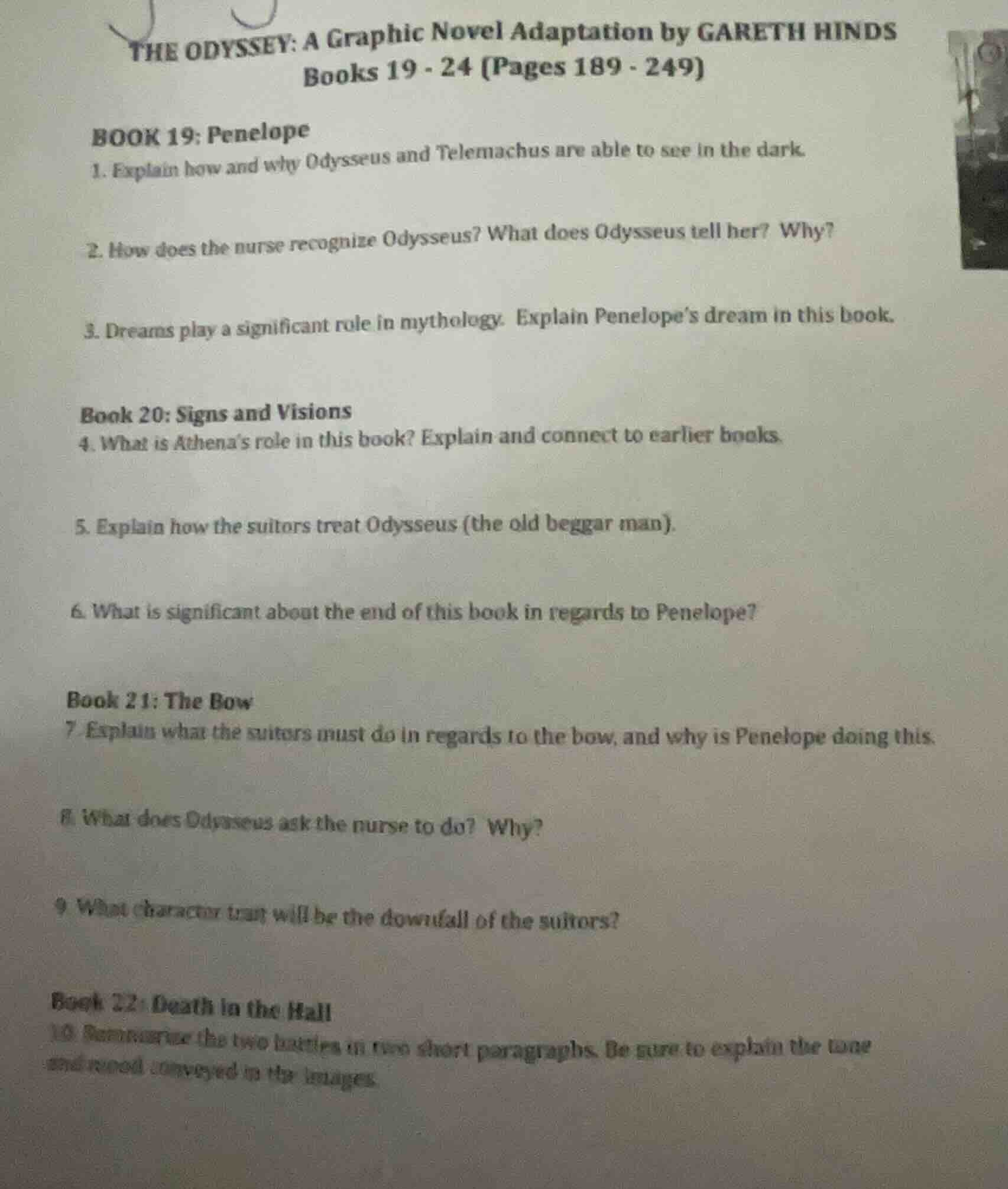
the odyssey: a graphic novel adaptation by gareth hinds
books 19 - 24 (pages 189 - 249)
book 19: penelope
- explain how and why odysseus and telemachus are able to see in the dark.
- how does the nurse recognize odysseus? what does odysseus tell her? why?
- dreams play a significant role in mythology. explain penelopes dream in this book.
book 20: signs and visions
- what is athenas role in this book? explain and connect to earlier books.
- explain how the suitors treat odysseus (the old beggar man).
- what is significant about the end of this book in regards to penelope?
book 21: the bow
- explain what the suitors must do in regards to the bow, and why is penelope doing this.
- what does odysseus ask the nurse to do? why?
- what character trait will be the downfall of the suitors?
book 22: death in the hall
- summarize the two battles in two short paragraphs. be sure to explain the tone and mood conveyed in the images.
To answer these questions, we analyze each one based on the text of The Odyssey: A Graphic Novel Adaptation by Gareth Hinds:
Question 1: Explain how and why Odysseus and Telemachus are able to see in the dark.
Athena, the goddess of wisdom and warfare, uses her divine power to grant Odysseus and Telemachus the ability to see in the dark. This is done to aid them in their plans against the suitors, as the cover of darkness helps them move stealthily and prepare for the confrontation without being detected by the suitors or other household members who might oppose their efforts.
Question 2: How does the nurse recognize Odysseus? What does Odysseus tell her? Why?
The nurse, Eurycleia, recognizes Odysseus by noticing a distinctive scar on his leg (from a childhood boar-hunting accident). When she sees the scar, she realizes the old beggar is actually Odysseus. Odysseus quickly stops her from revealing his identity, telling her to keep his secret. He does this because he is still in the process of planning his revenge against the suitors and needs to maintain his disguise to catch them off - guard.
Question 3: Dreams play a significant role in mythology. Explain Penelope’s dream in this book.
Penelope dreams of twenty geese (which represent the suitors) being killed by a hawk (which represents Odysseus). In mythological terms, dreams often act as omens or symbols of future events. This dream symbolizes Penelope’s subconscious awareness of Odysseus’ impending return and his plan to eliminate the suitors who have been trying to take over his home and marry Penelope.
Question 4: What is Athena’s role in this book? Explain and connect to earlier books.
Athena continues to be Odysseus’ protector and helper. In this book, she enhances Odysseus’ and Telemachus’ ability to see in the dark, boosts Odysseus’ confidence, and manipulates events to favor him. In earlier books, she helped Odysseus by intervening with other gods (like convincing Zeus to allow his return), giving him advice, and aiding him in battles and escapes (such as during his encounter with the Cyclops). Her role is consistent: she uses her divine influence to ensure Odysseus’ safe return and successful reclaiming of his home.
Question 5: Explain how the suitors treat Odysseus (the old beggar man).
The suitors treat Odysseus (disguised as an old beggar) with cruelty and disrespect. They mock him, taunt him, and even physically abuse him. For example, they throw things at him, insult his appearance and supposed status as a beggar, and generally act as if he is a nuisance. This treatment shows their arrogance and their belief that they can do as they please in Odysseus’ home, as well as their ignorance of his true identity.
Question 6: What is significant about the end of this book in regards to Penelope?
At the end of Book 20, Penelope has a moment of realization or intuition that Odysseus (the beggar) might be her true husband. This is significant because it shows that Penelope’s faith in Odysseus’ return is not completely lost, and it foreshadows the reunion of Odysseus and Penelope. It also sets the stage for the events in Book 21, where Penelope will use the bow - contest to test the suitors (and ultimately allow Odysseus to reveal himself).
Question 7: Explain what the suitors must do in regards to the bow, and why is Penelope doing this.
The suitors must string Odysseus’ great bow and then shoot an arrow through a row of axe - heads. Penelope sets up this challenge because she believes that only Odysseus (or someone with his strength and sk…

Snap & solve any problem in the app
Get step-by-step solutions on Sovi AI
Photo-based solutions with guided steps
Explore more problems and detailed explanations
To answer these questions, we analyze each one based on the text of The Odyssey: A Graphic Novel Adaptation by Gareth Hinds:
Question 1: Explain how and why Odysseus and Telemachus are able to see in the dark.
Athena, the goddess of wisdom and warfare, uses her divine power to grant Odysseus and Telemachus the ability to see in the dark. This is done to aid them in their plans against the suitors, as the cover of darkness helps them move stealthily and prepare for the confrontation without being detected by the suitors or other household members who might oppose their efforts.
Question 2: How does the nurse recognize Odysseus? What does Odysseus tell her? Why?
The nurse, Eurycleia, recognizes Odysseus by noticing a distinctive scar on his leg (from a childhood boar-hunting accident). When she sees the scar, she realizes the old beggar is actually Odysseus. Odysseus quickly stops her from revealing his identity, telling her to keep his secret. He does this because he is still in the process of planning his revenge against the suitors and needs to maintain his disguise to catch them off - guard.
Question 3: Dreams play a significant role in mythology. Explain Penelope’s dream in this book.
Penelope dreams of twenty geese (which represent the suitors) being killed by a hawk (which represents Odysseus). In mythological terms, dreams often act as omens or symbols of future events. This dream symbolizes Penelope’s subconscious awareness of Odysseus’ impending return and his plan to eliminate the suitors who have been trying to take over his home and marry Penelope.
Question 4: What is Athena’s role in this book? Explain and connect to earlier books.
Athena continues to be Odysseus’ protector and helper. In this book, she enhances Odysseus’ and Telemachus’ ability to see in the dark, boosts Odysseus’ confidence, and manipulates events to favor him. In earlier books, she helped Odysseus by intervening with other gods (like convincing Zeus to allow his return), giving him advice, and aiding him in battles and escapes (such as during his encounter with the Cyclops). Her role is consistent: she uses her divine influence to ensure Odysseus’ safe return and successful reclaiming of his home.
Question 5: Explain how the suitors treat Odysseus (the old beggar man).
The suitors treat Odysseus (disguised as an old beggar) with cruelty and disrespect. They mock him, taunt him, and even physically abuse him. For example, they throw things at him, insult his appearance and supposed status as a beggar, and generally act as if he is a nuisance. This treatment shows their arrogance and their belief that they can do as they please in Odysseus’ home, as well as their ignorance of his true identity.
Question 6: What is significant about the end of this book in regards to Penelope?
At the end of Book 20, Penelope has a moment of realization or intuition that Odysseus (the beggar) might be her true husband. This is significant because it shows that Penelope’s faith in Odysseus’ return is not completely lost, and it foreshadows the reunion of Odysseus and Penelope. It also sets the stage for the events in Book 21, where Penelope will use the bow - contest to test the suitors (and ultimately allow Odysseus to reveal himself).
Question 7: Explain what the suitors must do in regards to the bow, and why is Penelope doing this.
The suitors must string Odysseus’ great bow and then shoot an arrow through a row of axe - heads. Penelope sets up this challenge because she believes that only Odysseus (or someone with his strength and skill) will be able to complete it. By doing this, she hopes to either find a worthy suitor (though she secretly wishes it will be Odysseus) or at least delay the suitors’ attempts to marry her, buying more time for Odysseus to return.
Question 8: What does Odysseus ask the nurse to do? Why?
Odysseus asks the nurse, Eurycleia, to lock all the women (the maids who have been unfaithful and sided with the suitors) in a room and guard the doors so they cannot interfere with his and Telemachus’ plan to kill the suitors. He does this to ensure that there are no distractions or obstacles from the household staff as he carries out his revenge.
Question 9: What character trait will be the downfall of the suitors?
The suitors’ arrogance (or hubris) will be their downfall. They are overconfident in their ability to take over Odysseus’ home, marry Penelope, and avoid any consequences. They underestimate the beggar (Odysseus) and do not believe that Odysseus will ever return. This overconfidence leads them to be unprepared for Odysseus’ revenge and ultimately results in their deaths.
Question 10: Summarize the two battles in two short paragraphs. Be sure to explain the tone and mood conveyed in the images.
Battle 1 (Odysseus vs. Suitors with the Bow):
Odysseus, having revealed himself, uses his bow to shoot down the suitors one by one. The tone of the images is one of triumph and retribution. The mood is intense and violent, with a sense of justice being served as Odysseus, the rightful master of the house, takes back what is his. The images likely show Odysseus’ strength and precision as he dispatches the suitors, with the suitors’ fear and desperation evident.
Battle 2 (Odysseus, Telemachus, and Allies vs. Suitors’ Supporters):
After the initial bow - killing, the suitors’ supporters (some of the household staff and other allies) try to fight back. Odysseus, Telemachus, and their allies (like Eumaeus and Philoetius) engage in a fierce battle. The tone of the images here is one of chaos and final conflict. The mood is one of urgency and finality, as this battle represents the last stand of the suitors’ faction. The images convey a sense of the struggle for control of the house, with the forces of Odysseus ultimately prevailing.