QUESTION IMAGE
Question
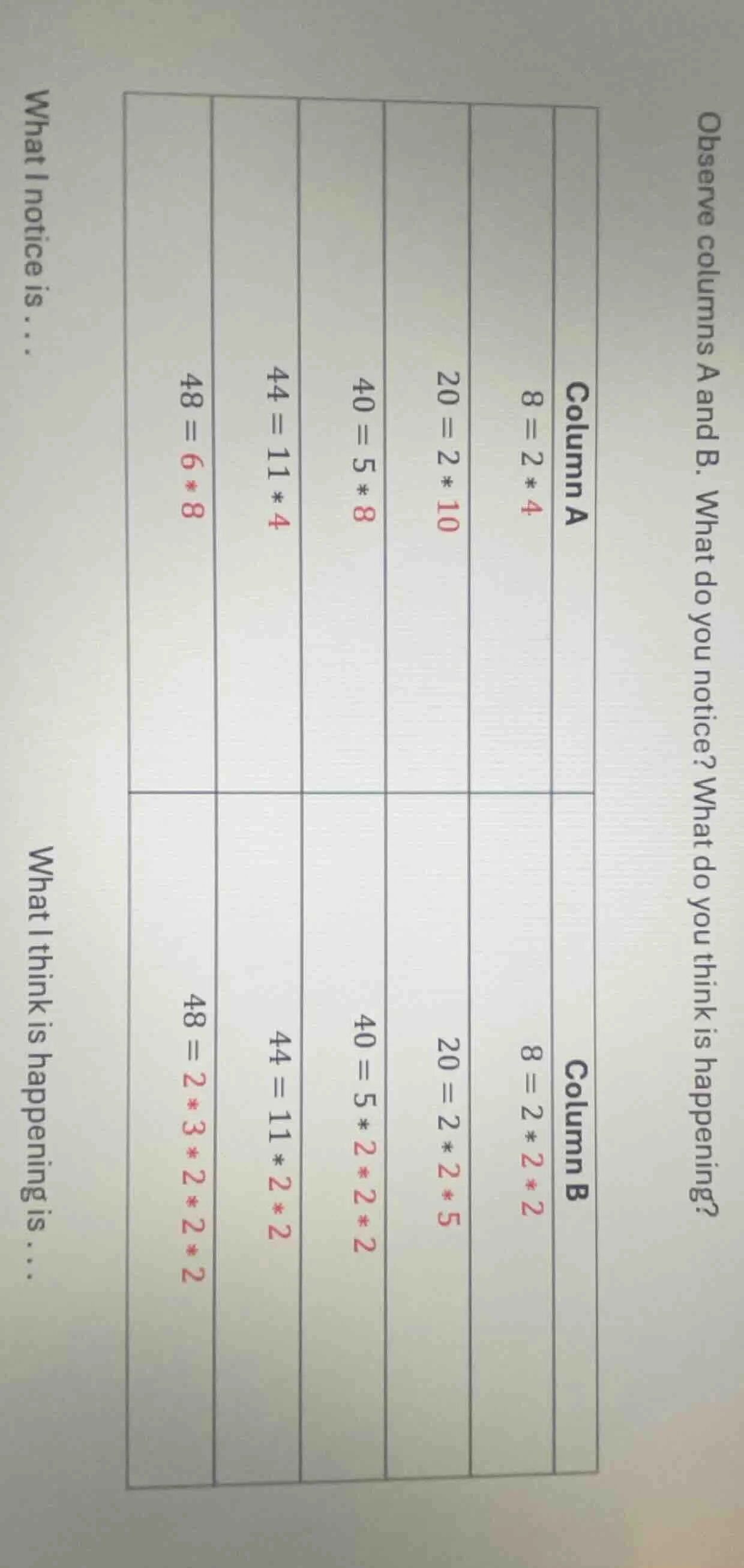
observe columns a and b. what do you notice? what do you think is happening?
column a
8 = 2 * 4
20 = 2 * 10
40 = 5 * 8
44 = 11 * 4
48 = 6 * 8
column b
8 = 2 2 2
20 = 2 2 5
40 = 5 2 2 * 2
44 = 11 2 2
48 = 2 3 2 2 2
what i notice is...
what i think is happening is...
Looking at Column A and Column B, in Column A, numbers are expressed as products of two factors (e.g., \(8 = 2\times4\), \(20 = 2\times10\), \(40 = 5\times8\), \(44 = 11\times4\), \(48 = 6\times8\)). In Column B, the same numbers are expressed as products of their prime factors (e.g., \(8 = 2\times2\times2\), \(20 = 2\times2\times5\), \(40 = 5\times2\times2\times2\), \(44 = 11\times2\times2\), \(48 = 2\times3\times2\times2\times2\)). So, Column A shows composite factorizations (not necessarily prime), while Column B shows prime factorizations (breaking numbers into their prime components).

Snap & solve any problem in the app
Get step-by-step solutions on Sovi AI
Photo-based solutions with guided steps
Explore more problems and detailed explanations
Column A shows non - prime factorizations (e.g., \(8 = 2\times4\)), and Column B shows prime factorizations (e.g., \(8 = 2\times2\times2\)). The process is that Column A expresses numbers as products of two integers (not all prime), and Column B expresses the same numbers as products of their prime factors (prime factorization).