QUESTION IMAGE
Question
objective
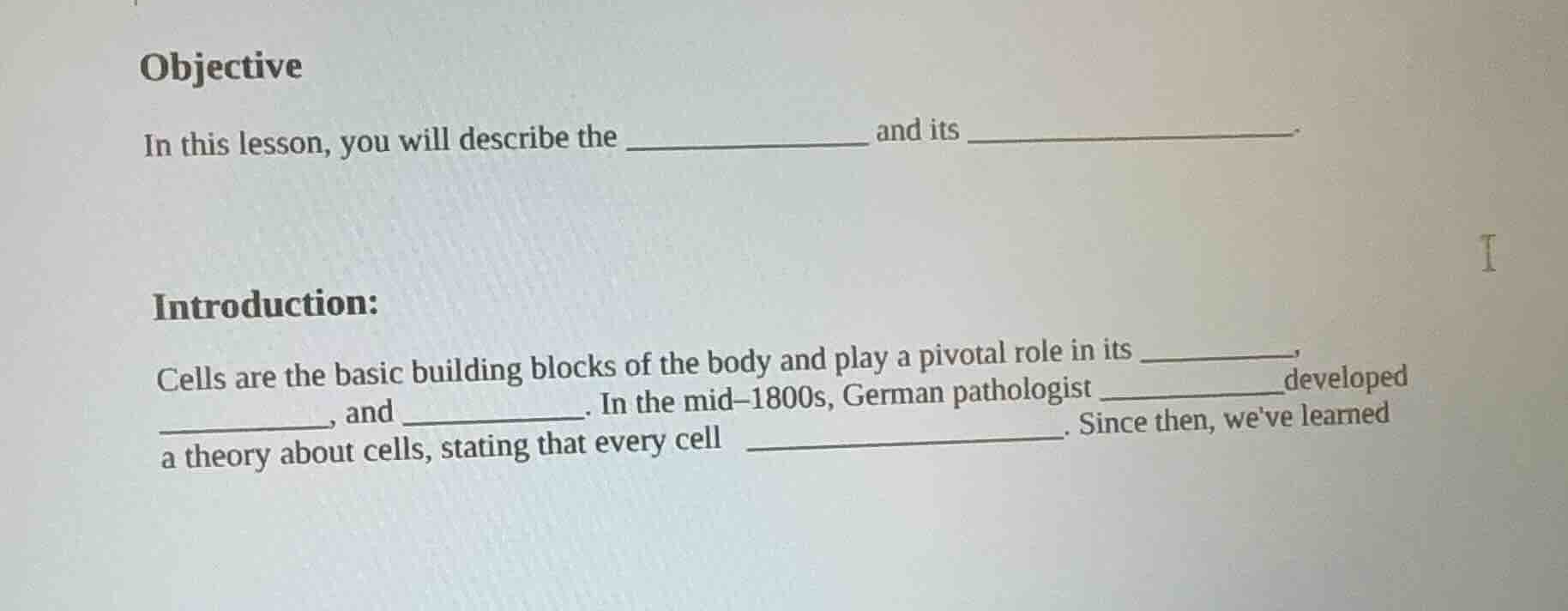
in this lesson, you will describe the ______ and its ______.
introduction:
cells are the basic building blocks of the body and play a pivotal role in its ______, ____, and ____. in the mid-1800s, german pathologist ____ developed a theory about cells, stating that every cell ______. since then, weve learned
Identificar el objetivo de la lección
Using the Cell Theory History knowledge point
El texto inicial describe el objetivo de la lección: "In this lesson, you will describe the ______ and its ______". Basándonos en el contexto de la teoría celular y la estructura típica de estas lecciones de biología, el objetivo es describir la teoría celular y su desarrollo histórico.
- Primer espacio: "cell theory" (teoría celular)
- Segundo espacio: "history" (historia) o "development" (desarrollo)
Analizar la introducción sobre las células
Using the Modern Cell Theory knowledge point
La introducción comienza con: "Cells are the basic building blocks of the body and play a pivotal role in its ______, ____, and ______."
De acuerdo con los principios fundamentales de la biología celular, las células son las unidades estructurales y funcionales que permiten el funcionamiento, crecimiento y salud del cuerpo. Los términos estándar que completan esta idea sobre el rol fundamental de las células en el cuerpo son:
- "structure" (estructura)
- "function" (función)
- "development" (desarrollo) o "growth" (crecimiento)
Identificar al patólogo alemán y su contribución
Using the Cell Theory History and Cell Theory Tenets knowledge points
El texto continúa: "In the mid-1800s, German pathologist ______ developed a theory about cells, stating that every cell ______."
- El patólogo alemán de mediados del siglo XIX que contribuyó de manera decisiva a la teoría celular (específicamente postulando que toda célula proviene de otra preexistente) es Rudolf Virchow.
- Su famoso postulado en latín "Omnis cellula e cellula" se traduce en la teoría celular como: "comes from a preexisting cell" (proviene de una célula preexistente).

Snap & solve any problem in the app
Get step-by-step solutions on Sovi AI
Photo-based solutions with guided steps
Explore more problems and detailed explanations
Question 1
Objective
In this lesson, you will describe the <blank>cell theory</blank> and its <blank>history</blank>.
Question 2
Introduction:
Cells are the basic building blocks of the body and play a pivotal role in its <blank>structure</blank>, <blank>function</blank>, and <blank>growth</blank>. In the mid-1800s, German pathologist <blank>Rudolf Virchow</blank> developed a theory about cells, stating that every cell <blank>comes from a preexisting cell</blank>.