QUESTION IMAGE
Question
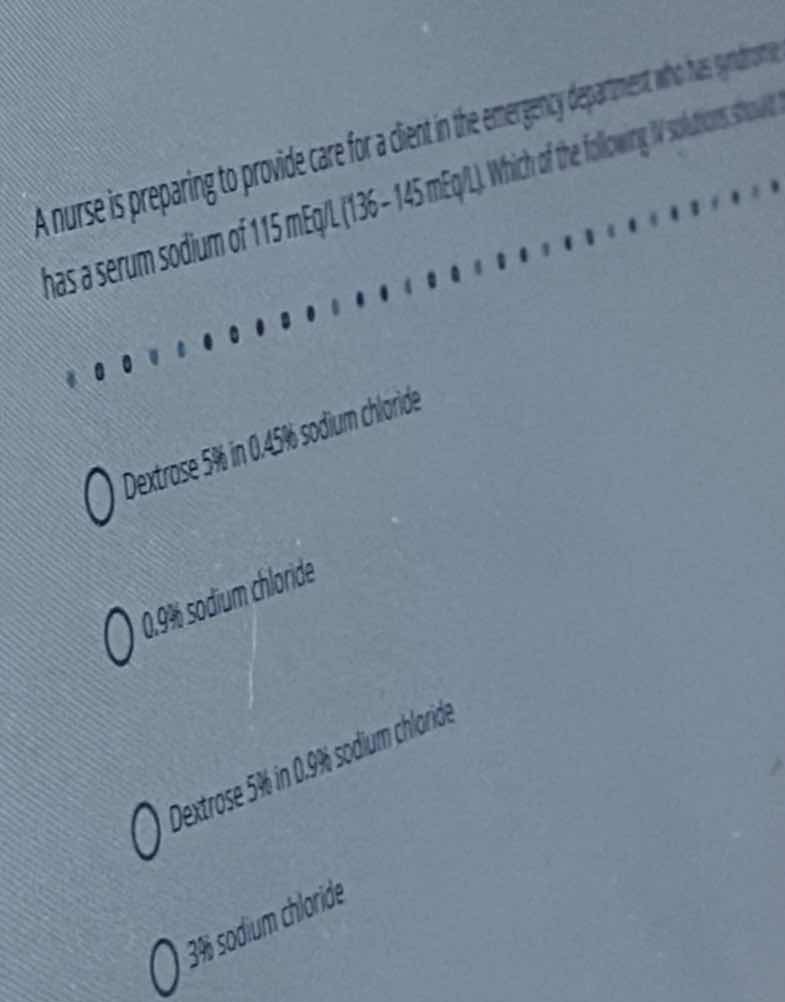
a nurse is preparing to provide care for a client in the emergency department who has syndrome of inappropriate antidiuretic hormone (siadh) and has a serum sodium of 115 meq/l (136-145 meq/l). which of the following iv solutions should the nurse anticipate administering?
dextrose 5% in 0.45% sodium chloride
0.9% sodium chloride
dextrose 5% in 0.9% sodium chloride
3% sodium chloride
Analyze the clinical scenario
The client is in the emergency department with a serum sodium level of \(115\text{ mEq/L}\), which is significantly below the normal reference range of \(136\text{--}145\text{ mEq/L}\). This indicates severe, symptomatic hyponatremia. The question text also mentions "syndrome of...", which refers to the Syndrome of Inappropriate Antidiuretic Hormone (SIADH), a common cause of dilutional hyponatremia.
Evaluate the physiological needs
In severe hyponatremia (especially when serum sodium is less than \(120\text{ mEq/L}\)), there is a high risk of severe neurological complications, including cerebral edema, seizures, coma, and death. The immediate therapeutic goal is to raise the serum sodium level safely to prevent or treat these neurological symptoms.
Compare the intravenous fluid options
- Dextrose 5% in 0.45% sodium chloride and 0.9% sodium chloride: These are hypotonic and isotonic solutions, respectively. In SIADH, administering isotonic or hypotonic fluids will worsen the fluid overload and further dilute the serum sodium because the kidneys cannot excrete free water.
- Dextrose 5% in 0.9% sodium chloride: This is hypertonic in the bag but physiologically isotonic/hypotonic once dextrose is metabolized, which does not effectively correct severe hyponatremia in SIADH.
- 3% sodium chloride: This is a highly hypertonic saline solution. It increases the extracellular sodium concentration, drawing water out of the swollen brain cells and correcting severe hyponatremia. It is the standard treatment for severe, symptomatic hyponatremia.
Determine the correct intervention
For a client with severe hyponatremia (\(115\text{ mEq/L}\)) secondary to SIADH, the nurse should prepare to administer a hypertonic saline solution, which is 3% sodium chloride, under close monitoring to avoid rapid overcorrection.

Snap & solve any problem in the app
Get step-by-step solutions on Sovi AI
Photo-based solutions with guided steps
Explore more problems and detailed explanations
- Dextrose 5% in 0.45% sodium chloride
- 0.9% sodium chloride
- Dextrose 5% in 0.9% sodium chloride
- 3% sodium chloride (Correct answer)