QUESTION IMAGE
Question
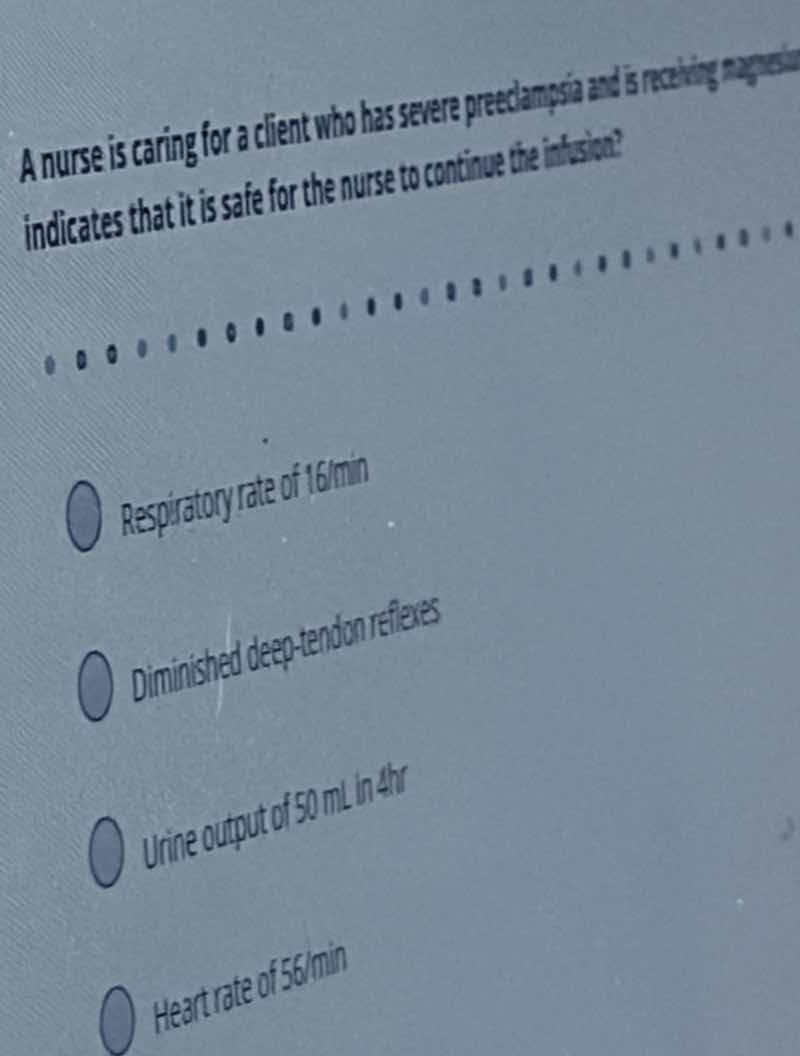
a nurse is caring for a client who has severe preeclampsia and is receiving magnesium sulfate. which of the following findings indicates that it is safe for the nurse to continue the infusion?
respiratory rate of 16/min
diminished deep-tendon reflexes
urine output of 50 ml in 4hr
heart rate of 56/min
Identify the clinical scenario and drug
The client has severe preeclampsia and is receiving a magnesium sulfate infusion. Magnesium sulfate is used to prevent seizures (eclampsia). However, it has a narrow therapeutic index, and the nurse must monitor closely for magnesium toxicity.
Analyze the parameters for safe administration
To safely continue a magnesium sulfate infusion, the nurse must verify that the client does not show signs of magnesium toxicity. The key assessment findings required to continue the infusion include:
- Adequate respiratory rate (typically \(\ge 12/\text{min}\)).
- Presence of deep-tendon reflexes (DTRs) (patellar reflex should be active, not diminished or absent).
- Adequate urinary output (typically \(\ge 30\text{ mL/hr}\) or at least \(120\text{ mL}\) over 4 hours) because magnesium is excreted renally.
Evaluate the given options
- Respiratory rate of 16/min: This is within the normal range (\(12\text{--}20/\text{min}\)) and well above the threshold of \(12/\text{min}\). This indicates it is safe to continue.
- Diminished deep-tendon reflexes: Loss or decrease of DTRs is an early sign of magnesium toxicity. The infusion should be stopped.
- Urine output of 50 mL in 4hr: This is approximately \(12.5\text{ mL/hr}\), which is significantly below the safe threshold of \(30\text{ mL/hr}\). Decreased urine output leads to magnesium accumulation and toxicity.
- Heart rate of 56/min: Bradycardia can be a sign of worsening toxicity or cardiac depression, and is not a reassuring sign to continue.
Confirm the correct choice
A respiratory rate of \(16/\text{min}\) is normal and confirms that respiratory depression (a life-threatening sign of magnesium toxicity) is not present, making it safe to continue the infusion.

Snap & solve any problem in the app
Get step-by-step solutions on Sovi AI
Photo-based solutions with guided steps
Explore more problems and detailed explanations
- (A) Respiratory rate of 16/min (Correct answer)
- (B) Diminished deep-tendon reflexes
- (C) Urine output of 50 mL in 4hr
- (D) Heart rate of 56/min