QUESTION IMAGE
Question
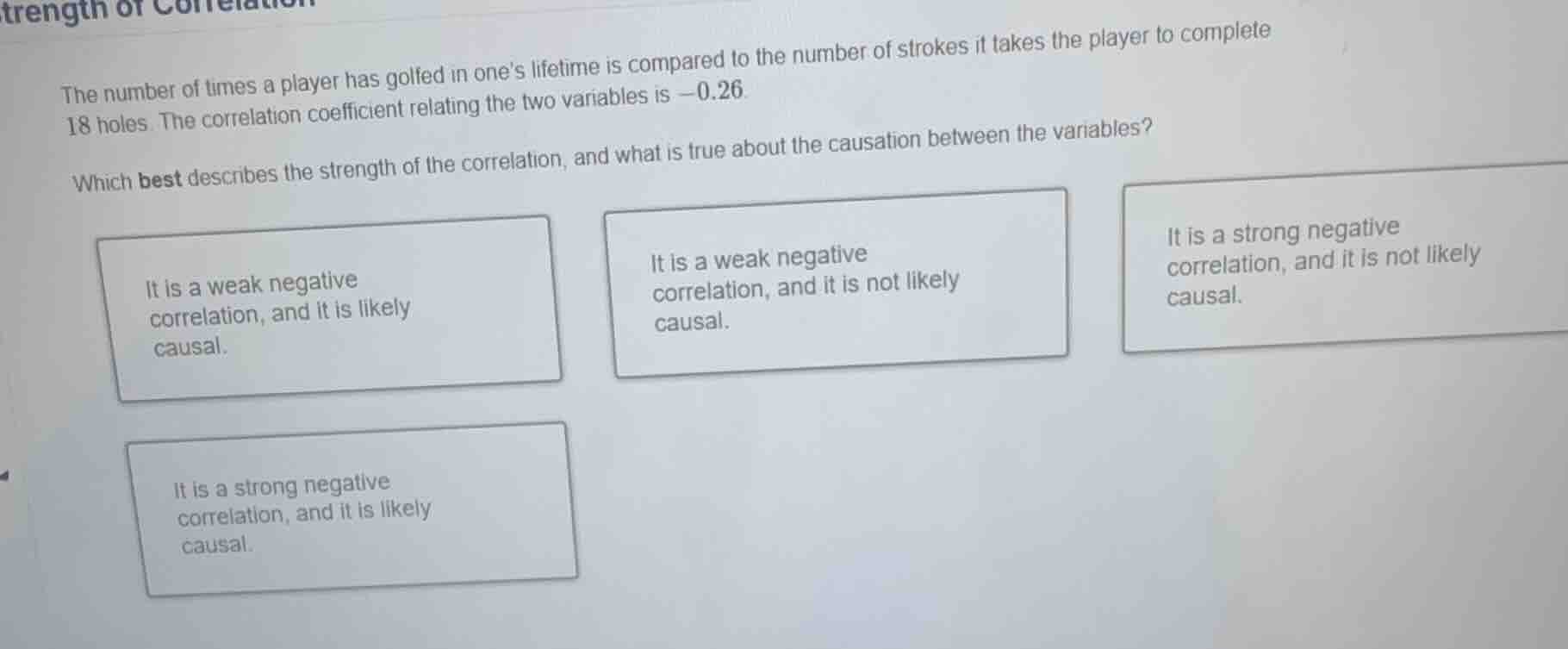
the number of times a player has golfed in ones lifetime is compared to the number of strokes it takes the player to complete 18 holes. the correlation coefficient relating the two variables is \\(-0.26\\).
which best describes the strength of the correlation, and what is true about the causation between the variables?
- it is a weak negative correlation, and it is likely causal.
- it is a weak negative correlation, and it is not likely causal.
- it is a strong negative correlation, and it is not likely causal.
- it is a strong negative correlation, and it is likely causal.
Analyze the correlation coefficient
Using the Correlation Coefficient and Correlation Strength knowledge points, we evaluate the given correlation coefficient, \(r = -0.26\).
- The negative sign indicates a negative correlation.
- The absolute value \(|r| = 0.26\) is close to \(0\), which falls into the range typically classified as a weak correlation (generally \(|r| < 0.3\) or \(0.4\)).
- Therefore, the relationship is a weak negative correlation.
Evaluate causation
We analyze whether a causal relationship is likely between the two variables:
- The variables are "the number of times a player has golfed in one's lifetime" and "the number of strokes it takes to complete 18 holes."
- While practice (golfing more) generally helps improve performance (reducing strokes), a correlation coefficient of \(-0.26\) is very weak.
- A weak correlation indicates that lifetime golf frequency alone does not reliably predict or directly cause a specific change in the score, as many other confounding variables (such as natural talent, coaching, or physical fitness) play a much larger role.
- Thus, with such a weak statistical association, it is not likely causal.

Snap & solve any problem in the app
Get step-by-step solutions on Sovi AI
Photo-based solutions with guided steps
Explore more problems and detailed explanations
- It is a weak negative correlation, and it is likely causal.
- It is a weak negative correlation, and it is not likely causal. (Correct answer)
- It is a strong negative correlation, and it is not likely causal.
- It is a strong negative correlation, and it is likely causal.