QUESTION IMAGE
Question
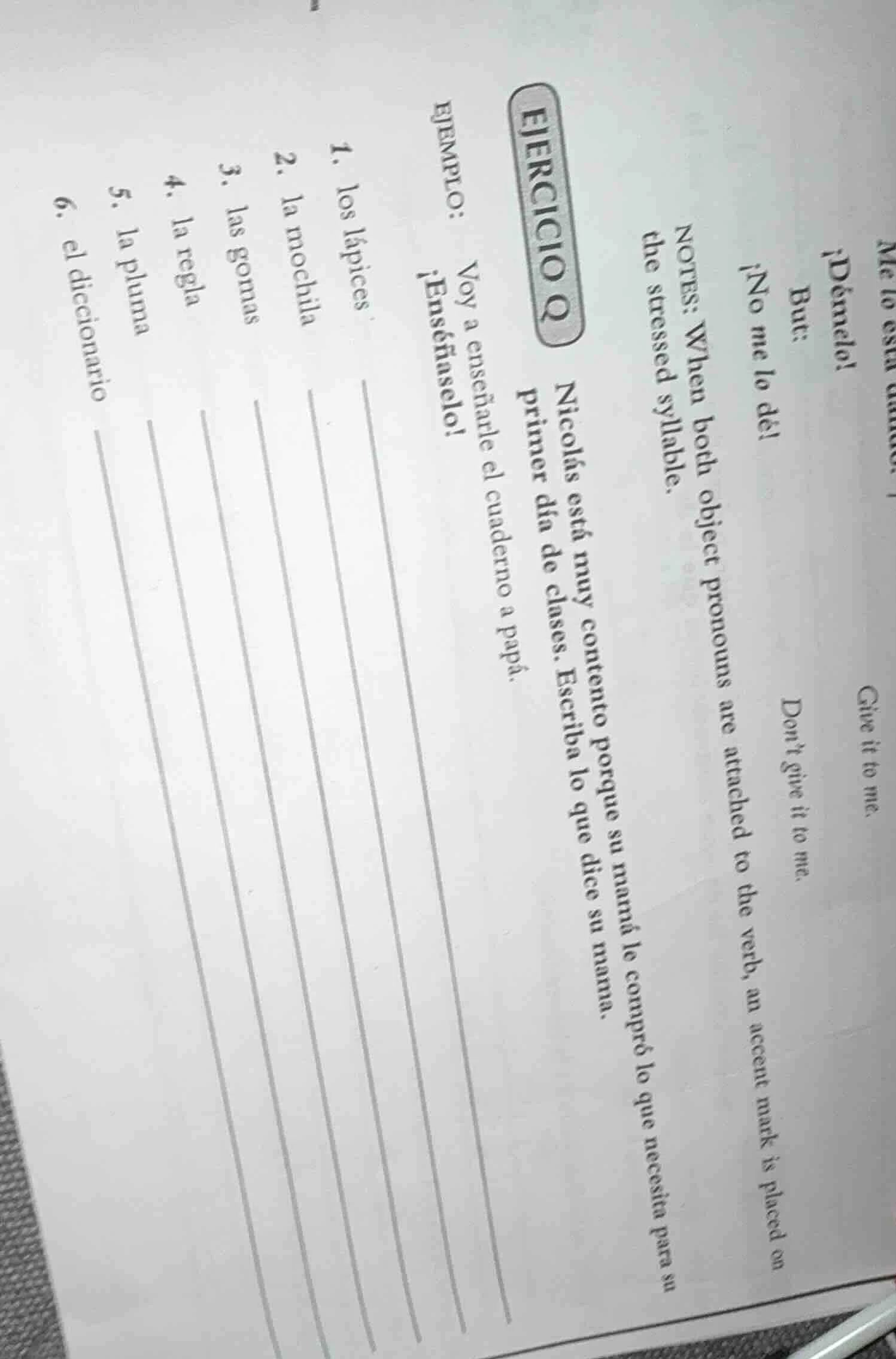
notes: when both object pronouns are attached to the verb, an accent mark is placed on the stressed syllable.
ejercicio q
nicolas está muy contento porque su mamá le compró lo que necesita para su primer día de clases. escriba lo que dice su mamá.
ejemplo:
voy a enseñarle el cuaderno a papá.
¡enséñaselo!
- los lápices
- la mochila
- las gomas
- la regla
- la pluma
- el diccionario
To solve this exercise, we need to form commands using the object pronouns and the given nouns, following the example. The structure is "¡[Verb][Object Pronoun][Noun]!" (for positive commands) or "¡No me lo [Verb]!" (for negative commands, but in this case, we'll focus on positive commands as per the example "¡Enséñaselo!"). The verbs we'll use are "dame" (informal "give me") but adjusted for the object pronouns. Wait, actually, the correct structure for "give me" with object pronouns is "démelo" (tú form, informal command) or "démelos" (plural), "démela" (feminine singular), etc. Let's analyze each noun:
1. los lápices (the pencils, masculine plural)
The informal command for "give me" with a masculine plural object is "démelos". So the sentence is "¡Démelos!".
2. la mochila (the backpack, feminine singular)
For a feminine singular object, the command is "démela". So "¡Démela!".
3. las gomas (the erasers, feminine plural)
For feminine plural, it's "démelas". So "¡Démelas!".
4. la regla (the ruler, feminine singular)
Same as la mochila, "démela". So "¡Démela!".
5. la pluma (the pen, feminine singular)
Same as above, "démela". So "¡Démela!".
6. el diccionario (the dictionary, masculine singular)
For masculine singular, it's "démelo". So "¡Démelo!".
Final Answers:
- ¡Démelos!
- ¡Démela!
- ¡Démelas!
- ¡Démela!
- ¡Démela!
- ¡Démelo!

Snap & solve any problem in the app
Get step-by-step solutions on Sovi AI
Photo-based solutions with guided steps
Explore more problems and detailed explanations
To solve this exercise, we need to form commands using the object pronouns and the given nouns, following the example. The structure is "¡[Verb][Object Pronoun][Noun]!" (for positive commands) or "¡No me lo [Verb]!" (for negative commands, but in this case, we'll focus on positive commands as per the example "¡Enséñaselo!"). The verbs we'll use are "dame" (informal "give me") but adjusted for the object pronouns. Wait, actually, the correct structure for "give me" with object pronouns is "démelo" (tú form, informal command) or "démelos" (plural), "démela" (feminine singular), etc. Let's analyze each noun:
1. los lápices (the pencils, masculine plural)
The informal command for "give me" with a masculine plural object is "démelos". So the sentence is "¡Démelos!".
2. la mochila (the backpack, feminine singular)
For a feminine singular object, the command is "démela". So "¡Démela!".
3. las gomas (the erasers, feminine plural)
For feminine plural, it's "démelas". So "¡Démelas!".
4. la regla (the ruler, feminine singular)
Same as la mochila, "démela". So "¡Démela!".
5. la pluma (the pen, feminine singular)
Same as above, "démela". So "¡Démela!".
6. el diccionario (the dictionary, masculine singular)
For masculine singular, it's "démelo". So "¡Démelo!".
Final Answers:
- ¡Démelos!
- ¡Démela!
- ¡Démelas!
- ¡Démela!
- ¡Démela!
- ¡Démelo!