QUESTION IMAGE
Question
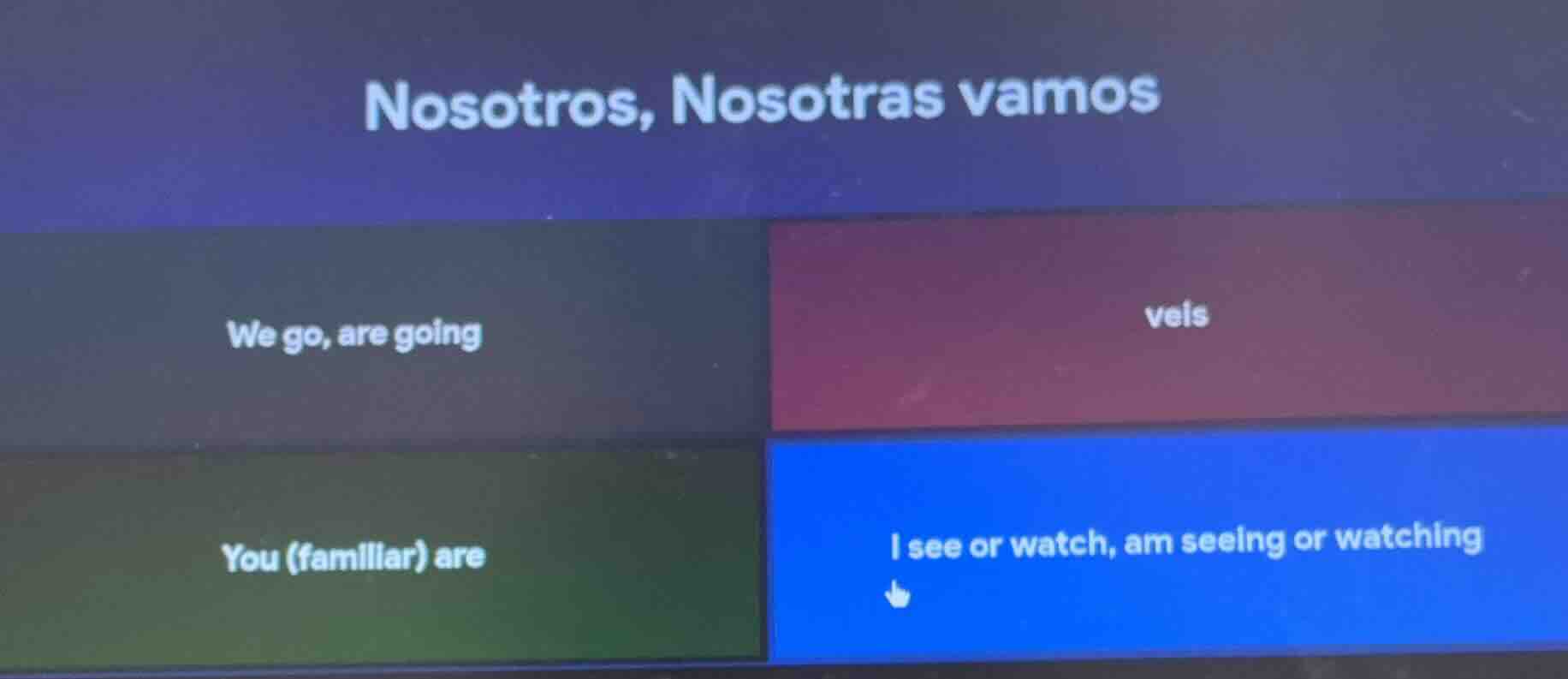
nosotros, nosotras vamos
we go, are going
veis
you (familiar) are
i see or watch, am seeing or watching
<pre_analysis>
{
"quality": "clear",
"question_count": 1,
"skills_matched": [
"direct_cot",
"multiple_choice_formatter",
"explain_then_answer",
"quick"
],
"needs_drawing": false,
"concepts_used": [
"Spanish Verb Translation",
"Spanish Present Tense"
],
"new_concepts": [],
"current_concepts": [
"Spanish Verb Translation",
"Spanish Present Tense",
"Spanish Verbs"
]
}
</pre_analysis>
<reasoning>
Analyze the prompt phrase
The prompt phrase is "Nosotros, Nosotras vamos".
- "Nosotros" and "Nosotras" are the masculine/mixed and feminine plural subject pronouns in Spanish, meaning "We".
- "vamos" is the first-person plural present tense conjugation of the irregular verb "ir" (to go).
Translate the phrase
- "vamos" translates to "we go" or "we are going" in English.
- Therefore, "Nosotros, Nosotras vamos" translates directly to "We go, are going".
Evaluate the options
- Option 1: "We go, are going" matches the translation of "Nosotros, Nosotras vamos".
- Option 2: "veis" is a Spanish verb form (you all see/watch).
- Option 3: "You (familiar) are" corresponds to "tú eres" or "tú estás".
- Option 4: "I see or watch, am seeing or watching" corresponds to "veo".
</reasoning>
<answer>
<mcq-correct>(A) We go, are going</mcq-correct>
<mcq-option>(B) veis</mcq-option>
<mcq-option>(C) You (familiar) are</mcq-option>
<mcq-option>(D) I see or watch, am seeing or watching</mcq-option>
</answer>
<post_analysis>
{
"subject": "Others",
"question_type": "Multiple Choice",
"knowledge_point": [
"Others",
"Spanish",
"Spanish Verb Translation"
]
}
</post_analysis>
Snap & solve any problem in the app
Get step-by-step solutions on Sovi AI
Photo-based solutions with guided steps
Explore more problems and detailed explanations
<pre_analysis>
{
"quality": "clear",
"question_count": 1,
"skills_matched": [
"direct_cot",
"multiple_choice_formatter",
"explain_then_answer",
"quick"
],
"needs_drawing": false,
"concepts_used": [
"Spanish Verb Translation",
"Spanish Present Tense"
],
"new_concepts": [],
"current_concepts": [
"Spanish Verb Translation",
"Spanish Present Tense",
"Spanish Verbs"
]
}
</pre_analysis>
<reasoning>
Analyze the prompt phrase
The prompt phrase is "Nosotros, Nosotras vamos".
- "Nosotros" and "Nosotras" are the masculine/mixed and feminine plural subject pronouns in Spanish, meaning "We".
- "vamos" is the first-person plural present tense conjugation of the irregular verb "ir" (to go).
Translate the phrase
- "vamos" translates to "we go" or "we are going" in English.
- Therefore, "Nosotros, Nosotras vamos" translates directly to "We go, are going".
Evaluate the options
- Option 1: "We go, are going" matches the translation of "Nosotros, Nosotras vamos".
- Option 2: "veis" is a Spanish verb form (you all see/watch).
- Option 3: "You (familiar) are" corresponds to "tú eres" or "tú estás".
- Option 4: "I see or watch, am seeing or watching" corresponds to "veo".
</reasoning>
<answer>
<mcq-correct>(A) We go, are going</mcq-correct>
<mcq-option>(B) veis</mcq-option>
<mcq-option>(C) You (familiar) are</mcq-option>
<mcq-option>(D) I see or watch, am seeing or watching</mcq-option>
</answer>
<post_analysis>
{
"subject": "Others",
"question_type": "Multiple Choice",
"knowledge_point": [
"Others",
"Spanish",
"Spanish Verb Translation"
]
}
</post_analysis>