QUESTION IMAGE
Question
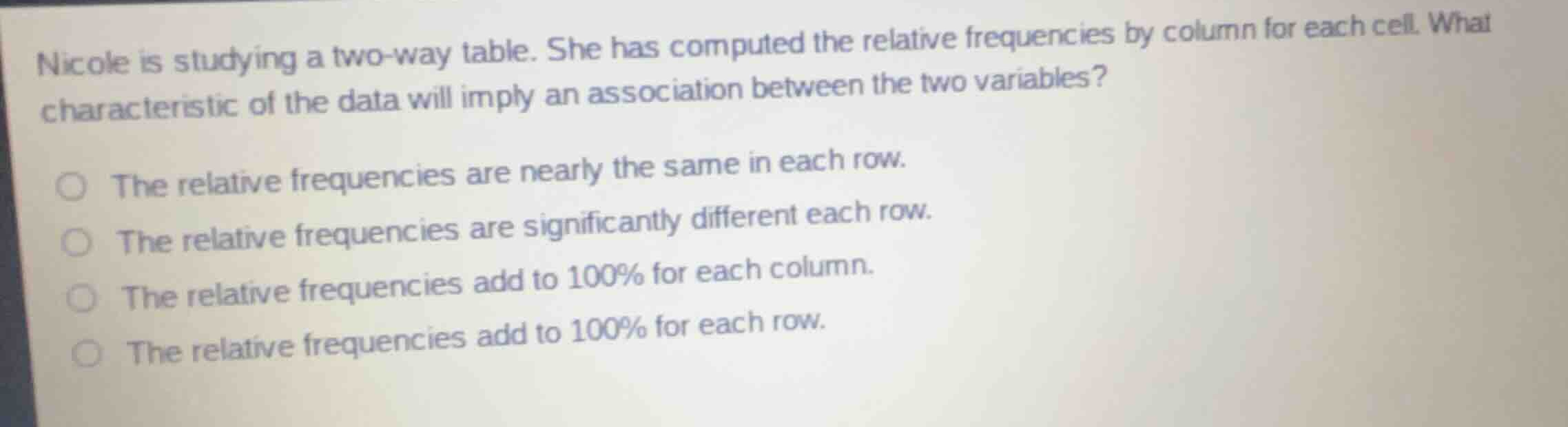
nicole is studying a two-way table. she has computed the relative frequencies by column for each cell. what characteristic of the data will imply an association between the two variables?
- the relative frequencies are nearly the same in each row.
- the relative frequencies are significantly different each row.
- the relative frequencies add to 100% for each column.
- the relative frequencies add to 100% for each row.
Analyze the definition of association in two-way tables
An association exists between two categorical variables if the conditional relative frequencies of one variable differ depending on the value of the other variable. Since Nicole computed relative frequencies by column, we compare these conditional relative frequencies across the columns for each row.
Evaluate the options based on conditional relative frequencies
- If the relative frequencies in each row are nearly the same across columns, it implies that the distribution of the row variable does not depend on the column variable, indicating no association.
- If the relative frequencies in each row are significantly different across columns, the distribution of the row variable changes depending on the column variable, which implies an association.
- The relative frequencies by column adding to 100% for each column is a mathematical property of how they were calculated, not an indicator of association.
Identify the correct statement
The characteristic that implies an association is that the relative frequencies are significantly different in each row across the columns.

Snap & solve any problem in the app
Get step-by-step solutions on Sovi AI
Photo-based solutions with guided steps
Explore more problems and detailed explanations
- The relative frequencies are nearly the same in each row.
- The relative frequencies are significantly different each row. (Correct answer)
- The relative frequencies add to 100% for each column.
- The relative frequencies add to 100% for each row.