QUESTION IMAGE
Question
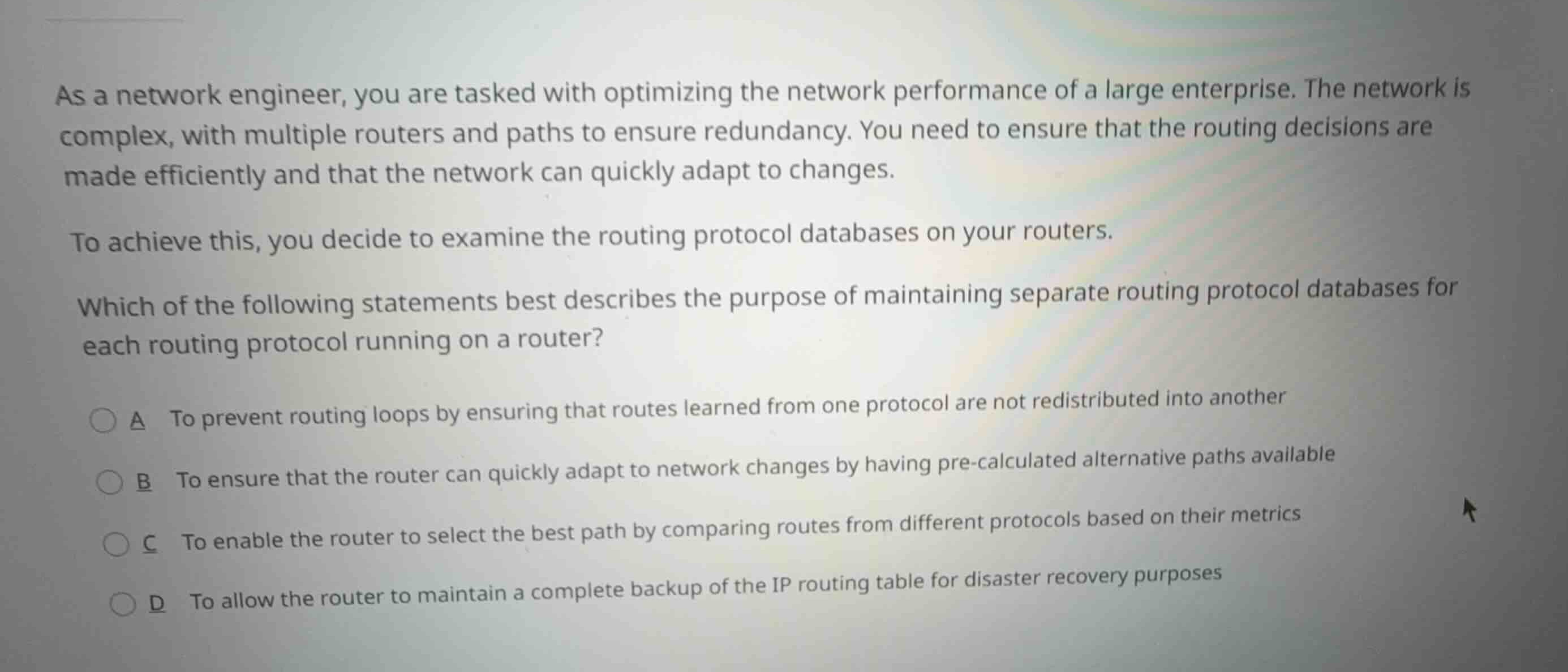
as a network engineer, you are tasked with optimizing the network performance of a large enterprise. the network is complex, with multiple routers and paths to ensure redundancy. you need to ensure that the routing decisions are made efficiently and that the network can quickly adapt to changes.
to achieve this, you decide to examine the routing protocol databases on your routers.
which of the following statements best describes the purpose of maintaining separate routing protocol databases for each routing protocol running on a router?
a to prevent routing loops by ensuring that routes learned from one protocol are not redistributed into another
b to ensure that the router can quickly adapt to network changes by having pre-calculated alternative paths available
c to enable the router to select the best path by comparing routes from different protocols based on their metrics
d to allow the router to maintain a complete backup of the ip routing table for disaster recovery purposes
Analyze the role of routing protocol databases
Each dynamic routing protocol (such as OSPF, EIGRP, or BGP) running on a router maintains its own independent database (e.g., the OSPF Link-State Database) to store topology information and calculate its own preferred paths. This separation is essential because different protocols use entirely different metrics, algorithms, and path selection criteria.
Evaluate the purpose of separate databases
By keeping these databases isolated, each protocol can independently calculate its optimal routes and alternative paths (such as OSPF backup paths or EIGRP feasible successors). This allows the router to quickly adapt to network changes by having pre-calculated alternative paths ready to be injected into the main routing table if the primary path fails, ensuring rapid convergence.
Assess the incorrect options
- Option A is incorrect because route redistribution policies, not separate databases, prevent loops during redistribution.
- Option C is incorrect because comparing routes from different protocols is done using Administrative Distance (AD) in the global routing table, not by comparing metrics across separate protocol databases.
- Option D is incorrect because protocol databases do not serve as disaster recovery backups for the IP routing table.

Snap & solve any problem in the app
Get step-by-step solutions on Sovi AI
Photo-based solutions with guided steps
Explore more problems and detailed explanations
- (A) To prevent routing loops by ensuring that routes learned from one protocol are not redistributed into another
- (B) To ensure that the router can quickly adapt to network changes by having pre-calculated alternative paths available (Correct answer)
- (C) To enable the router to select the best path by comparing routes from different protocols based on their metrics
- (D) To allow the router to maintain a complete backup of the IP routing table for disaster recovery purposes