QUESTION IMAGE
Question
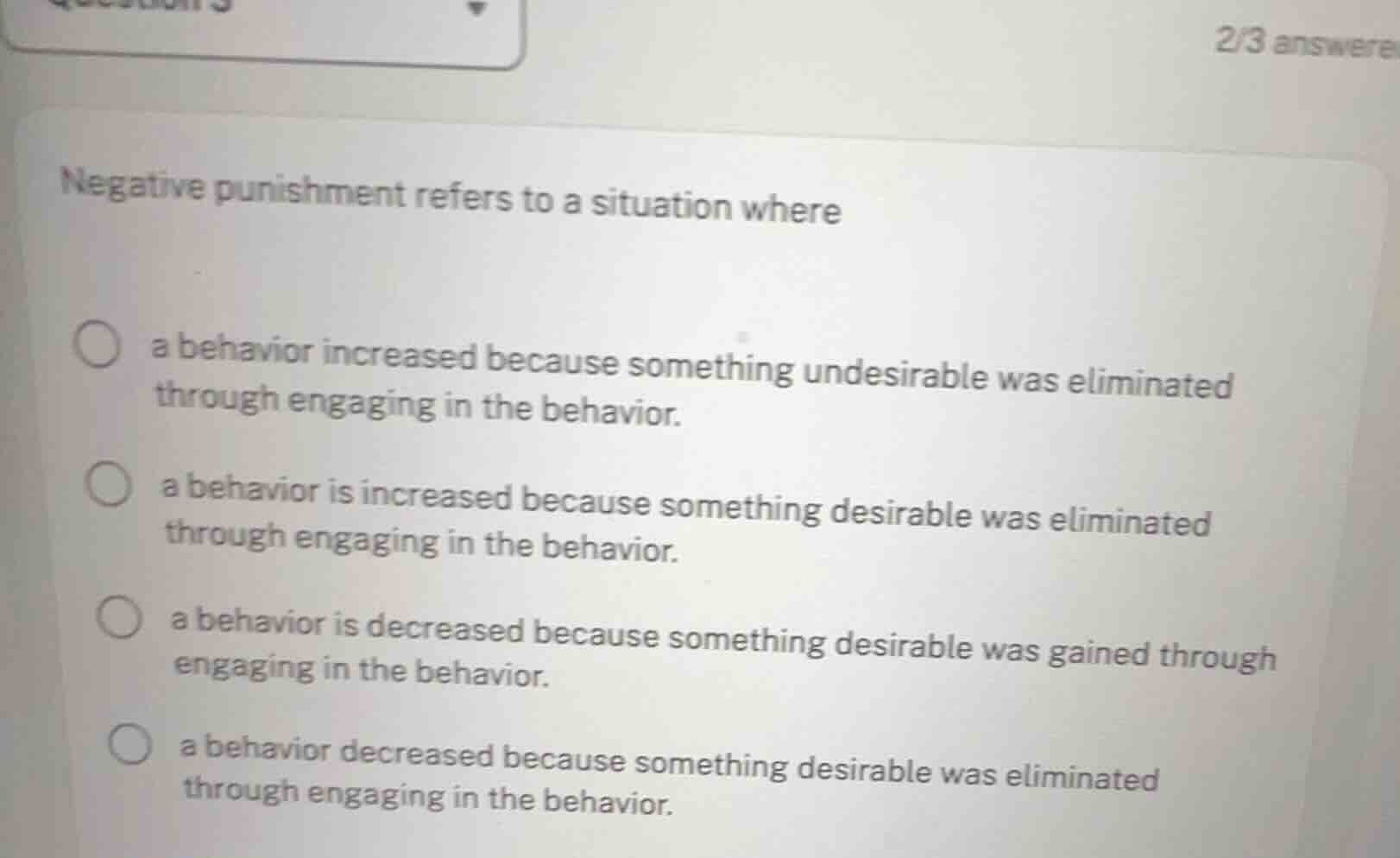
negative punishment refers to a situation where
a behavior increased because something undesirable was eliminated through engaging in the behavior.
a behavior is increased because something desirable was eliminated through engaging in the behavior.
a behavior is decreased because something desirable was gained through engaging in the behavior.
a behavior decreased because something desirable was eliminated through engaging in the behavior.
<pre_analysis>
{
"quality": "clear",
"question_count": 1,
"skills_matched": [
"direct_cot",
"multiple_choice_formatter",
"explain_then_answer",
"tutor",
"mastery_adaptive_brevity"
],
"needs_drawing": false,
"concepts_used": [
"Operant Conditioning",
"Negative Reinforcement"
],
"new_concepts": [
"Negative Punishment",
"Punishment vs Reinforcement"
],
"current_concepts": [
"Operant Conditioning",
"Negative Reinforcement",
"Negative Punishment",
"Punishment vs Reinforcement"
]
}
</pre_analysis>
<reasoning>
Define operant conditioning terms
Using the Operant Conditioning knowledge point, we analyze the components of the term "negative punishment." In behavioral psychology, "punishment" always means the goal is to decrease a behavior, while "negative" means a stimulus is removed or eliminated.
Analyze the effects of negative punishment
Using the Negative Reinforcement and Operant Conditioning knowledge points, we contrast reinforcement (which increases behavior) with punishment (which decreases behavior). Therefore, negative punishment must involve a decrease in behavior resulting from the removal (elimination) of a desirable stimulus.
Evaluate the given choices
- Option 1 describes a behavior increasing because an undesirable stimulus is eliminated. This is Negative Reinforcement.
- Option 2 describes a behavior increasing because a desirable stimulus is eliminated. This is logically inconsistent with reinforcement principles.
- Option 3 describes a behavior decreasing because a desirable stimulus is gained. This is inconsistent with operant conditioning definitions.
- Option 4 describes a behavior decreasing because a desirable stimulus is eliminated. This perfectly matches the definition of negative punishment.
</reasoning>
<answer>
<mcq-option>(A) a behavior increased because something undesirable was eliminated through engaging in the behavior.</mcq-option>
<mcq-option>(B) a behavior is increased because something desirable was eliminated through engaging in the behavior.</mcq-option>
<mcq-option>(C) a behavior is decreased because something desirable was gained through engaging in the behavior.</mcq-option>
<mcq-correct>(D) a behavior decreased because something desirable was eliminated through engaging in the behavior.</mcq-correct>
</answer>
<post_analysis>
{
"subject": "Social Science",
"question_type": "Multiple Choice",
"knowledge_point": [
"Social Science",
"Psychology",
"Operant Conditioning"
]
}
</post_analysis>
Snap & solve any problem in the app
Get step-by-step solutions on Sovi AI
Photo-based solutions with guided steps
Explore more problems and detailed explanations
<pre_analysis>
{
"quality": "clear",
"question_count": 1,
"skills_matched": [
"direct_cot",
"multiple_choice_formatter",
"explain_then_answer",
"tutor",
"mastery_adaptive_brevity"
],
"needs_drawing": false,
"concepts_used": [
"Operant Conditioning",
"Negative Reinforcement"
],
"new_concepts": [
"Negative Punishment",
"Punishment vs Reinforcement"
],
"current_concepts": [
"Operant Conditioning",
"Negative Reinforcement",
"Negative Punishment",
"Punishment vs Reinforcement"
]
}
</pre_analysis>
<reasoning>
Define operant conditioning terms
Using the Operant Conditioning knowledge point, we analyze the components of the term "negative punishment." In behavioral psychology, "punishment" always means the goal is to decrease a behavior, while "negative" means a stimulus is removed or eliminated.
Analyze the effects of negative punishment
Using the Negative Reinforcement and Operant Conditioning knowledge points, we contrast reinforcement (which increases behavior) with punishment (which decreases behavior). Therefore, negative punishment must involve a decrease in behavior resulting from the removal (elimination) of a desirable stimulus.
Evaluate the given choices
- Option 1 describes a behavior increasing because an undesirable stimulus is eliminated. This is Negative Reinforcement.
- Option 2 describes a behavior increasing because a desirable stimulus is eliminated. This is logically inconsistent with reinforcement principles.
- Option 3 describes a behavior decreasing because a desirable stimulus is gained. This is inconsistent with operant conditioning definitions.
- Option 4 describes a behavior decreasing because a desirable stimulus is eliminated. This perfectly matches the definition of negative punishment.
</reasoning>
<answer>
<mcq-option>(A) a behavior increased because something undesirable was eliminated through engaging in the behavior.</mcq-option>
<mcq-option>(B) a behavior is increased because something desirable was eliminated through engaging in the behavior.</mcq-option>
<mcq-option>(C) a behavior is decreased because something desirable was gained through engaging in the behavior.</mcq-option>
<mcq-correct>(D) a behavior decreased because something desirable was eliminated through engaging in the behavior.</mcq-correct>
</answer>
<post_analysis>
{
"subject": "Social Science",
"question_type": "Multiple Choice",
"knowledge_point": [
"Social Science",
"Psychology",
"Operant Conditioning"
]
}
</post_analysis>