QUESTION IMAGE
Question
name
period
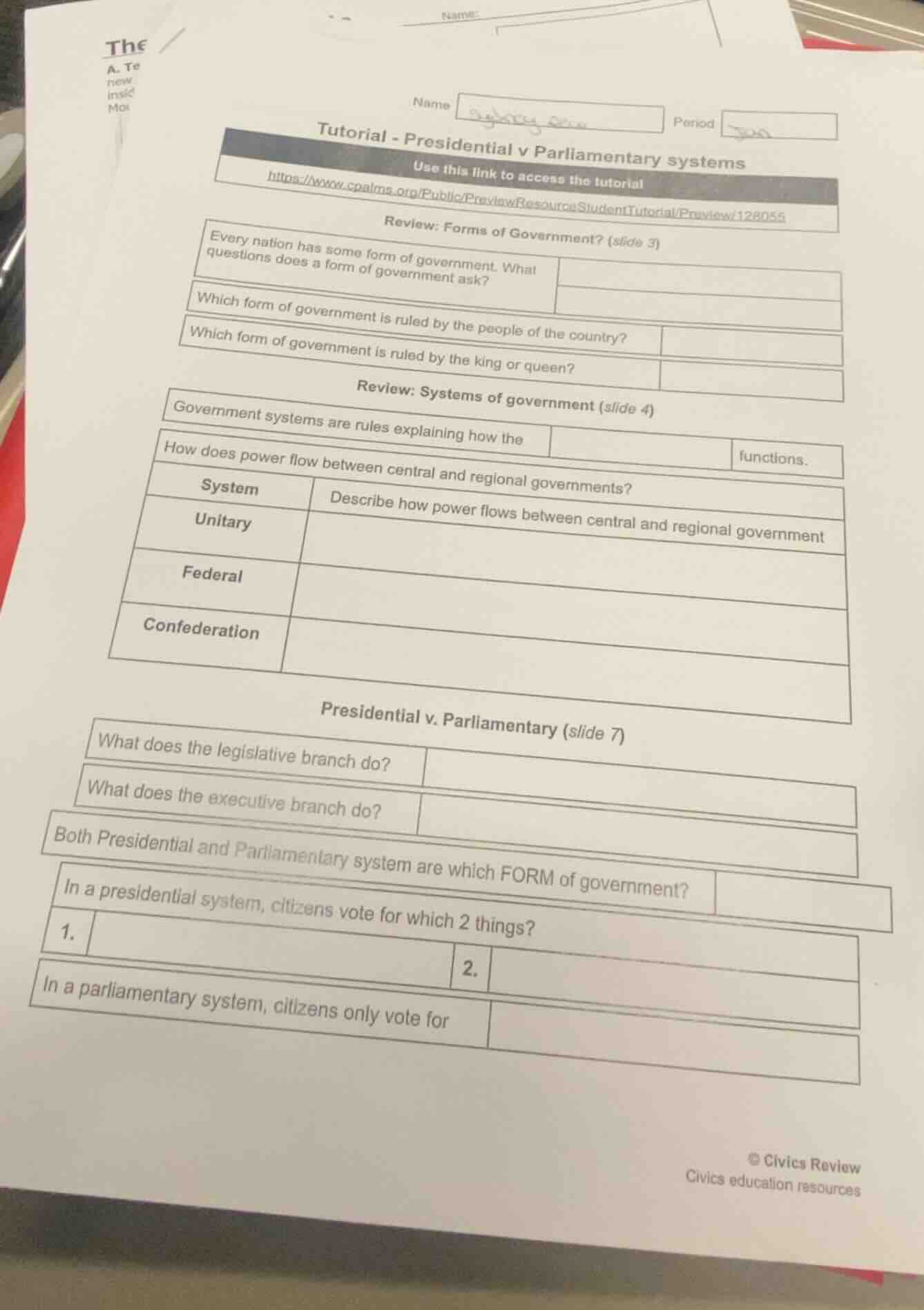
tutorial - presidential v parliamentary systems
use this link to access the tutorial
https://www.cpalms.org/public/previewresourcestudenttutorial/preview/128055
review: forms of government? (slide 3)
every nation has some form of government. what questions does a form of government ask?
which form of government is ruled by the people of the country?
which form of government is ruled by the king or queen?
review: systems of government (slide 4)
government systems are rules explaining how the functions.
how does power flow between central and regional governments?
system | describe how power flows between central and regional government
unitary |
federal |
confederation |
presidential v. parliamentary (slide 7)
what does the legislative branch do?
what does the executive branch do?
both presidential and parliamentary system are which form of government?
in a presidential system, citizens vote for which 2 things?
- | 2.
in a parliamentary system, citizens only vote for
© civics review
civics education resources
To answer these questions, we can use knowledge of government systems (from the field of Politics, a subfield of Social Science) and the provided tutorial link (which likely has the needed information). Here are the answers based on standard civics/government knowledge:
Review: Forms of Government? (slide 3)
- What questions does a form of government ask?
A form of government asks: Who rules? How do they rule? Who has power? (Or more specifically: Who is in charge? How are laws made? Who has authority?)
- Which form of government is ruled by the people of the country?
Democracy (specifically, direct or representative democracy).
- Which form of government is ruled by the king or queen?
Monarchy (specifically, absolute or constitutional monarchy).
Review: Systems of government (slide 4)
- Government systems are rules explaining how the [government] functions. (Fills in the blank.)
- How does power flow between central and regional governments?
- Unitary: Power is centralized; the central government holds most or all power, and regional governments have limited authority (delegated by the central government).
- Federal: Power is shared between a central government and regional (state/provincial) governments; both have independent authority in their areas.
- Confederation: Power is held primarily by regional governments; the central government is weak and exists to coordinate the regions (e.g., historical Confederation of States).
Presidential v. Parliamentary (slide 7)
- What does the legislative branch do?
Makes laws (e.g., passes legislation, approves budgets, oversees the executive branch).
- What does the executive branch do?
Enforces laws (e.g., the president/prime minister and their administration carry out laws, manage day - to - day governance).
- Both Presidential and Parliamentary systems are which FORM of government?
Democracy (they are both forms of democratic government, with representative elements).
- In a presidential system, citizens vote for which 2 things?
- The president (executive branch leader).
- Legislators (members of the legislative branch, like Congress in the US).
- In a parliamentary system, citizens only vote for
Members of the legislative branch (e.g., Parliament); the executive (prime minister and cabinet) is selected from the legislative branch.
If you need to fill in the worksheet, use these answers (or cross - check with the tutorial link provided: https://www.cpalms.org/Public/PreviewResourceStudentTutorial/Preview/128055).

Snap & solve any problem in the app
Get step-by-step solutions on Sovi AI
Photo-based solutions with guided steps
Explore more problems and detailed explanations
To answer these questions, we can use knowledge of government systems (from the field of Politics, a subfield of Social Science) and the provided tutorial link (which likely has the needed information). Here are the answers based on standard civics/government knowledge:
Review: Forms of Government? (slide 3)
- What questions does a form of government ask?
A form of government asks: Who rules? How do they rule? Who has power? (Or more specifically: Who is in charge? How are laws made? Who has authority?)
- Which form of government is ruled by the people of the country?
Democracy (specifically, direct or representative democracy).
- Which form of government is ruled by the king or queen?
Monarchy (specifically, absolute or constitutional monarchy).
Review: Systems of government (slide 4)
- Government systems are rules explaining how the [government] functions. (Fills in the blank.)
- How does power flow between central and regional governments?
- Unitary: Power is centralized; the central government holds most or all power, and regional governments have limited authority (delegated by the central government).
- Federal: Power is shared between a central government and regional (state/provincial) governments; both have independent authority in their areas.
- Confederation: Power is held primarily by regional governments; the central government is weak and exists to coordinate the regions (e.g., historical Confederation of States).
Presidential v. Parliamentary (slide 7)
- What does the legislative branch do?
Makes laws (e.g., passes legislation, approves budgets, oversees the executive branch).
- What does the executive branch do?
Enforces laws (e.g., the president/prime minister and their administration carry out laws, manage day - to - day governance).
- Both Presidential and Parliamentary systems are which FORM of government?
Democracy (they are both forms of democratic government, with representative elements).
- In a presidential system, citizens vote for which 2 things?
- The president (executive branch leader).
- Legislators (members of the legislative branch, like Congress in the US).
- In a parliamentary system, citizens only vote for
Members of the legislative branch (e.g., Parliament); the executive (prime minister and cabinet) is selected from the legislative branch.
If you need to fill in the worksheet, use these answers (or cross - check with the tutorial link provided: https://www.cpalms.org/Public/PreviewResourceStudentTutorial/Preview/128055).