QUESTION IMAGE
Question
name: hour:
why are cows so good at math?
(angle relationships practice)
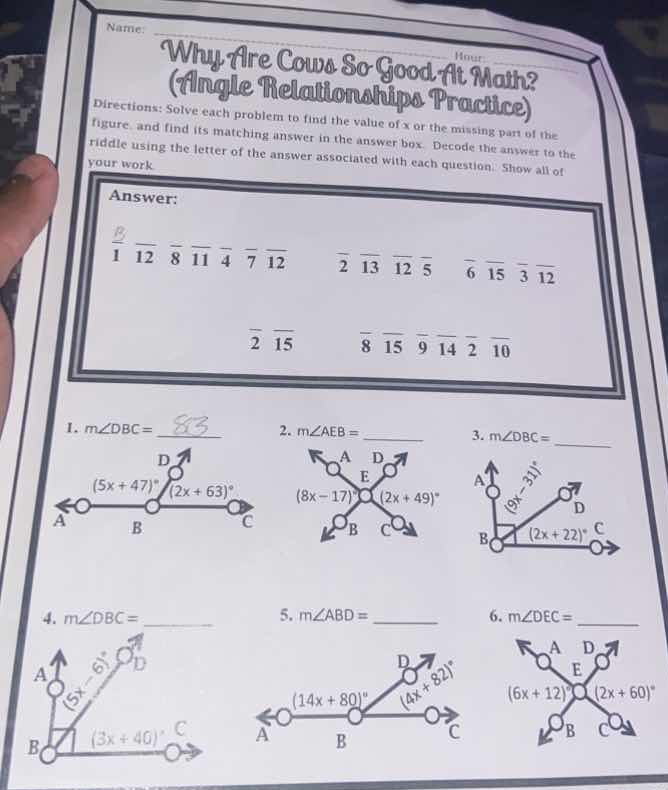
directions: solve each problem to find the value of x or the missing part of the figure, and find its matching answer in the answer box. decode the answer to the riddle using the letter of the answer associated with each question. show all of your work.
answer:
\\(\frac{b}{1}\\) \\(\overline{12}\\) \\(\overline{8}\\) \\(\overline{11}\\) \\(\overline{4}\\) \\(\overline{7}\\) \\(\overline{12}\\) \\(\quad\\) \\(\overline{2}\\) \\(\overline{13}\\) \\(\overline{12}\\) \\(\overline{5}\\) \\(\quad\\) \\(\overline{6}\\) \\(\overline{15}\\) \\(\overline{3}\\) \\(\overline{12}\\)
\\(\overline{2}\\) \\(\overline{15}\\) \\(\quad\\) \\(\overline{8}\\) \\(\overline{15}\\) \\(\overline{9}\\) \\(\overline{14}\\) \\(\overline{2}\\) \\(\overline{10}\\)
- \\(m\angle dbc = \\)
(figure 1: line ac with ray bd. \\(m\angle abd = (5x + 47)^\circ\\), \\(m\angle dbc = (2x + 63)^\circ\\))
- \\(m\angle aeb = \\)
(figure 2: intersecting lines ac and bd at e. \\(m\angle aeb = (8x - 17)^\circ\\), \\(m\angle dec = (2x + 49)^\circ\\))
- \\(m\angle dbc = \\)
(figure 3: angle abc is a right angle, split by ray bd. \\(m\angle abd = (9x - 31)^\circ\\), \\(m\angle dbc = (2x + 22)^\circ\\))
- \\(m\angle dbc = \\)
(figure 4: angle abc is a right angle, split by ray bd. \\(m\angle abd = (5x - 6)^\circ\\), \\(m\angle dbc = (3x + 40)^\circ\\))
- \\(m\angle abd = \\)
(figure 5: line ac with ray bd. \\(m\angle abd = (14x + 80)^\circ\\), \\(m\angle dbc = (4x + 82)^\circ\\))
- \\(m\angle dec = \\)
(figure 6: intersecting lines ac and bd at e. \\(m\angle aeb = (6x + 12)^\circ\\), \\(m\angle dec = (2x + 60)^\circ\\))
Set up equations using angle relationships
We analyze the geometric relationships shown in each of the six problems:
- Question 1: Angles \(\angle ABD\) and \(\angle DBC\) form a linear pair on line \(AC\). Using the Linear Pair Postulate, their sum is \(180^\circ\):
- Question 2: Angles \(\angle AEB\) and \(\angle DEC\) are vertical angles. Using the Vertical Angles Theorem, they are equal:
- Question 3: Angles \(\angle ABD\) and \(\angle DBC\) form a right angle (\(90^\circ\)), as indicated by the square angle symbol at vertex \(B\). Using the definition of Complementary Angles, their sum is \(90^\circ\):
- Question 4: Angles \(\angle ABD\) and \(\angle DBC\) form a right angle (\(90^\circ\)). Using Complementary Angles, their sum is \(90^\circ\):
- Question 5: Angles \(\angle ABD\) and \(\angle DBC\) form a linear pair on line \(AC\). Using the Linear Pair Postulate, their sum is \(180^\circ\):
- Question 6: Angles \(\angle AEB\) and \(\angle DEC\) are vertical angles. Using the Vertical Angles Theorem, they are equal:
Solve for x in each equation
We solve each linear equation to find the value of \(x\):
- Question 1:
- Question 2:
- Question 3:
- Question 4:
- Question 5:
- Question 6:
Calculate the requested angle measures
We substitute the value of \(x\) back into the expression for the target angle:
- Question 1: Find \(\text{m}\angle DBC = 2x + 63\):
- Question 2: Find \(\text{m}\angle AEB = 8x - 17\):
- Question 3: Find \(\text{m}\angle DBC = 2x + 22\):
- Question 4: Find \(\text{m}\angle DBC = 3x + 40\):
- Question 5: Find \(\text{m}\angle ABD = 14x + 80\):
- Question 6: Find \(\text{m}\angle DEC = 2x + 60\):

Snap & solve any problem in the app
Get step-by-step solutions on Sovi AI
Photo-based solutions with guided steps
Explore more problems and detailed explanations
| No. | Answer |
|---|---|
| 2 | \(71^\circ\) |
| 3 | \(40^\circ\) |
| 4 | \(61^\circ\) |
| 5 | \(94^\circ\) |
| 6 | \(84^\circ\) |