Sovi.AI - AI Math Tutor

Scan to solve math questions

QUESTION IMAGE

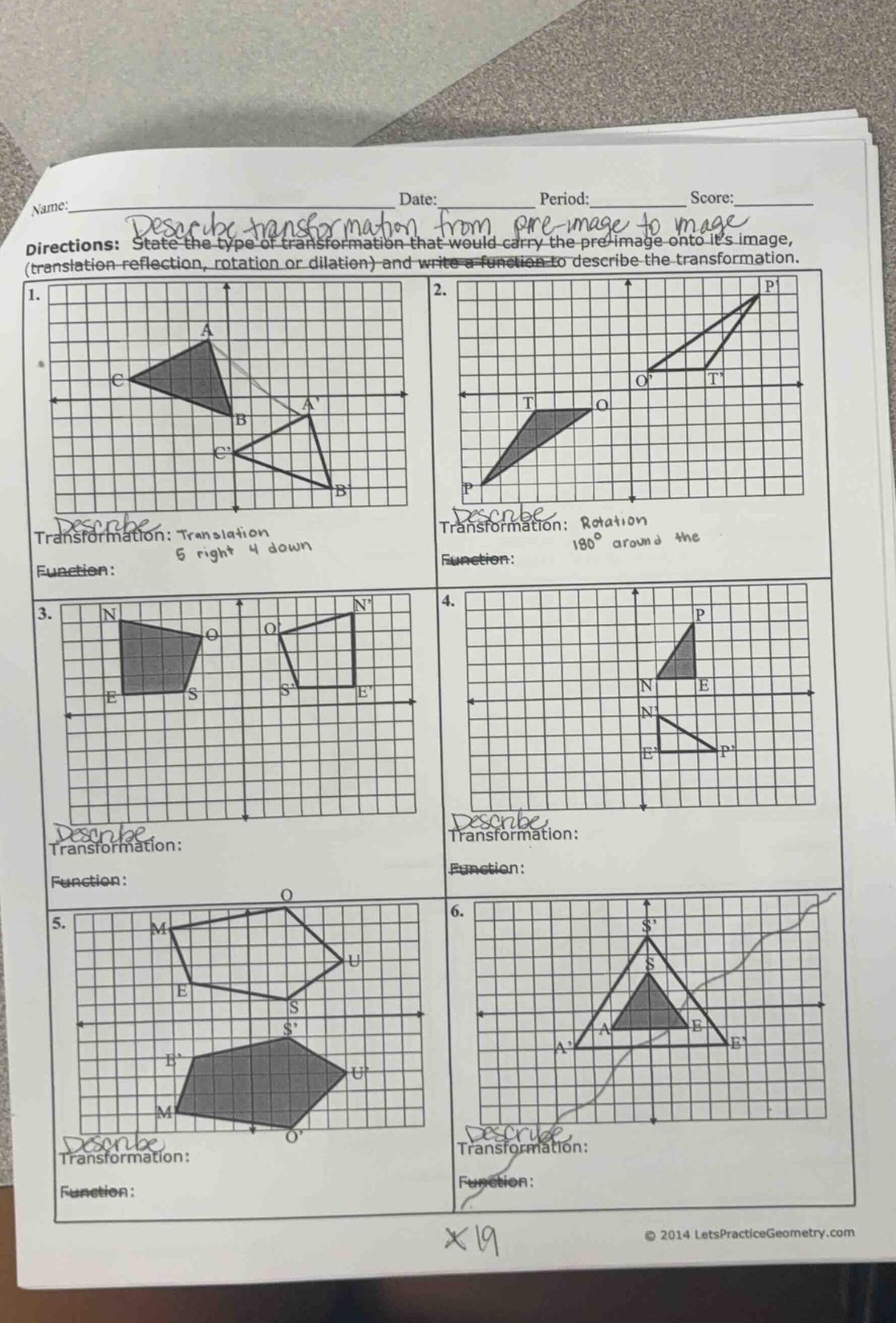
name: date: period: score: directions: state the type of transformation…

Question

name: date: period: score:
directions: state the type of transformation that would carry the pre-image onto its image, (translation, reflection, rotation or dilation) and write a function to describe the transformation.

1.
describe transformation:
function:

2.
describe transformation:
function:

3.
describe transformation:
function:

4.
describe transformation:
function:

5.
describe transformation:
function:

6.
describe transformation:
function:

Explanation:

Response

<pre_analysis>
{
"quality": "clear",
"question_count": 6,
"skills_matched": [
"step_cot",
"table_formatter",
"explain_then_answer",
"tutor",
"mastery_adaptive_brevity"
],
"needs_drawing": false,
"concepts_used": [
"Geometric Reflections",
"Geometric Translations",
"Geometric Rotations",
"Coordinate Rules for Transformations"
],
"new_concepts": [
"Geometric Dilations",
"Coordinate Rules for Dilations"
],
"current_concepts": [
"Geometric Translations",
"Geometric Rotations",
"Geometric Reflections",
"Geometric Dilations",
"Coordinate Rules for Transformations"
]
}
</pre_analysis>

<reasoning>

Identify coordinates of pre-image and image vertices

Using the Coordinate Rules for Transformations knowledge point, we determine the coordinates of the vertices for each problem to analyze the transformations.

  • Question 1:

Pre-image \(\triangle ABC\): \(A(-1, 3)\), \(B(0, -1)\), \(C(-4, 1)\)
Image \(\triangle A'B'C'\): \(A'(5, -1)\), \(B'(6, -5)\), \(C'(2, -3)\)

  • Question 2:

Pre-image \(\triangle PTQ\): \(P(-8, -6)\), \(T(-4, -2)\), \(Q(-1, -2)\)
Image \(\triangle P'T'O'\): \(P'(8, 6)\), \(T'(4, 2)\), \(O'(1, 2)\) (Note: \(O'\) corresponds to \(Q\))

  • Question 3:

Pre-image quadrilateral \(NOES\): \(N(-6, 5)\), \(O(-2, 3)\), \(E(-6, 0)\), \(S(-3, 0)\)
Image quadrilateral \(N'O'E'S'\): \(N'(6, 5)\), \(O'(2, 3)\), \(E'(6, 0)\), \(S'(3, 0)\) (Note: \(E'\) is at \((6,0)\), \(S'\) is at \((3,0)\))

  • Question 4:

Pre-image \(\triangle NEP\): \(N(1, 1)\), \(E(3, 1)\), \(P(3, 4)\)
Image \(\triangle N'E'P'\): \(N'(1, -1)\), \(E'(1, -3)\), \(P'(4, -3)\)

  • Question 5:

Pre-image pentagon \(MOUSE\): \(M(-4, 4)\), \(O(2, 5)\), \(U(4, 2)\), \(S(2, 0)\), \(E(-3, 1)\)
Image pentagon \(M'O'U'S'E'\): \(M'(-4, -4)\), \(O'(2, -5)\), \(U'(4, -2)\), \(S'(2, 0)\), \(E'(-3, -1)\)

  • Question 6:

Pre-image \(\triangle ASE\): \(A(-2, -1)\), \(S(0, 2)\), \(E(2, -1)\)
Image \(\triangle A'S'E'\): \(A'(-4, -2)\), \(S'(0, 4)\), \(E'(4, -2)\)

Determine transformation rules and functions

Using the Geometric Translations, Geometric Rotations, and Geometric Reflections knowledge points:

  • Question 1:

Using the Geometric Translations and Coordinate Rules for Transformations knowledge points
\[
(x, y)
ightarrow (x + 6, y - 4)
\]
This is a translation 6 units right and 4 units down.

  • Question 2:

Using the Geometric Rotations and Coordinate Rules for Transformations knowledge points
\[
(x, y)
ightarrow (-x, -y)
\]
This is a rotation of \(180^\circ\) about the origin.

  • Question 3:

Using the Geometric Reflections and Coordinate Rules for Transformations knowledge points
\[
(x, y)
ightarrow (-x, y)
\]
This is a reflection across the y-axis.

  • Question 4:

We analyze the mapping: \(N(1,1)
ightarrow N'(1,-1)\), \(E(3,1)
ightarrow E'(1,-3)\), \(P(3,4)
ightarrow P'(4,-3)\).
Notice that the coordinates are swapped and the signs are modified:
\(N(1,1)
ightarrow (1, -1)\)
\(E(3,1)
ightarrow (1, -3)\)
\(P(3,4)
ightarrow (4, -3)\)
The mapping is \((x, y)
ightarrow (y, -x)\).
This represents a rotation of \(90^\circ\) clockwise (or \(270^\circ\) counterclockwise) about the origin.

  • Question 5:

We compare coordinates: \(M(-4, 4)
ightarrow M'(-4, -4)\), \(O(2, 5)
ightarrow O'(2, -5)\), \(E(-3, 1)
ightarrow E'(-3, -1)\).
The x-coordinates remain unchanged, while the y-coordinates are negated: \((x, y)
ightarrow (x, -y)\).
This represents a reflection acros…

Answer:

<pre_analysis>
{
"quality": "clear",
"question_count": 6,
"skills_matched": [
"step_cot",
"table_formatter",
"explain_then_answer",
"tutor",
"mastery_adaptive_brevity"
],
"needs_drawing": false,
"concepts_used": [
"Geometric Reflections",
"Geometric Translations",
"Geometric Rotations",
"Coordinate Rules for Transformations"
],
"new_concepts": [
"Geometric Dilations",
"Coordinate Rules for Dilations"
],
"current_concepts": [
"Geometric Translations",
"Geometric Rotations",
"Geometric Reflections",
"Geometric Dilations",
"Coordinate Rules for Transformations"
]
}
</pre_analysis>

<reasoning>

Identify coordinates of pre-image and image vertices

Using the Coordinate Rules for Transformations knowledge point, we determine the coordinates of the vertices for each problem to analyze the transformations.

  • Question 1:

Pre-image \(\triangle ABC\): \(A(-1, 3)\), \(B(0, -1)\), \(C(-4, 1)\)
Image \(\triangle A'B'C'\): \(A'(5, -1)\), \(B'(6, -5)\), \(C'(2, -3)\)

  • Question 2:

Pre-image \(\triangle PTQ\): \(P(-8, -6)\), \(T(-4, -2)\), \(Q(-1, -2)\)
Image \(\triangle P'T'O'\): \(P'(8, 6)\), \(T'(4, 2)\), \(O'(1, 2)\) (Note: \(O'\) corresponds to \(Q\))

  • Question 3:

Pre-image quadrilateral \(NOES\): \(N(-6, 5)\), \(O(-2, 3)\), \(E(-6, 0)\), \(S(-3, 0)\)
Image quadrilateral \(N'O'E'S'\): \(N'(6, 5)\), \(O'(2, 3)\), \(E'(6, 0)\), \(S'(3, 0)\) (Note: \(E'\) is at \((6,0)\), \(S'\) is at \((3,0)\))

  • Question 4:

Pre-image \(\triangle NEP\): \(N(1, 1)\), \(E(3, 1)\), \(P(3, 4)\)
Image \(\triangle N'E'P'\): \(N'(1, -1)\), \(E'(1, -3)\), \(P'(4, -3)\)

  • Question 5:

Pre-image pentagon \(MOUSE\): \(M(-4, 4)\), \(O(2, 5)\), \(U(4, 2)\), \(S(2, 0)\), \(E(-3, 1)\)
Image pentagon \(M'O'U'S'E'\): \(M'(-4, -4)\), \(O'(2, -5)\), \(U'(4, -2)\), \(S'(2, 0)\), \(E'(-3, -1)\)

  • Question 6:

Pre-image \(\triangle ASE\): \(A(-2, -1)\), \(S(0, 2)\), \(E(2, -1)\)
Image \(\triangle A'S'E'\): \(A'(-4, -2)\), \(S'(0, 4)\), \(E'(4, -2)\)

Determine transformation rules and functions

Using the Geometric Translations, Geometric Rotations, and Geometric Reflections knowledge points:

  • Question 1:

Using the Geometric Translations and Coordinate Rules for Transformations knowledge points
\[
(x, y)
ightarrow (x + 6, y - 4)
\]
This is a translation 6 units right and 4 units down.

  • Question 2:

Using the Geometric Rotations and Coordinate Rules for Transformations knowledge points
\[
(x, y)
ightarrow (-x, -y)
\]
This is a rotation of \(180^\circ\) about the origin.

  • Question 3:

Using the Geometric Reflections and Coordinate Rules for Transformations knowledge points
\[
(x, y)
ightarrow (-x, y)
\]
This is a reflection across the y-axis.

  • Question 4:

We analyze the mapping: \(N(1,1)
ightarrow N'(1,-1)\), \(E(3,1)
ightarrow E'(1,-3)\), \(P(3,4)
ightarrow P'(4,-3)\).
Notice that the coordinates are swapped and the signs are modified:
\(N(1,1)
ightarrow (1, -1)\)
\(E(3,1)
ightarrow (1, -3)\)
\(P(3,4)
ightarrow (4, -3)\)
The mapping is \((x, y)
ightarrow (y, -x)\).
This represents a rotation of \(90^\circ\) clockwise (or \(270^\circ\) counterclockwise) about the origin.

  • Question 5:

We compare coordinates: \(M(-4, 4)
ightarrow M'(-4, -4)\), \(O(2, 5)
ightarrow O'(2, -5)\), \(E(-3, 1)
ightarrow E'(-3, -1)\).
The x-coordinates remain unchanged, while the y-coordinates are negated: \((x, y)
ightarrow (x, -y)\).
This represents a reflection across the x-axis.

  • Question 6:

We compare coordinates: \(A(-2, -1)
ightarrow A'(-4, -2)\), \(S(0, 2)
ightarrow S'(0, 4)\), \(E(2, -1)
ightarrow E'(4, -2)\).
Each coordinate is multiplied by 2: \((x, y)
ightarrow (2x, 2y)\).
This represents a dilation centered at the origin with a scale factor of 2.
</reasoning>

<answer>

No.Describe TransformationFunction

ightarrow (x + 6, y - 4)\) |

2Rotation of \(180^\circ\) about the origin\((x, y)

ightarrow (-x, -y)\) |

3Reflection across the y-axis\((x, y)

ightarrow (-x, y)\) |

4Rotation of \(90^\circ\) clockwise about the origin\((x, y)

ightarrow (y, -x)\) |

5Reflection across the x-axis\((x, y)

ightarrow (x, -y)\) |

6Dilation centered at the origin with a scale factor of 2\((x, y)

ightarrow (2x, 2y)\) |
</answer>

<post_analysis>
{
"subject": "Mathematics",
"question_type": "Multi-part",
"knowledge_point": [
"Mathematics",
"Geometry",
"Coordinate Rules for Transformations"
]
}
</post_analysis>