Sovi.AI - AI Math Tutor

Scan to solve math questions

QUESTION IMAGE

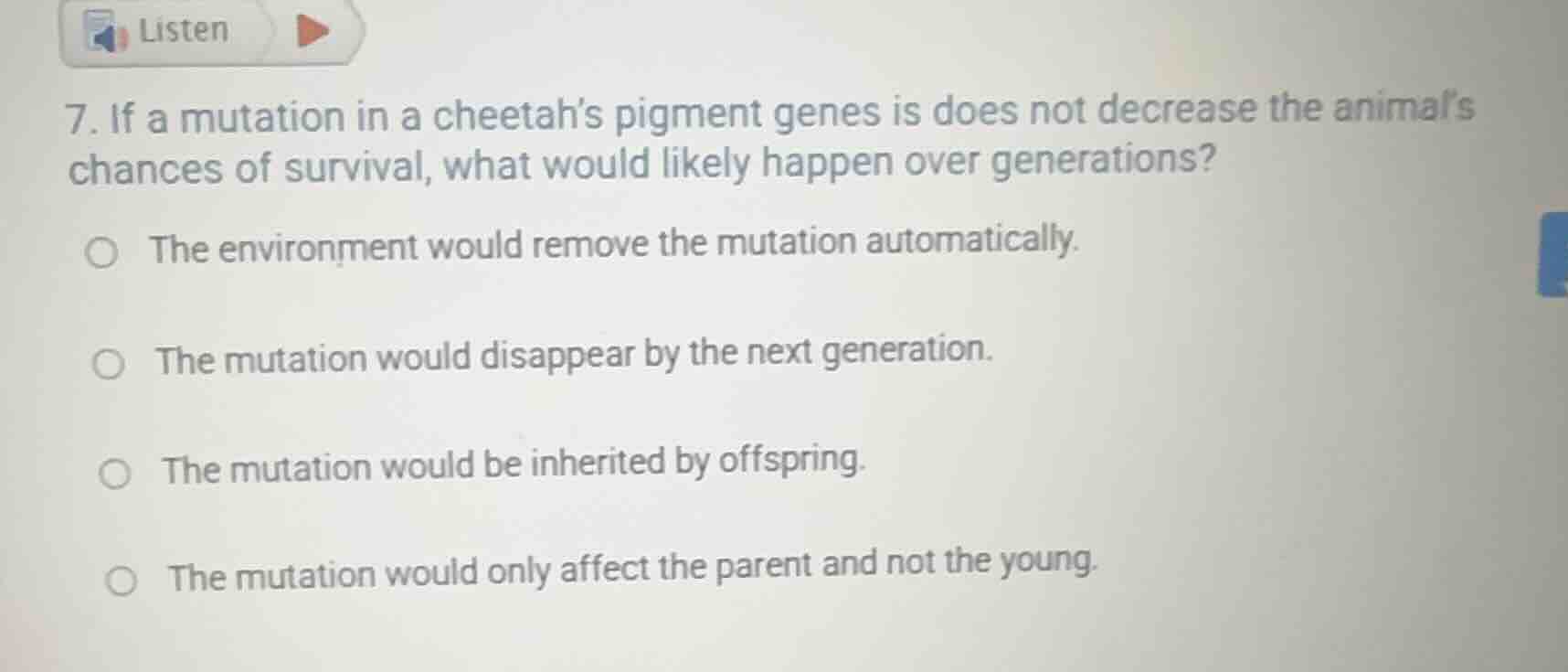
7. if a mutation in a cheetahs pigment genes is does not decrease the a…

Question

  1. if a mutation in a cheetahs pigment genes is does not decrease the animals chances of survival, what would likely happen over generations?

the environment would remove the mutation automatically.

the mutation would disappear by the next generation.

the mutation would be inherited by offspring.

the mutation would only affect the parent and not the young.

Explanation:

Response

<pre_analysis>
{
"quality": "clear",
"question_count": 1,
"skills_matched": [
"direct_cot",
"multiple_choice_formatter",
"explain_then_answer",
"quick"
],
"needs_drawing": false,
"concepts_used": [],
"new_concepts": [
"Natural Selection",
"Neutral Mutations"
],
"current_concepts": [
"Genetic Mutations",
"Genetic Inheritance",
"Natural Selection",
"Neutral Mutations"
]
}
</pre_analysis>

<reasoning>

Analyze the effect of the mutation

The question describes a mutation in a cheetah's pigment genes that does not decrease the animal's chances of survival. This means the mutation is either neutral or potentially beneficial, so natural selection will not actively eliminate it from the population.

Evaluate inheritance over generations

Because the mutation is genetic, it is located in the DNA. If it occurs in or reaches the germline cells, it can be passed down to future generations. Since it does not hinder survival or reproduction, individuals carrying this mutation can reproduce normally, allowing the mutation to be inherited by offspring.

Eliminate incorrect options

  • "The environment would remove the mutation automatically": Incorrect, because the mutation does not decrease survival, so natural selection has no pressure to eliminate it.
  • "The mutation would disappear by the next generation": Incorrect, genetic traits do not automatically disappear in one generation without strong negative selection or genetic drift.
  • "The mutation would only affect the parent and not the young": Incorrect, genetic mutations in germ cells are heritable and can be passed to offspring.

</reasoning>

<answer>
<mcq-option>The environment would remove the mutation automatically.</mcq-option>
<mcq-option>The mutation would disappear by the next generation.</mcq-option>
<mcq-correct>The mutation would be inherited by offspring.</mcq-correct>
<mcq-option>The mutation would only affect the parent and not the young.</mcq-option>
</answer>

<post_analysis>
{
"subject": "Natural Science",
"question_type": "Multiple Choice",
"knowledge_point": [
"Natural Science",
"Biology",
"Genetic Inheritance"
]
}
</post_analysis>

Answer:

<pre_analysis>
{
"quality": "clear",
"question_count": 1,
"skills_matched": [
"direct_cot",
"multiple_choice_formatter",
"explain_then_answer",
"quick"
],
"needs_drawing": false,
"concepts_used": [],
"new_concepts": [
"Natural Selection",
"Neutral Mutations"
],
"current_concepts": [
"Genetic Mutations",
"Genetic Inheritance",
"Natural Selection",
"Neutral Mutations"
]
}
</pre_analysis>

<reasoning>

Analyze the effect of the mutation

The question describes a mutation in a cheetah's pigment genes that does not decrease the animal's chances of survival. This means the mutation is either neutral or potentially beneficial, so natural selection will not actively eliminate it from the population.

Evaluate inheritance over generations

Because the mutation is genetic, it is located in the DNA. If it occurs in or reaches the germline cells, it can be passed down to future generations. Since it does not hinder survival or reproduction, individuals carrying this mutation can reproduce normally, allowing the mutation to be inherited by offspring.

Eliminate incorrect options

  • "The environment would remove the mutation automatically": Incorrect, because the mutation does not decrease survival, so natural selection has no pressure to eliminate it.
  • "The mutation would disappear by the next generation": Incorrect, genetic traits do not automatically disappear in one generation without strong negative selection or genetic drift.
  • "The mutation would only affect the parent and not the young": Incorrect, genetic mutations in germ cells are heritable and can be passed to offspring.

</reasoning>

<answer>
<mcq-option>The environment would remove the mutation automatically.</mcq-option>
<mcq-option>The mutation would disappear by the next generation.</mcq-option>
<mcq-correct>The mutation would be inherited by offspring.</mcq-correct>
<mcq-option>The mutation would only affect the parent and not the young.</mcq-option>
</answer>

<post_analysis>
{
"subject": "Natural Science",
"question_type": "Multiple Choice",
"knowledge_point": [
"Natural Science",
"Biology",
"Genetic Inheritance"
]
}
</post_analysis>