QUESTION IMAGE
Question
multiple select question
select all that apply
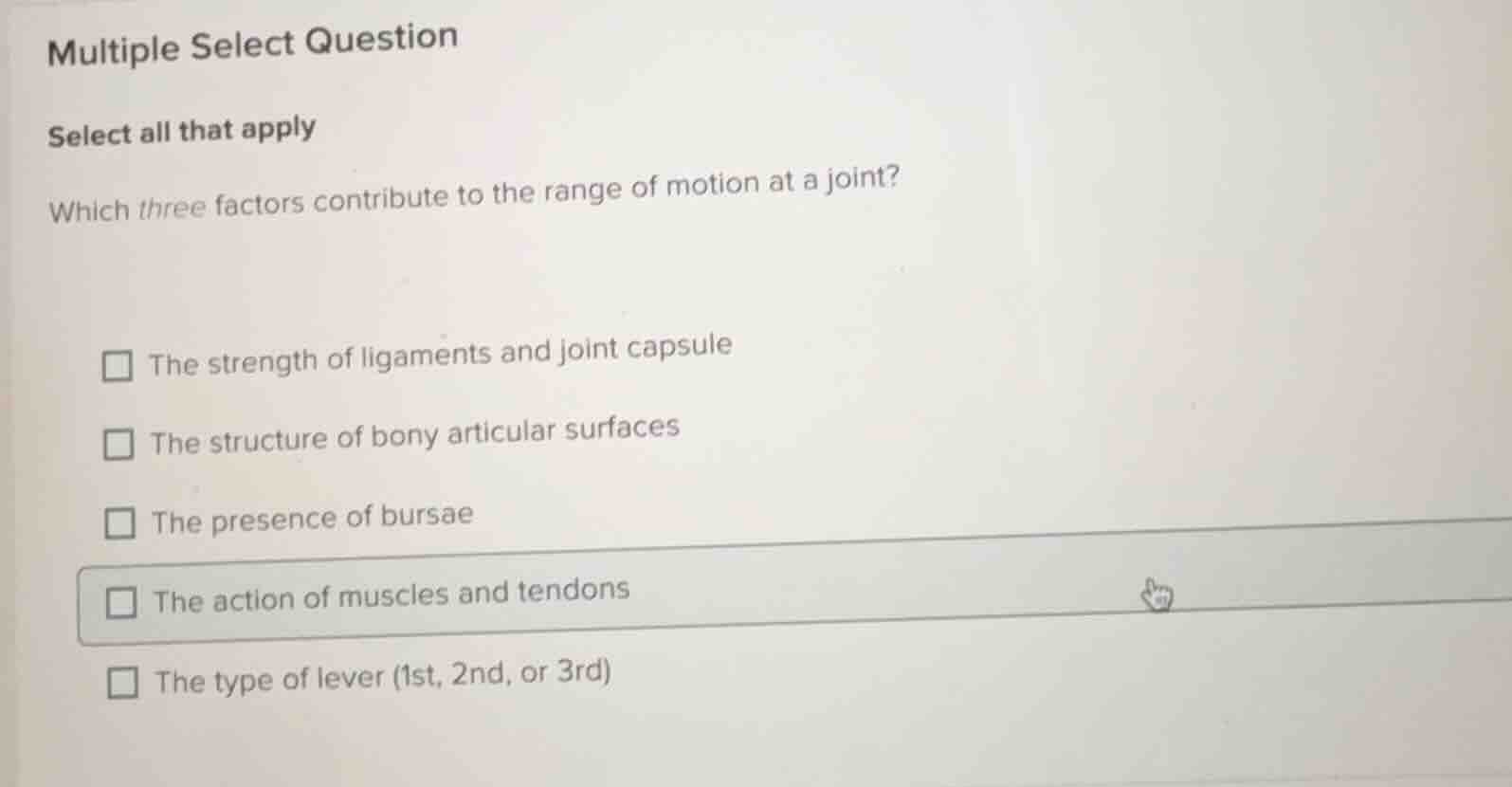
which three factors contribute to the range of motion at a joint?
- the strength of ligaments and joint capsule
- the structure of bony articular surfaces
- the presence of bursae
- the action of muscles and tendons
- the type of lever (1st, 2nd, or 3rd)
Analyze the question requirements
The question asks to select the three factors that contribute to the range of motion (ROM) at a joint.
Evaluate the options
Using the Joint Mobility Factors knowledge point:
- The structure of bony articular surfaces: The shapes of the bone surfaces determine what movements are physically possible (e.g., a ball-and-socket joint allows far more movement than a hinge joint). This is a primary factor.
- The strength of ligaments and joint capsule: Ligaments and joint capsules prevent excessive movement and stabilize the joint, directly limiting its range of motion. This is a primary factor.
- The action of muscles and tendons: Muscles and their tendons provide tension and limit movement, acting as dynamic stabilizers that restrict or facilitate range of motion. This is a primary factor.
- The presence of bursae: Bursae are fluid-filled sacs that reduce friction between moving parts but do not determine or limit the structural range of motion of a joint.
- The type of lever (1st, 2nd, or 3rd): Lever classes describe the mechanical advantage and relative positions of effort, fulcrum, and resistance, but they do not structurally determine the range of motion at the joint itself.
Select the three correct factors
The three correct factors contributing to the range of motion at a joint are:
- The strength of ligaments and joint capsule
- The structure of bony articular surfaces
- The action of muscles and tendons

Snap & solve any problem in the app
Get step-by-step solutions on Sovi AI
Photo-based solutions with guided steps
Explore more problems and detailed explanations
- The strength of ligaments and joint capsule (Correct answer)
- The structure of bony articular surfaces (Correct answer)
- The presence of bursae
- The action of muscles and tendons (Correct answer)
- The type of lever (1st, 2nd, or 3rd)