QUESTION IMAGE
Question
multiple select question
select all that apply
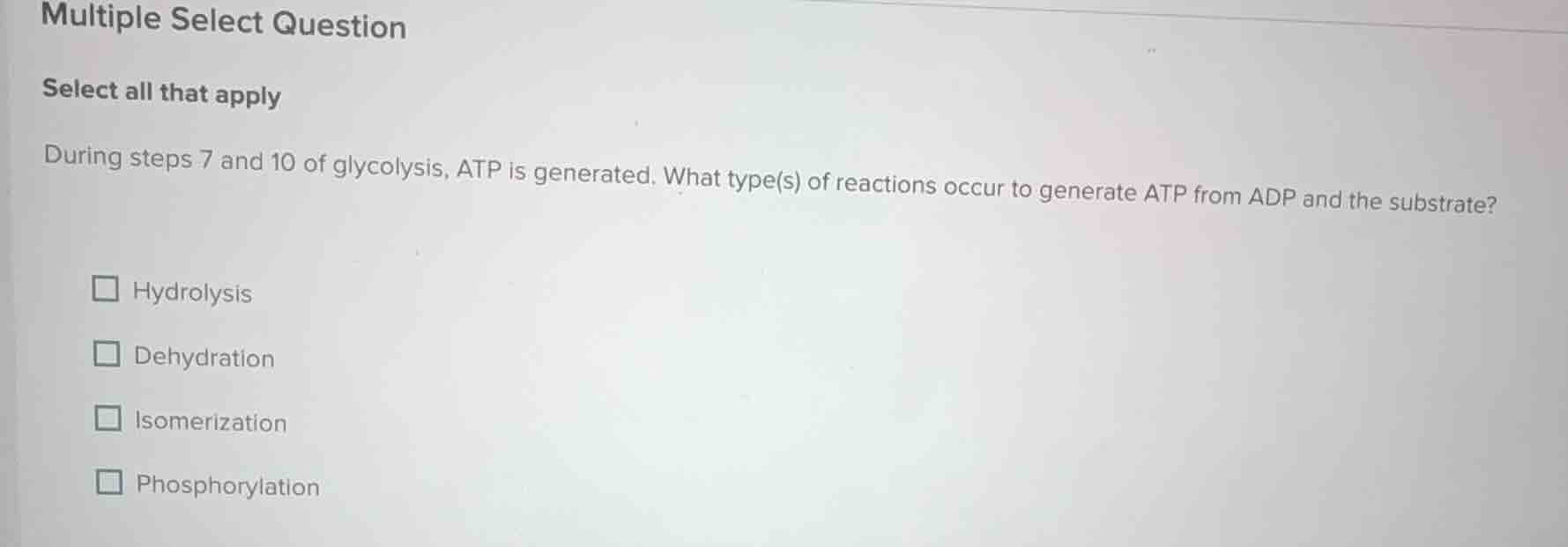
during steps 7 and 10 of glycolysis, atp is generated. what type(s) of reactions occur to generate atp from adp and the substrate?
hydrolysis
dehydration
isomerization
phosphorylation
Identify the mechanism of ATP generation in steps 7 and 10 of glycolysis
In glycolysis, steps 7 and 10 involve the transfer of a high-energy phosphate group from a phosphorylated substrate directly to ADP, forming ATP. This specific biochemical mechanism is known as substrate-level phosphorylation.
Evaluate the given options against the mechanism
- Hydrolysis: Involves breaking bonds using water, which is not the primary reaction generating ATP here.
- Dehydration: Involves the removal of water, which occurs in step 9 (catalyzed by enolase) but not the ATP-generating steps.
- Isomerization: Involves structural rearrangement, which occurs in steps 2 and 5.
- Phosphorylation: Specifically, ADP is phosphorylated to ATP by receiving a phosphate group. Therefore, phosphorylation is the correct reaction type.

Snap & solve any problem in the app
Get step-by-step solutions on Sovi AI
Photo-based solutions with guided steps
Explore more problems and detailed explanations
- Hydrolysis
- Dehydration
- Isomerization
- Phosphorylation (Correct answer)